Sunday, 8 July 2012

Human Guinea Pig: Part 3 - Actiheart Monitor & Step Test

This is the third part of the story about my overnight stay in the hospital's research department, having lots of tests to look at the effect my pituitary tumour is having on my body and metabolism. You can read the first part here, and the second part here.

Actiheart Monitor & Step Test

Once my body composition scan was finished, there was a certain amount of fretting that I would be late for my MRI scan appointment, so I was immediately whisked off to have my step test and Actiheart monitor fitted. This meant I was still wearing giant scrubs and no bra when I was supposed to be doing mildly athletic deeds, which proved somewhat inconvenient.

The Actiheart monitor is a teeeny tiny heart monitor which attaches to your chest by means of two sticky pads coated in glue so vicious it's almost impossible to wash off without taking the top layer of skin off too. I was informed I would be wearing it until midday Friday (I had not had any kind of advanced warning about that!) and that they wanted to carry out a step test to calibrate it. Essentially, while standing in a room full of cycling machines and a giant treadmill, you have to spend eight minutes stepping alternately onto and off of a purple plastic step, in time with a computerised voice which says "Up. Up. Down. Down." and gradually gets faster. The Actiheart records your heartrate as you do so, and then this is compared to the recording of your heart over the next few days, and used to gauge your activity level against your heartrate.

It's so tiny!
This explanation seemed pretty bizarre to me, because they were recording my exercising heartrate while I was off medication and therefore had an unusually fast heartrate, and then using this to calibrate the results of the heart monitor recording my heartrate when I was back on the medication. I have not yet had a satisfactory explanation of why this isn't stupid, but I live in hope.

Anyway. The computerised voice started up, and after only a minute or so began to take on a strangely hypnotic quality as I stepped endlessly up and down. By 5 minutes 30 seconds, the voice saying "Up. Up." started to sound more like an evil "Ha. Ha." and I became convinced the computer was laughing at me. The whole time, I had to hold up the trouser legs of my giant scrubs because they were too long as well as too wide, and I was concerned I would trip and fall on my (apparently worryingly fat) arse. Pro tip for the creators of Actiheart: I have to say that the whole experience would be vastly improved if you set the "Up. Up. Down. Down." man's voice to trance music.

Having just been told that I was 36% lard, I became quite concerned that I must be hideously unfit and would utterly disgrace myself by being unable to complete the step test, but in fact it was totally fine and even when he got quite fast at the end I was still happilly stepping away.

There was no printout of results to take away with me; I have to wait until the five-day recording has been analysed and then I should get some feedback through the post. I can't believe quite how small and awesome it is, compared to the 24-hour heart monitors which I've had to wear previously, which have invariably been vast, bulky and inconvenient.

My experience of the Actiheart Monitor and Step Test:

Hassle: 5/5
Fun: 3/5
Weirdness: 4/5
Results: 2/5
Total score: 14/20

Saturday, 7 July 2012

Human Guinea Pig: Part 2 - DEXA scan

This is the second part of the story about my overnight stay in the hospital's research department, having lots of tests to look at the effect my pituitary tumour is having on my body and metabolism. You can read the first part here.

DEXA (Dual Energy X-ray Absorbtiometry) Scans - Bone Density & Body Composition

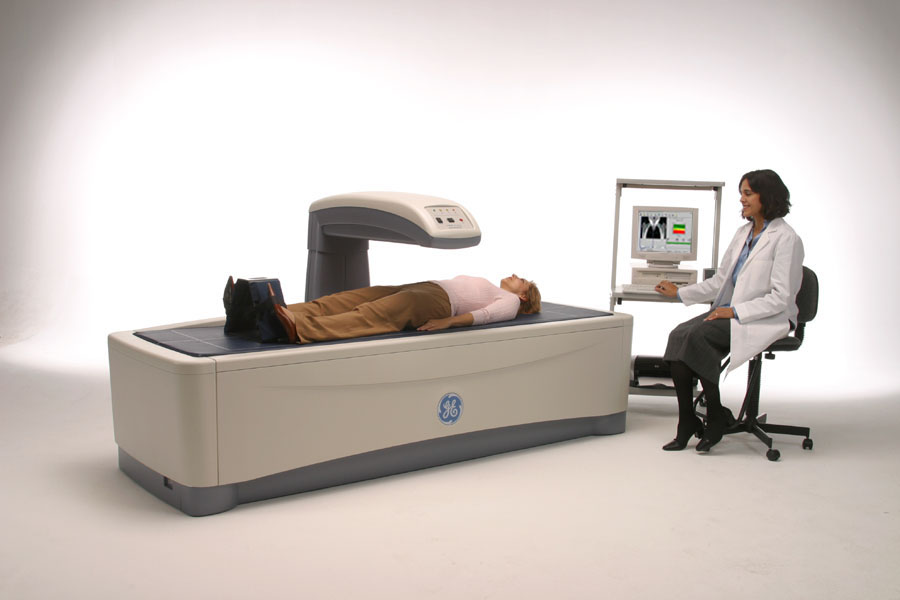
The first scan I had in the research department was a DEXA scan. People with hyperthyroidism are at risk of osteoporosis, so they wanted to check whether I had lower than expected bone density, a high risk factor. They also performed a body composition scan using the same machine, which analyses your whole body to determine what percentage of your body is made up of fat.

As the machine uses x-rays, you can't wear anything metal. They gave me a pair of scrubs to change into, as my trousers had metal bits in them. Initially, I was secretly very excited about this chance to see what I would look like as a nurse. However, the scrubs they gave me were absolutely huge - so in fact I found out what I look like as a formerly obese nurse who needs to update her wardrobe post-Weight Watchers. The trousers were so large that I could fit in one leg. Don't believe me? Here's a photo: 

Anyone care to join me in here?
I asked the lady doing the scan if I needed to remove my jewellery as well, and she said not to worry, it was just the trousers that were the problem. Seemed odd, but ok. Then I got into the scanning room and she asked me to take off my jewellery. No problem. Then I had to get lined up for the scan. Because it looks at your spine ,it's important you lie down in a perfectly straight line on the machine, which took a few minutes. Then, just as the scan was about to start, she turned around, looked at me and said "Are you wearing a bra?"

As I had not been told to take it off, I was indeed wearing a bra. It hadn't even occurred to me that the underwiring would get in the way of the scan. So I had to get up and take it off, then go through the whole aligning-your-spine-to-the-scanner process again. The DEXA scanner is basically a big table which you lie on, with an arm over the top which very ponderously slides (or rather, judders) along its length, just above you. The x-rays are fairly low dose, less than a long-distance flight. The whole process is quite quick; first the body composition scan was taken as I lay down normally, then they scanned my spine. In order to scan it properly, you have to lie with your legs up on a block so that your spine is flat against the table surface. Finally, they scan your femur at the hip joint, which requires that you rotate your leg slightly in an unnatural fashion. In order to assist with this, they tie your foot to a plastic block. It's all pretty weird.

In the corner of the scanning room was a human-sized giant egg with a little window in it. Apparently it was a BOD POD, a different kind of body composition scanner. I was pretty intigued by this piece of kit and faintly disappointed I didn't get to try it out.

The best thing about the DEXA scanner is the fact that you get an immediate print-out of your results and graphs plotting you against the expected and normal values for your age group. As it happens, I actually have slightly higher than normal bone density, rather than lower, which was good news (the blue is the normal range):

Superhuman bone density! ...or something

I was also complimented on my "beautiful" spine (actual quote - hospital folk give you very weird compliments).

Work it, baby.
However, the most interesting results were from the body composition scan. My body composition came out as 36% fat, which is at the upper end of the normal range for my age group, with the average being 30% (for women; obviously men need less fat). As you can imagine, this got me somewhat worried that I should hit the salads with a vengeance, but when I spoke to my endocrinologist the next day, she said that it was most likely due to the fact that extended period of hyperthyroidism tends to lead to muscle loss and that she didn't think I needed a lifestyle overhaul!

The me on the left needs to eat more.
Update: googling values for normal body fat percentages informs me that the American Council on Exercise considers a body fat value above 32% for women to be obese and I've found alternative readings which say anything over 35% is obese! This does nothing to make me feel better. I also found a formula used to estimate body fat based on BMI, which puts my body fat at 24.96% (full disclosure: my BMI is 20.7) i.e. a low average score, close to fitness level. Just goes to show BMI is silly and you can't rely on formulae to estimate these things!

I also worked out that, assuming I don't gain any muscle, I would need to lose 7.5 pounds in order to get down to being 30% fat. That would put my weight at 8 1/2 stone (or 54 kgs), which would put my BMI at 18.6, which would be just 0.1 away from being classed as underweight. So it seems that gaining muscle is the only solution to the problem. I can't win!

I do at least feel better about the fact that I haven't put any muscle on in my arms despite exercise, although I have put some muscle on in my stomach since the beginning of the year (bellydance, whoop!). Feels like more of an achievement now!

My DEXA scan experience:

Hassle: 3/5
Fun: 1/5
Weirdness: 3/5
Results: 4/5 (would have been 5/5, if it hadn't said I was fat!)
Total Score: 11/20

You can read the next part of the story, about my MRI scan, by clicking here.

Friday, 6 July 2012

Human Guinea Pig: Part 1 - The Research Facility

 I turned up at the hospital at 2pm on Tuesday and met up with the endocrinologist who's been in charge of arranging the series of tests which I was due to undergo  (she needs a top secret blogging name; we'll call her Dr Olive). We went to the research department where the tests would be carried out, and I was delighted to be introduced to my private room - complete with en-suite bathroom and free TV (and sharps bin, and cardiac arrest instructions).

My charming room
I think I've mentioned this before, but just in case - the tests which I had done over the past few days were done partly as general research into my condition and partly as a guide on what kind of treatment I should be given next. Firstly, a nurse was called in to do my initial tests; height (5'7"), weight (57.9 kgs), blood pressure (105 over 77), blood oxygen (97%) and resting heartrate (116 beats per minute - normal rate is 70-100 bpm). She had obviously not been informed about my tachycardia, because when she saw how fast my heart was going she looked at me askance and said "Did you come here running?" I assured her I had not, and that 116 bpm was perfectly normal for me. Later when Dr Olive looked at the results I think she was quite surprised; I had explained to her that I had tachycardia but she was surprised that my resting heartrate could be so high; of course, at that point when she took my pulse it was a perfectly standard 79 bpm.

I also had my breathing rate observed which was deeply disconcerting, as it essentially involves a nurse staring at your boobs for a solid minute while you attempt to "breathe normally". It is strangely difficult to breathe normally when you know someone is counting every inhalation.

Next came my ECG (electrocardiogram, a.k.a. EKG), where they put a bunch of incredibly sticky pads on your wrists, ankles, and across your chest around the heart. Then they attach a bunch of wires to the pads, which feed into a machine, which then prints out a trace of your heartbeat. It doesn't take very long but it is a bit of a hassle - the worst part is peeling the sticky pads off afterwards, although as the very nice nurse - let's call her Carla - pointed out afterwards, it's definitely a lot worse for blokes with hairy chests!

After that, I had to give my consent to the various tests that they wanted to do, and answer a few questions about my medication, my pituitary adenoma and any other medical conditions. It wasn't particularly exciting, although when Carla asked me if I ever suffered from any kind of recurrent pain, I said no. It was only after she'd asked me two further questions about pain that I finally remembered the fact that I have hypermobility syndrome and consequently have fairly regular bouts of joint pain, and have done since I was a child. I apologised for apparently being a massive idiot and she laughed and said people often forget these things when it becomes normal for them.

Some people with hypermobility/Ehlers Dahnlos Syndrome are incredibly flexible - later, Dr Olive came to ask me another set of questions, and when I mentioned the hypermobility again I think she was faintly disappointed at my lack of hilariously bendy joints. My little fingers do bend backwards alarmingly, but the joints that are most affected are in my legs and feet so they're not very impressive - and at the moment I can't even get vaguely close to touching my toes thanks to damaging a muscle in my left leg dancing.

Once I had been thoroughly questioned, I was left alone to contemplate my crimes - or at least, someone else's crimes, thanks to Arthur Conan Doyle, Sherlock Holmes and my Kobo e-reader, a birthday present from my parents and an excellent device for anyone planning to spend time in hospital.

Not quite an ocean view...

You can read the next post about my time in the hospital, and my DEXA body density scan, by clicking here.

Thursday, 5 July 2012

Medical Test Top Trumps

In relation to last night's post: Panic over! Turns out the darn thing is completely waterproof after all and I should have just left it on. Another example of my excellent sievebrain: good at draining pasta, not so good at retaining pertinent information about medical devices.

ANYWAY.

I am back from l'hôpital and I did indeed have an interesting time of it. While I did not appreciate waking up to an array of 23 blood tests yesterday morning, I can't deny that they hospital have been pretty darn thorough in their endeavours to understand what my pituitary tumour is doing to my metabolism! They also thoughtfully froze some spare blood - in case they later think of other blood tests they wish they'd done at the time. The tests were partly for research purposes into TSHoma and other rare thyroid conditions, and partly to decide how they want to move forward with my own treatment.

Here is a list of the tests and scans they did:

MRI Scan
CT Scan
PET Scan
DEXA Scans:
     - body composition
     - bone density (spine and hip/femur)
ECG heart trace
Step test
Actiheart 5-day heart rate and activity monitor
12 hour urine collection
Glucose tolerance test
GEM resting metabolic rate testing
TFT bloods
Blood pressure, blood oxygen, etc.
Symptoms/Quality of life questionnaire

Don't know what half of those acronyms stand for? Never fear, neither did I. All will become clear shortly. I had so many tests that there's no way on earth I could describe them all in one post, unless it was the longest and most terrifying blog post in the world, so I figure I'll go through what happened chronologically. In order to introduce an element of competition to the proceedings, I have decided to rate each medical test against a set of four criteria: Hassle (how much hassle the test was to undergo), Fun (how fun the test was. I may have to introduce minus scores), Weirdness (self explanatory) and Results (does the test produce a pretty picture/interesting information once completed).

Each type of test will be scored on a range of 0-5, and by the time I have finished it should be possible to play Emer's Medical Test Top Trumps. Just what you've always wanted!

_____________________________________________
p.s. - forgot to mention, I took my camera with me as promised so I actually finally have a few photos to show you!

Wednesday, 4 July 2012

Almost forgot I was wearing a very tiny, very expensive heartrate monitor as I was about to have a shower. Fortunately I remembered before getting in!

More updates on the very exciting past two days will be arriving shortly...

Tuesday, 3 July 2012

Once More Unto The Breach

Good morning my fine friends! I have now heard back from the endocrinologist about where I'm supposed to be going and at what time. 2 o'clock is zero hour! Also I don't think I mentioned in my last post that on Saturday she also informed me that I was banned from vigorous exercise and caffeinated drinks until I leave the hospital on Wednesday. Obviously I was distraught on both counts, but the lack of tea is starting to take its toll. One of my colleagues very kindly let me drink her herbal red berry tea all day at work yesterday when I realised I'd forgotten to bring in my own decaf alternative to the Altar to Caffeine which is provided by our tea fund, but it's just not quite the same.

Anyway, I won't be blogging in hospital but just you wait til I get out... Hopefully I'll have something halfway interesting to write about.

Sunday, 1 July 2012

Terminal Stupidity

So the endocrinologist managed to send all the information on the metabolic testing I'm due to have on Tuesday-Wednesday to the wrong address. Realising her error she called me and agreed to drop off the information today. When I arrived home an envelope was waiting, but sadly while it does contain some info about the tests I will be undergoing, it does not contain any details of where this testing will take place or indeed at what time on Tuesday I should arrive at this undisclosed location...