Showing posts with label art. Show all posts

Tuesday, 18 September 2012

IMFW: Scintillating Scotoma

Up until recently, I had never heard of scintillating scotoma, but my boyfriend is an occasional sufferer - and although that is not so fun for him, it's certainly a handy suggestion for an Interesting Medical Fact of the Week!

The word scintillating comes from the Latin scintillare - to sparkle, glitter, gleam or flash. The word scotoma comes from the Greek for darkness. So at first etymological glance, it would appear that a scintillating scotoma is something of an oxymoron.

Medically speaking, a scintillating scotoma is a symptom which often precedes the onset of migraine, although it can also appear as an isolated symptom without headache. Wikipedia describes it as follows:

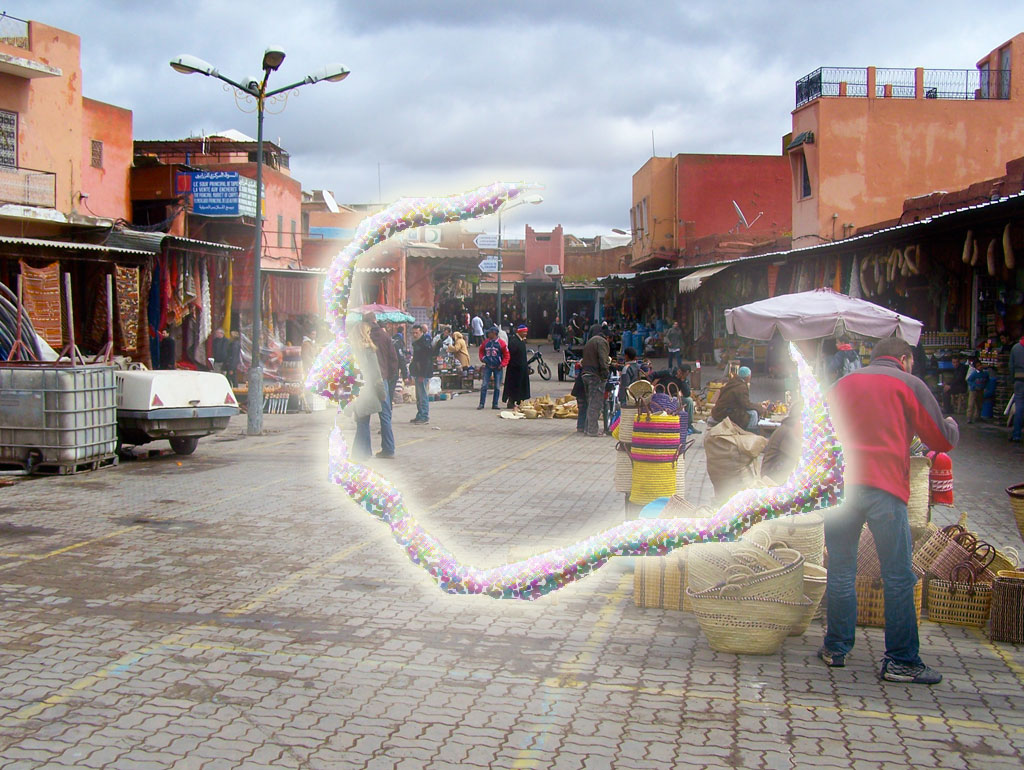
Scintillating scotoma usually begins as a spot of flickering light near or in the center of the visual fields, which prevents vision within the scotoma. The scotoma area flickers, but is not dark. The scotoma then expands into one or more shimmering arcs of white or colored flashing lights. An arc of light may gradually enlarge, become more obvious, and may take the form of a definite zigzag pattern, sometimes called a fortification spectrum, because of its resemblance to the fortifications of a castle or fort seen from above. 

The visual anomaly results from abnormal functioning of portions of the occipital cortex, at the back of the brain, not in the eyes. Symptoms typically appear gradually over 5 to 20 minutes and generally last fewer than 60 minutes, leading to the headache in classic migraine with aura, or resolving without consequence in acephalgic migraine.

Sounds kind of pretty, right? Unfortunately, even if you don't get a headache or other symptoms, it does massively mess with your vision until it resolves. If you search online, you can see a selection of artist's impressions of what scintillating scotoma can look like to sufferers:

Monday, 23 April 2012

IMFW: Life Imitates Art

So Blogger has changed its layout and everything, which is deeply confusing to a simple soul like me. If I manage to do anything wildly stupid like posting this next April or forgetting to use a title or something, please forgive me. I am easily baffled.

Anyway: back to IMFW! Today's Interesting Medical Fact of the Week is kind of related to two of my previous interesting medical posts, which focused on face transplants. There's an interesting article on the BBC News website about the fact that the University of Lincoln is offering an art course to plastic surgeons and medical students. They work at life drawing, self portraiture and clay modelling, with a focus on the real-life application for these skills: applying them in their surgical work.

It sounds a little bizarre at first, but at second glance it does make sense. The course aims to enhance students' observational skills and their perceptions of their work, emphasizing that they should look at reconstruction from a patient's point of view as well as their own.

Despite its rather trite acronym, the name of the British Association of Aesthetic Plastic Surgeons (BAAPS...) emphasizes the importance of beauty and aesthetic in the work of plastic surgeons, something which is obviously important in purely cosmetic procedures, but equally key in reconstructive work. I know next to nothing about the training of plastic surgeons, but it would certainly be interesting to know whether surgeons who go into this specialty tend to have more of an interest in art compared to those who gravitate towards other specialisms.

A press release from the university emphasizes the historical link between art and medicine, which was far more pronounced centuries ago; it was considered that artists needed an understanding of anatomy in order to recreate the human form on canvas, while medical texts relied upon anatomical drawings produced by artists, who would often attend dissections. Vesalius's seminal work on anatomy, De humani corporis fabrica, written in 1543, incorporated anatomical illustrations from artists working in the studio of Titian. Perhaps now the link between art and medicine link is being strengthened once more.

Monday, 28 November 2011

IMFW: Art Imitates Life?

Having written previously about Pio Pico, the last Governor of Mexican California who, it has recently been suggested, may have suffered from acromegaly caused by a growth-hormone producing pituitary adenoma, I got to thinking about this retrospective diagnosis lark, and I did a bit of reading. It turn out, doctors love arguing over whether Mozart had kidney failure or rheumatic fever, Schönlein-Henoch syndrome, trichinosis or the 'flu - and he's not the only famous composer to get the "what did he die of" treatment.

But this article takes things to another level. Professor Michael Baum takes his medical students around the National Gallery on a veritable orgy of slightly tenuous diagnoses, based solely on what they see in paintings. He and his students have suggested that The Ugly Duchess by Massys may show a woman suffering from Paget's disease of the bone, and suggested that An Allegory with Venus and Cupid by Bronzino has a hidden syphilitic message. Some of their arguments are more compelling than others, but it's an interesting article and I recommend following up the full versions of his analysis as well.

Monday, 14 November 2011

IMFW: heART

It's not precisely an interesting fact this week; more like an interesting set of pictures. But still cool. The British Heart Foundation ran a competition, inviting scientists to submit the best images they have of their work on heart disease, and the results are surprisingly artistic.

Medical imaging has certainly come a long way from the day that Röntgen first used x-rays to create an image of his wife's hand. She was purportedly unimpressed with his efforts, believing that the picture of her own skeleton was a herald of death - although as she lived for another 25 years, it was a herald rather ahead of its time.