Monday, 23 July 2012

IMFW: Lipodystrophy

Today's Interesting Medical Fact of the Week is about lipodystrophy, defined by the ever-noble Wikipedia as "a medical condition characterized by abnormal or degenerative conditions of the body's adipose tissue." Adipose tissue = fat. As you would know if you watched the freaky Dr Who episode which featured little fat aliens called the Adipose.

Dr Who: making obesity cute.
But I digress.

I first heard about lipodystrophy when chatting to a very lovely nurse in the research department of the hospital where I went to have a bunch of tests at the beginning of the month. It's a subject they have been doing some research into, and I have to admit it kind of caught the imagination.

The term "lipodystrophy" actually covers a whole range of conditions in which the body's fat does weird things. It may include a loss of fat from certain areas of the body (lipoatrophy), or even an increase in fat in certain areas (lipohyperthrophy), or even both (lipoWTF-ery):

Congenital generalised lipodystrophy:
A rare genetic disorder in which there is extremely low fat in the subcutaneous tissue.
Other symptoms include having a giant liver and being very hairy. And, unfortunately, heart problems.

Benign Symmetric Lipomatosis:
In which the patient develops extensive fat deposits in the neck, head and shoulder area. Often associated with alcohol abuse.

Barraquer-Simons Syndrome:
This rare condition usually appears after a viral infection in childhood, and is characterised by the gradual loss of fat from the top half of the body; the face, neck, shoulders, arms and chest, often accompanied by an increase of fat in the thighs, and sometimes by other symptoms such as deafness and epilepsy.

HIV-associated lipodystrophy:
This condition occurs in people with HIV, usually those who are being treated with anti-retroviral drugs, although there is some debate about whether it is caused by the drugs or by HIV infection alone. Often there may be fat accumulation in the back, creating a 'buffalo hump', the neck and breasts, and patients often develop abdominal obesity. However, at the same time they may have loss of fat in the face, arms, shoulders, thighs and buttocks.

Those are just a few examples - lipodystrophy is quite poorly understood and quite difficult to treat. Liposuction may be used to treat excess fat deposits, or lipomas (benign tumours of fat tissue) may be removed surgically; equally implants or even fat injections may be used to improve the cosmetic appearance of fat loss from the face and body.

Friday, 20 July 2012

Human Guinea Pig: Part 7 - How To Get Over Your Fear Of Needles

Holy lord! Who would have thought, when I agreed to go into hospital for all this testing, that the experience would prove to be such a rich vein of blog posts?

Anyway! This is the sixth part of the story about my overnight stay in the hospital's research department, having lots of tests to look at the effect my pituitary tumour is having on my body and metabolism. Here are links to: part one, part two, part three, parts four, five and six!

A Whole Lot of Blood Tests

After my GEM ventilated hood calorimetry test was over, and the strange astronaut hood was removed from my person, you might be imagining they'd let me have breakfast. If so, you are imagining wrong. Please stop.

No, it was time for my blood glucose testing! And so I was presented with this:

Yay, breakfast
No, it's not a refreshing beer: it's a pint of Lucozade. At nine in the morning. And I had to drink it all within five minutes.

Basically the idea is that, having eaten/drunk nothing but air for twelve hours, they present you with a massive sugary drink and then do a bunch of blood tests over the next two hours to see how well your body deals with it. I'll be interested to find out the results of this, as I'm pretty sure my body isn't great at coping with sugar; sometimes eating sugary things really noticeably raises my heartrate - and especially when I'm on my lanreotide injections, I have to try to be really careful about eating regularly, and carry around a packet of Starburst (or similar sugary hit) because occassionally I go hypoglycaemic at unexpected moments. Lanreotide messes around with your insulin and glucagon levels, meaning that it can confusingly cause both high and low blood sugar, and it sure is annoying.

I looked it up, and it turns out Lucozade was originally conceived as an Irish health drink and called Glucozade! Who knew! Between that and Guinness, it seems my ancestors had some peculiar ideas about what was "healthy". It also turns out that Lucozade contains 85g of sugar per 500ml, which is almost all of a woman's daily allowance. Holy crap! You can see why they chose it for my morning tipple.

While I was distracted trying to gulp down the hideous stuff, the sneaky nurses set up the trolley ready for my blood tests. Having finally finished all my Lucozade, I turned around to see this:
Oh, dear lord.

Yep. All those tubes were for me. I got to have twenty-three bloods taken in total - lucky me!

First they put an IV cannula into my arm - basically it's a giant needle that stays in your vein and they can attach tubes and things to so that they don't have to re-stab your arm every time they take another blood. They took about 16 of the bloods immediately, and then I had the rest over the next two hours. I still can't really bring myself to look at cannulas in my arm due to being a wuss, so one of the nurses very kindly bandaged it up for me.

Safely hidden away!

The nurses and my endocrinologist formed a sort of production line around my arm for the first sixteen, with one nurse preparing the tubes, Dr Olive taking the blood, and the other nurse stacking them up (some had to go straight into a bucket of ice; some had to be left to clot).

Once they've finished taking one lot of bloods via a cannula, the tube is flushed out with saline solution (i.e. they effectively inject saline into the tube). This clears the blood out of the tube, preventing it from clotting and blocking the tube in-between blood tests. Of course, then the next time they come to take blood, this means that they get half a tube of saline back before the blood starts coming through properly, which is of no use to anybody. Because of this, before taking further bloods, they take an extra tube which comes out as a mix of the saline & blood, then continue with the tests - and then sometimes (if you're having a lot of bloods taken, like me) they'll re-inject the blood and saline, to minimise blood loss.

I've never written the word "blood" so much in my life as I just did in that last paragraph, but I promise I'm not just trying to gross you out; there's an interesting fact coming up. Before re-injecting the blood & saline, I was asked if I was ok with it. I was very much ok with it, because sometimes having lots of blood taken gives me a Funny Turn (in this case I was fine, probably thanks to the pint of Lucozade) and thus I like to hang on to the stuff. Turns out they always have to ask before re-injecting the blood, in case you're a Jehovah's Witness.

I have long been aware that Jehovah's Witnesses are against blood transfusions, but I'd always assumed that this was due to believing that it was wrong to have someone else's blood put into your body; I hadn't appreciated that in fact the problem is with any blood that has left the body at all, even your own. According to Wikipedia, for Jehovah's Witnesses "Blood represents life and is sacred to God. It is reserved for only one special use, the atonement for sins. When a Christian abstains from blood, they are in effect expressing faith that only the shed blood of Jesus Christ can truly redeem them and save their life".

My Lucozade & Blood Tests Experience:

Hassle: 4/5
Fun: 1/5 (It would have been a zero, but I learned an interesting fact!)
Weirdness: 2/5
Results: 2/5
Total Score: 9/20

Monday, 16 July 2012

Human Guinea Pig: Part 6 - Resting Energy Expenditure Test

This is the sixth part of the story about my overnight stay in the hospital's research department, having lots of tests to look at the effect my pituitary tumour is having on my body and metabolism. Here are links to: part one, part two, part three, part four and indeed part five.

Resting Energy Expenditure and the GEM Ventilated Hood Indirect Calorimeter

I was woken up at half eight the next morning by the very lovely technician* who did my step test and heart monitor the previous day. She was dragging a large piece of equipment into my room, where it was placed next to my bed; it was time for my resting energy expenditure to be monitored. This has to be done first thing in the morning for maximum accuracy, which is why they kept me in hospital overnight.

 There's a tricky balance to be met with regards to this test; on the one hand, you have to be awake for the whole thing, but equally you're not supposed to get out of bed - or even move, as far as possible. For a sleepy creature like me, this makes it pretty hard to stay awake, but fortunately the whole experience was so surreal that I didn't want to let myself drift off.

Firstly, the equipment is switched on, set up, and left to monitor the room for ten minutes. Essentially, your metabolism is monitored by measuring the amount of carbon dioxide you breathe out. These measurements are then used to calculate your respiratory quotient. The technician explained it to me like this: when you're asleep, you usually breathe out a lower level of carbon dioxide, indicating that your body is metabolising your fat stores to produce energy (RQ = <0.7). When you're out and about, you'll be breathing out a higher level of carbon dioxide, indicating that you're metabolising carbohydrates (RQ= >0.7). I have a pituitary tumour which is messing with my hormones so they want to know what the heck my metabolism is actually doing. Or something.

Anyway - in order to make sure that the readings they take of the air you breathe out is accurate, the composition of the air in the room you're in has to be measured before and after the test. So I lay in bed for ten minutes, listening to it whirring happily next to me.

And then the technician returned with the rest of the equipment.

I am genuinely unspeakably ensorrowed by the fact that I didn't get a picture of me in it, but unfortunately it was early in the morning, my brain was still in first gear, and I wasn't actually allowed to move. So you'll have to use your imagination. Essentially, the rest of the equipment (the "ventilated hood") is a large goldfish bowl with a cape hanging off it, a small hole at the top, and a large pipe or two running out of it. Imagine a giant plastic medical jellyfish and you'll be on the right track.

I did find a picture of the machine all bundled up, but it doesn't look as amusing as it did once it was set up:
This piece of kit is called a GEM (Gas Exchange Measurement) ventilated hood indirect calorimeter. Snappy name, right? The GEM Nutrition website describes it as "an open circuit indirect calorimeter designed for nutritionists needing to measure energy balance and substrate turnover. The compact bedside unit measures gas exchange volumes, respiratory quotient and energy expenditure."

So now you know.

This strange contraption was connected up to the machine, and then placed over my head, at which point I understood why the nurses had double-and-triple checked with me whether or not I had claustrophobia the previous day. Then, safely ensconced in my plastic bubble, the cape was draped around me, and after checking that I wasn't freaking out and providing me with a call button, I was left.

I can't actually remember whether it was for twenty minutes or half an hour, but it didn't feel like very long. I could hear my breathing inside the big clear plastic helmet, which made me feel like a very lazy astronaut. Every now and again someone popped their head around the door to make sure I was ok, but it actually felt quite relaxing. The lights were still off in the room and it was all very chilled. I tried to keep my resting energy expenditure normal.

At some point later, I was freed from my goldfish bowl prison, and the GEM calorimeter sat burbling away in the corner for another ten minutes, measuring the room's air again.

The machine comes complete with a program which shows you the results immediately, along with little graphs showing the levels of carbon dioxide you were breathing out vs. the oxygen you were breathing in, etc. This would have been pretty awesome if I had had any clue what the results meant, but sadly they have to play with them further before they can draw any actual conclusions.

My Experience of the GEM Ventilated Hood Indirect Calorimeter:

Hassle: 1/5 (all I had to do was wake up and keep breathing, which I've managed to do every day of my life so far)
Fun: 3/5
Weirdness: 5/5
Results: 3/5
Total score: 12/20
____________________________________________________
*I don't know what her official job title is, so I'm going with "technician" but I could well be extremely wrong; I just know she was neither a doctor nor a nurse.

IMFW: Where are you on the Global Fat Scale?

A bonus Interesting Medical fact of the Week this time - I've skipped a few, because with writing up my hospital trip and all, I've been updating pretty regularly without them - which is more of an Interesting Medical Do It Yourself. The BBC website has created a calculator which allows you to input your height, weight, age and gender, and then calculates your Body Mass Index (BMI). This is then compared to average BMIs for people of your age and gender in countries all across the world.

My attention was first drawn to this when my boyfriend announced that he had the BMI of someone from the Democratic Republic of Congo, which sounded pretty concerning. So of course I had to look it up. As it turns out, my own BMI is most like a woman aged 15-29 in Bangladesh. Hurrah!

Obviously BMI is a problematic calculation given that it does not take into account a person's frame size or muscle mass - and as we now know that I am in fact 36% fat it's pretty clear that in my case it is not even a vaguely accurate measurement! However, it is still a diverting way to spend two minutes, and I highly recommend it.

Saturday, 14 July 2012

Human Guinea Pig: Part 5 - Dinner at the Hospital

This is the fifth part of the story about my overnight stay in the hospital's research department, having lots of tests to look at the effect my pituitary tumour is having on my body and metabolism. Here are links to: part one, part two, part three and part four (I do go on).

Dinner at the Hospital

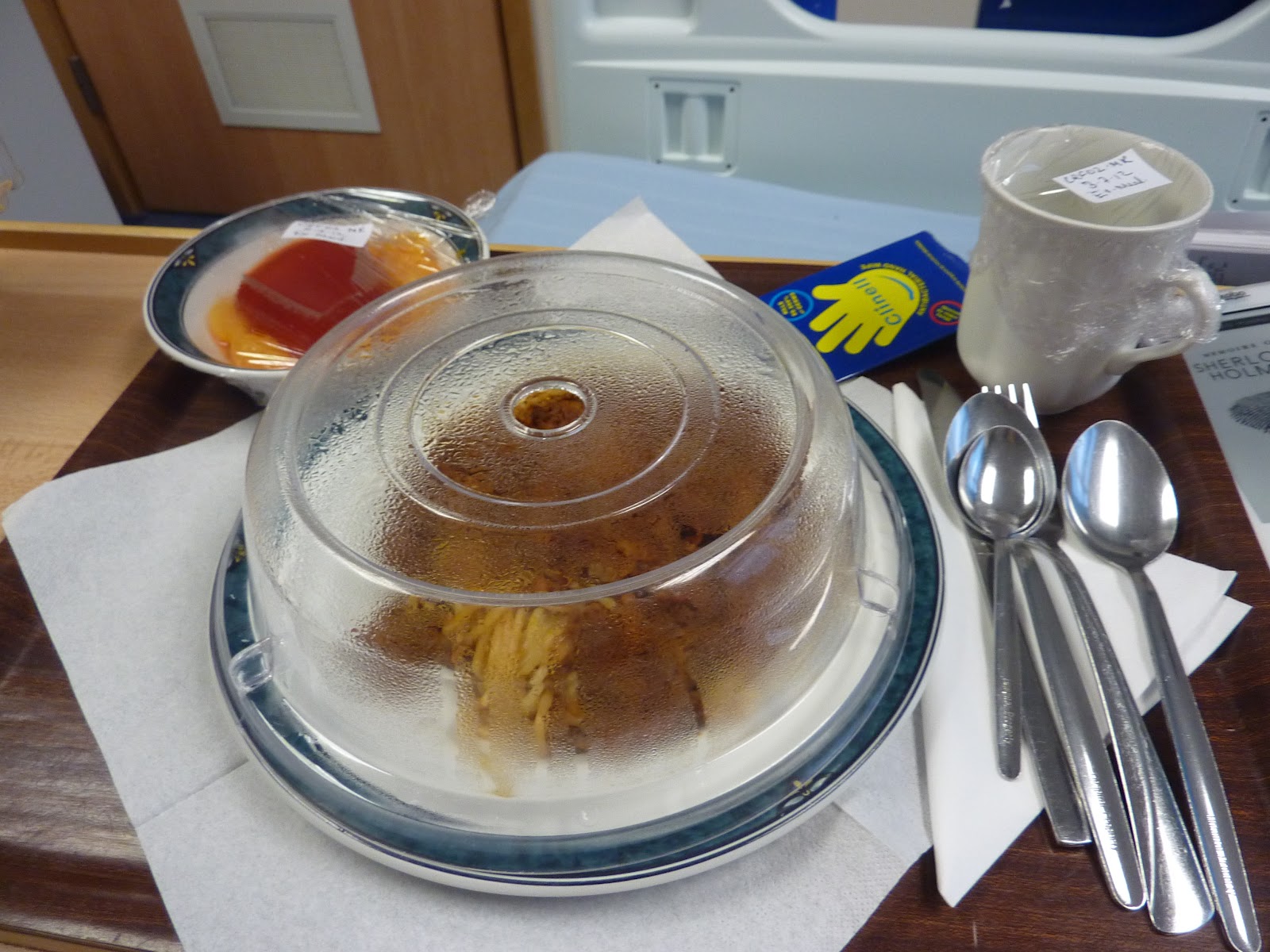
After a hurried trot back from the MRI department, I was dropped off at my room, ten minutes late for my dinner. The timing of this dinner was apparently important because it had been prepared just for me, and was apparently perfectly calibrated to contain exactly the right amount of calories for someone of my height and weight. I was allowed to eat the prepared meal only, nothing else, because they planned to monitor my metabolism and blood sugar levels in the morning and needed these to be unaffected by what I had eaten the night before.

I had barely had time to change out of my ridiculous scrubs and re-attach my Actiheart monitor when the night nurse's head appeared around the doorframe. "We're just heating your meal," she said, in a firm, no-nonsense voice. "You will be expected to eat all of it, you understand?"

And, with a stern look at me, she left. A few minutes later, she reappeared, tray in hand.

 Every dish had a label to show who it was for and when I should eat it, even to the extent that the milk for my evening (decaff) coffee had been measured out in advance, and I was not permitted any more. The main meal was, happily, spaghetti bolognese, one of my favourites.

But when I saw the dessert, my heart sank.

Close friends and family are aware that when it comes to desserts, I am usually more than enthusiastic in my appreciation of the culinary arts (unless it's cheesecake. Eurgh). However, I have a few basic rules. I don't eat jelly with sponge cake. I don't eat sponge cake with fruit.* And I don't eat fruit with jelly.

Here is a picture of the dessert:

In case you can't tell, it's strawberry jelly with tinned mandarin slices. NOOOOOO!
In fairness, it was partly my fault: the hospital did ask me whether I had any dietary requirements or dislikes, and I said no, because it would be strange and embarassing to have to explain my dessert law triad to a doctor. At least it wasn't cheesecake.

And so, I settled down to sup with good grace and managed to eat the entire thing. I did my utmost to separate the jelly from the mandarin segments wherever possible; where it was not possible, I adopted the approach to eating which has been popularised by the Burmese python, and gulped it down in one bite.

I don't know if the night nurse noticed my face fall when I saw the dessert, or whether she just thought I looked like an untrustworthy character, but she kept sticking her head around the door at unexpected moments while I was eating.

"Take your time," she said, smiling. "But you do have to eat it all."
"Ok, thanks," I replied.
My special tray!
Two minutes later, she popped up again. "You can take your time," she said. "Take as long as you want. But make sure you eat it all."

 And so on. It was very disconcerting. The constant visits created a weird kind of feedback loop where I found myself choking down the mouthfuls as quickly as possible in the hopes that she would finally stop telling me I could eat as slowly as I liked.

Eventually, I was done, and I had the evening to myself. I harassed my parents and boyfriend with text messages about jelly and fruit, read about the exploits of Mr Sherlock Holmes on my Kobo e-reader (which I LOVE), and flicked through TV channels. Eleven o'clock was lights-out and the terrifying night nurse came back again to confiscate my water and order me to pee in a jug overnight,** which was probably the moment I most felt like I was in prison.

Adding to this impression was the fact that my door had a small square window in it which opened onto the corridor and let an annoying amount of light in overnight, and the absurdly thin blanket on the bed. I often get chilly at night and hospitals are not cosy places, so I had brought my warmest hoody to wear in bed over my pyjamas, but I still woke up in the night absolutely freezing and had to ask for another blanket. This is extra annoying considering that hyperthyroidism is supposed to make you too hot, not too cold. In fact, I was given a questionaire about my symptoms, and one of the questions asked me to score my "heat intolerance" on a scale of 0-5, where 0 is no intolerance to heat and 5 is getting easily overheated. I wanted to add a -1 to the scale.

________________________________________________
*For those of you who really care about my pudding pickiness, I should note here that this rule only applies where the fruit makes the sponge cake all damp and hideous. I like fruit baked into cakes just fine. Fruit placed on top of a waterproof layer of icing is also acceptable. Trifle is the devil's pie.

**Not just for her own amusement; they did a 12 hour urine collection to monitor various hormone levels overnight.

Wednesday, 11 July 2012

The Very Scary Case of Kane Gorny

Before going into hospital last Tuesday, I stopped off at one of my favourite cafes for a hot chocolate, as a pre-hospital treat. I wasn't allowed caffeine in the three days before going in, so I had been suffering from a woeful lack of hot drinks. I got my hot chocolate (which was delicious) and sat down by the pile of daily papers they keep at the cafĂ©. Alas, all the more upmarket titles had been taken, so I had to settle for that peculiar bastion of journalistic achievement: the Daily Mail.

You can imagine my feeling of ill-omen when, immediately before going into hospital overnight for further investigations into my pituitary tumour, I saw that the Mail's headline story was about Kane Gorny, a 22-year-old with a pituitary tumour who died of dehydration in hospital after nurses denied him his medication.

You can read the Mail's story online here. According to the Mail, it seems that after his entirely routine hip replacement surgery, nurses did not give Mr Gorny medication necessary for fluid retention; he became so agitated from dehydration that he called 999 in an attempt to get some water, but was sedated and left unattended overnight, despite his mother raising concerns. Even after his death, the attitude of some members of the nursing staff appears to have been appalling.

I thought I would tackle a couple of questions raised by the reporting on this terrible story, before moving on to look at it as a whole:

What was wrong with him?

 Kane Gorny suffered from a pituitary tumour; that much is certain. The exact details of Mr Gorny's condition are still somewhat sketchy and vary depending on which paper you read, but I'm going to guess that he possibly had acromegaly or Cushing's Disease, from the statement of his endocrinologist that he had a "rare tumour", and the fact that he had joint problems.

Most papers have reported that he had a "malignant" brain tumour or "brain cancer". The tumour may well have been cancerous, but it should perhaps be noted that this extremely rare for pituitary tumours; they are sometimes misreported as malignant due to journalists misunderstanding the condition and the fact that a tumour labelled "benign" may still be very harmful. In any case, I'll be looking at the definition of malignancy/cancer with regard to pituitary tumours in a future post, hopefully within the next couple of weeks, because it's an interesting question.

Why did he need a hip replacement aged just 22?

After pituitary surgery, sometimes the healthy pituitary gland is damaged, leaving it unable to produce certain hormones, including ACTH (adrenocorticotrophic hormone), which stimulates the adrenal glands to produce the steroid hormone cortisol. Without cortisol in the body, you can die quite quickly - consequently, it is standard to give patients steroid pills after surgery until doctors are certain their pituitary gland is able to produce ACTH. If the pituitary gland has been damaged, patients will need to take these pills for life.

Most reports have stated that Mr Gorny's steroid treatment left him requiring a hip replacement; high levels of steroids in the body can lead to avascular necrosis (although not in "a couple of weeks" as one paper initially reported). Additionally, if he did indeed have Cushing's or acromegaly, both of these conditions can adversely affect joints.

How did he die of dehydration so quickly?

A healthy human can live for a couple of days without water, depending on exertion and environmental conditions. Kane Gorny could not. After his pituitary surgery, Mr Gorny was left with diabetes insipidus. This is a very different condition from what we refer to as "diabetes" (diabetes mellitus) and is caused by a deficiency in anti-diuretic hormone (ADH, or vasopressin). Anti-diuretic hormone is secreted by the pituitary gland and helps to control the body's fluid balance. In diabetes insipidus, the lack of this hormone means that the body cannot conserve much of the water which it takes in, and consequently the sufferer becomes extremely thirsty and needs to urinate frequently. Unfortunately, developing this condition is a fairly common side-effect of pituitary surgery and pituitary radiotherapy.

In order to treat his diabetes insipidus, Kane Gorny would have needed to take a drug called Desmopressin (DDAVP), which is a synthetic substitute for vasopressin. As long as he was taking this drug, his body would be able to retain a normal amount of the water he drank, and he would not become dehydrated. When the drug was witheld, his body could not remain hydrated, and he died.

How could the hospital get this so wrong?

Unfortunately this is the question that can't be answered. Kane Gorny's death appears to have been preceeded by a number of absolutely catastrophic blunders at the hospital. His endocrinologists were not informed that he was in the hospital for surgery; his surgeon was entirely unaware of his condition; nurses did not read his notes; no-one listened to his mother's concerns; the list goes on.

Diabetes insipidus is a common problem among pituitary patients, but far more rare in the general population. Endocrine and neurosurgery nurses would likely be familiar with the condition, the importance of the medication Mr Gorny was taking, and the crucial need to monitor his fluid balance. The nurses actually looking after him knew almost nothing about it.

It's a sad fact that there are a hell of a lot of medical conditions in the world. Patients with diabetes insipidus or the inability to produce steroid hormones are encouraged to wear MedicAlert jewellery to alert paramedics and medical staff to their conditions in case of emergency, yet it seems even when medical staff have access to full notes on a patient they can go unheeded. 

Sometimes it gets frustrating when you're in hospital or go to the doctors and are asked for the thousandth time to explain what's wrong with you. In the future I'll try to be more grateful that someone is checking...

_____________________________________________________________________
Kane Gorny's brother is fundraising for CLIC Sargent. You can donate here.


Tuesday, 10 July 2012

Human Guinea Pig: Part 4 - Pituitary MRI Scan

This is the fourth part of the story about my overnight stay in the hospital's research department, having lots of tests to look at the effect my pituitary tumour is having on my body and metabolism. You can read the first part here, the second part here and the third part here.

Pituitary MRI Scan

After my Actiheart was fitted, they had to take it right off again as I went straight down to have my pituitary MRI, another scan where no metal is allowed. I was strangely comforted by the fact that the MRI receptionist was fairly rude to Dr Olive when she asked to speak to the technicians - not because I dislike Dr Olive, who is lovely, but just because it's nice to know it's not only patients that bear the brunt of receptionists' bad days. I have a theory that in every hospital the receptionist recruitment protocol calls for exactly 50% completely lovely, can't-do-enough-to-help-you staff, and 50% short-tempered and angry people. That or they slip some kind of Jekyll-and-Hyde potion into their coffees.

"Have you come from Norway today?" the technician asked me.
I think she was quite disappointed that I had not, though I've no idea why.

I was still dressed in the giant scrubs and they keep scanning rooms pretty cool, as the equipment needs low temperatures. Fortunately the technician was both lovely and observant, and she gave me a blanket to keep me warm in the scanner. The usual ritual of ear plugs and glasses removal was observed, and packing was duly stuffed into the strange helmet thing you have to put your head in. Then I was drawn backwards into the machine.

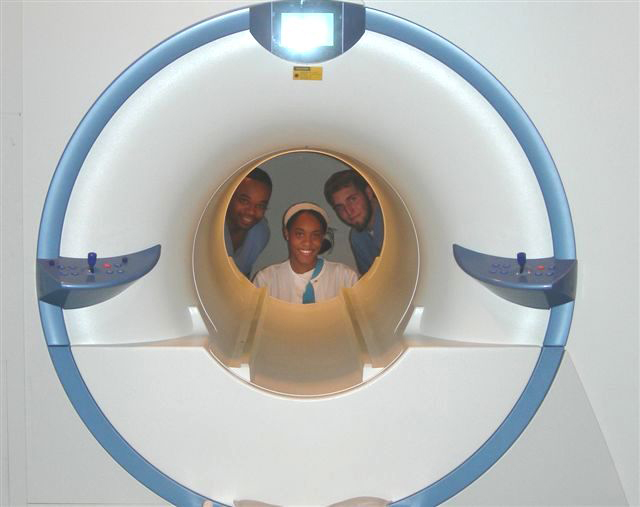
I didn't get a photo, so here's a cheesy stock image of some people smiling through an MRI scanner
MRIs can be quite claustrophobic, even if you're not normally bothered by confined spaces. I guess it is partly down to the fact that you don't have any control over it, partly down to the fact that your head is in a box and you're not allowed to move, and partly down to the weird and incredibly loud noises exploding into existence around you. However, if you do suffer from claustrophobia and you need to have an MRI, I can strongly recommend asking for a blanket. It makes the whole experience seem much more cosy. You can almost believe you're lying in bed on fireworks night. With your head in a box.

Then came the contrast injection, at which point I was given my panic button - usually they give you one at the start of the scan, but I was so happy under my blanket I hadn't even noticed I didn't have it - in case you have a reaction to the contrast dye (unlikely unless you have undiagnosed kidney failure, but still). Then another set of scans - each set took about ten minutes, I would guess - and then freedom! Easy as pre-packaged pie.

The strangest part of the scan actually happened after it was all over. There was another patient with the same condition as me who was having the tests at the same time - this meant we could both have our PET scans on the same day, as the hospital prefers doing two of the same type at once to save money. We'll call him Bob. I hadn't met him at that point, but he was having his pituitary MRI immediately after me, and so I stayed in the waiting room with a very sweet Filipino nurse waiting for his scan to be finished so we could all go back to the research department together.

I was, as I have mentioned before, still wearing scrubs. I was however wearing a pair of exclusive "I'M A PATIENT" bracelets detailing my name, age, hospital no. etc. and my allergies (trimethoprim = brings me out in an attractive full-body rash). The waiting room was pretty full, so I was sitting off to one side, flipping through an elderly magazine,* when a woman came up to me and asked me how much longer the current scan would take.

Well initially, I admit, I gave her a "woman, you crazy!" look, until I suddenly realised that in my current garb I probably looked like a member of staff.
"Sorry, I'm not a doctor, I'm a patient," I said.
"So how long will it take?" she asked.
I got out my "woman, you crazy!" face again. "Er, I don't know…"
"Well, I think it's really bad that we're not being given any information," she told me. "How long do you think it will take?"
"It probably depends on the type of scan?" I suggested.
And with that, she stamped off, muttering angrily to herself.

On the way back to the research department, I got to meet Bob! He is the first ever person I have met who also has a TSHoma, which is not surprising as there's only about 20 of us across the whole of the UK, Ireland and, apparently, Norway (this may explain the MRI technician's cryptic question). Bob was a bit of a legend and had sensibly rejected the scrubs they had suggested he wear, in favour of pyjamas with Animal from the Muppets on; obviously the preferable sartorial choice.


You might think that, on finally meeting someone else with the same incredibly rare pituitary tumour, we would discuss symptoms, or treatment. But no! People with TSH secreting pituitary adenomas are nothing if not polite, and of course we would not want the lovely Filipino nurse feeling left out of the conversation. So, as she most likely had no brain tumours of any sort, we instead discussed the best way to travel to Cardiff by public transport.

And a very educational conversation it was too.

My pituitary MRI scan experience:

Hassle: 2/5
Fun: 2/5 (extra point for meeting Bob!)
Weirdness: 3/5
Results: 2/5
Total Score: 9/20

I fear I've just had too many MRIs to find them exciting any more!

________________________________________________
*The magazine was old... it wasn't a magazine for old people.