So I made it to the hospital on Thursday for my appointment, and it went about as well as I could have hoped for. First stop: getting weighed (58.4kg). Second stop: blood pressure, resting and standing (both totally normal - a good sign as when I'm taking propranolol it's often very slightly low). Third stop: a comfortable chair in the waiting room for an hour.
Just as I was starting to think that I might actually have been forgotten, my endocrinologist swooped in. It was a pretty quick appointment really. My blood tests look good. I had a good response to the synacthen test and can stop taking hydrodortisone (if you don't understand all this medical terminology, in short: that is good!). All my thyroid hormones are solidly in the normal range - including the alpha subunit. The alpha subunit (a.k.a. chorionic gonadotropin alpha) is a protein. People who have TSHomas/thyrotropinomas often have an unusually high level of it in their blood. The normal range of the subunit in blood tests is below 1. When my blood was first tested for the alpha subunit, I think my level was about 13. My most recent test showed it at 0.95 - not only normal, by far the lowest it's ever been for me. Even after my first surgery it was around 5 or so.
So thus far, everything looks good and they don't want to refer me for radiotherapy. I don't particularly want to have radiotherapy, so that is excellent news. My MRI shows scar tissue, but nothing that looks like residual tumour, and my pituitary gland appears to be functioning normally despite two surgeries. Of course, if a few cells or a teeny tiny bit of tumour has been left behind, there's basically no way to tell unless it grows back, so the policy is just to watch and wait.
Next appointment is in six months. I had another round of blood tests and they kept some of my blood on ice for the various studies they do on TSH-secreting pituitary adenomas. I'll have another set of blood tests before the next appointment and see how they change. In the meantime, basically I just keep on keeping on!
Showing posts with label TSHoma. Show all posts
Showing posts with label TSHoma. Show all posts
Sunday, 28 July 2013

Monday, 6 May 2013
I'm Still Here!
Aloha! Long time no blog I know, profuse apologies all round. Partially I have been lazy, partially I have been working on other projects and partially I have been enjoying my recovery!
I went back to work around the beginning of March. I did a phased return, which I really recommend - the first couple of days back I felt pretty much exhausted by lunchtime, but by the end of my first week I was almost back to normal. So I've been back for two months now (how time flies!) and doing good.
I had a series of blood tests done in March by my endocrinologists and they came back looking good. My ACTH response wasn't quite back to normal, so I'm still taking hydrocortisone (albeit at a low dose), but my endocrinologists were optimistic that hopefully I'll be able to come off it in a few months. The same thing happened after my first surgery, so fingers crossed! The rest of my pituitary hormones are all fine - my TSH and free T3 and T4 came back the lowest they have ever been.
I'm back up to my pre-surgery level of fitness now too, and hopefully going to surpass it! I dance for 3 hours a week, swim for an hour, do lots of walking, the odd run, and yesterday I bought a bicycle so now I'll start doing some cycling too. I'm only taking propranolol very occassionally - I still get the odd bout of a fast resting heartrate, particularly after eating, but it's not often. I'm off to the doctors for an ECG to check that out tomorrow, although chances are it won't show anything and they'll need to do a 24-hour heart tape.
So all in all things are looking good so far. I've had an MRI scan now but I don't get the results til the 20th May when I go to meet with the neurosurgeon. Fingers crossed!
I went back to work around the beginning of March. I did a phased return, which I really recommend - the first couple of days back I felt pretty much exhausted by lunchtime, but by the end of my first week I was almost back to normal. So I've been back for two months now (how time flies!) and doing good.
I had a series of blood tests done in March by my endocrinologists and they came back looking good. My ACTH response wasn't quite back to normal, so I'm still taking hydrocortisone (albeit at a low dose), but my endocrinologists were optimistic that hopefully I'll be able to come off it in a few months. The same thing happened after my first surgery, so fingers crossed! The rest of my pituitary hormones are all fine - my TSH and free T3 and T4 came back the lowest they have ever been.
I'm back up to my pre-surgery level of fitness now too, and hopefully going to surpass it! I dance for 3 hours a week, swim for an hour, do lots of walking, the odd run, and yesterday I bought a bicycle so now I'll start doing some cycling too. I'm only taking propranolol very occassionally - I still get the odd bout of a fast resting heartrate, particularly after eating, but it's not often. I'm off to the doctors for an ECG to check that out tomorrow, although chances are it won't show anything and they'll need to do a 24-hour heart tape.
So all in all things are looking good so far. I've had an MRI scan now but I don't get the results til the 20th May when I go to meet with the neurosurgeon. Fingers crossed!
Wednesday, 29 August 2012
The Sound of Striped Hooves
Around a year or so ago, an interesting thing happened to me. I was in the car with my mother, we were driving down the motorway, and there was a car pulling a horsebox in front of us. We were going rather faster than the horsebox, and as we passed it, I looked inside and saw… a zebra. It was only a glimpse and it confused the hell out of me for a moment, but I am still sure it was a zebra, not a horse, inside that horsebox.* At first I was slightly worried I might be going mad, but my mother pointed out that there are plenty of zoos and animal parks around the place and presumably they must transport their zebras somehow.
Folk of a medical persuasion will probably see where I am going with this, but I promise it is an entirely true story, the proof of which is that it took months and months for it to occur to me that I could use it on this blog. What can I say? I am slow.
Healthy people are probably wondering why I am blathering about hoofed african mammals instead of my usual cheery chat about tumours, but fret not. All shall be revealed.
A zebra is, as Wikipedia (and, I believe, Scrubs) so nobly tells us, the medical term for a surprising diagnosis, which rather begs the question of what we should call those stripey ponies running around in nature documentaries. It comes from the aphorism that when you hear hoofbeats behind you, you don't expect to see a zebra. This is a wise observation which is totally inapplicable to anyone who lives in the African plains, but as it was coined by an American doctor in the 1940s, this oversight may perhaps be forgiven. The point is that when a doctor is presented with a set of symptoms which may be caused by a common illness or an uncommon one, the logical assumption should be that the patient most likely has the more common illness - even though there may be a temptation to go with the more dramatic diagnosis.
I have noticed this idea of being a medical zebra popping up in a few blogs by other people with rare pituitary tumours, particularly in those with Cushing's disease - possibly this is related to the fact that one of the symptoms of Cushing's is the development of dramatic stretchmarks of a stripey and thus zebra-like nature. A few further examples - here, here and here.
I guess I count as a medical zebra myself; my symptoms of hyperthyroidism such as tachycardia, hair loss and frenzied blogging** would normally be considered as indicating Graves disease or something - and even when the more common thyroid malfunctions were ruled out, it was considered more likely that I had a condition called Resistance to Thyroid Hormone than thyrotropinoma. But no, my body had picked the most unusual way it could think of to break down, and I was neither a horse, nor a pony, deer, mule, donkey, nor any one of a number of hoofed creatures which are more common in the UK than zebras.
Medical zebras are a tricky subject, on the whole, and there's obviously a balance to be struck. While it can be frustrating for those of us with unusual conditions to think that we waited a long time for a diagnosis, it would be far worse if doctors went around ignoring common diagnoses in favour of the weird ones. Equally though, doctors should be aware that just because something's weird and unusual doesn't mean it's not sitting in front of you - as anyone who's come face-to-face with Boris Johnson could tell you.
It's enough to make you wonder how rare your condition would have to be before you were considered a medical okapi...
______________________________________________
*Unless someone had painted a horse to look like a zebra. Which would be a pretty weird thing to do.
**Hint: one of these is not actually a symptom.
Folk of a medical persuasion will probably see where I am going with this, but I promise it is an entirely true story, the proof of which is that it took months and months for it to occur to me that I could use it on this blog. What can I say? I am slow.
Healthy people are probably wondering why I am blathering about hoofed african mammals instead of my usual cheery chat about tumours, but fret not. All shall be revealed.
A zebra is, as Wikipedia (and, I believe, Scrubs) so nobly tells us, the medical term for a surprising diagnosis, which rather begs the question of what we should call those stripey ponies running around in nature documentaries. It comes from the aphorism that when you hear hoofbeats behind you, you don't expect to see a zebra. This is a wise observation which is totally inapplicable to anyone who lives in the African plains, but as it was coined by an American doctor in the 1940s, this oversight may perhaps be forgiven. The point is that when a doctor is presented with a set of symptoms which may be caused by a common illness or an uncommon one, the logical assumption should be that the patient most likely has the more common illness - even though there may be a temptation to go with the more dramatic diagnosis.
I have noticed this idea of being a medical zebra popping up in a few blogs by other people with rare pituitary tumours, particularly in those with Cushing's disease - possibly this is related to the fact that one of the symptoms of Cushing's is the development of dramatic stretchmarks of a stripey and thus zebra-like nature. A few further examples - here, here and here.
 |
| A group of Cushing's sufferers at a recent conference. |
 |
| Neighbours of Lord Rothschild may not only have expected to see zebras when they heard the sound of hoofbeats, but also had to leap out of their way. |
It's enough to make you wonder how rare your condition would have to be before you were considered a medical okapi...

______________________________________________
*Unless someone had painted a horse to look like a zebra. Which would be a pretty weird thing to do.
**Hint: one of these is not actually a symptom.
Monday, 27 August 2012
IMFW: Thyrotoxic Period Paralysis
Today's Interesting Medical Fact of the Week is about thyrotoxic periodic paralysis, a curious malady occurring mainly in men of Japanese, Vietnamese, Chinese, Korean Thai and Filipino descent - and Native Americans are also at greater risk, as they share a genetic background with East Asian people. The condition causes attacks of muscle weakness and paralysis and usually occurs in the presence of high thyroid hormone levels (hyperthyroidism) and low potassium levels (hypokalemia).
The attacks of paralysis can be brought on by exercise, drinking alcohol and eating food high in carbohydrates or salt, and they can be dangerous if they lead to respiratory failure or irregular heartbeat. This condition can be treated by first correcting the hypokalemia, then the hyperthyroidism; once treatment has achieved normal thyroid levels, this usually leads to a complete resolution of the problem.
Thyrotoxic period paralysis is commonly associated with Graves Disease, although other illnesses which lead to high thyroid levels (including TSH-producing pituitary adenoma... yay!) can also cause the condition. It's not fully understood and there is still confusion over why males are predominantly affected despite the fact that overactive thyroid problems are more common in women.
The attacks of paralysis can be brought on by exercise, drinking alcohol and eating food high in carbohydrates or salt, and they can be dangerous if they lead to respiratory failure or irregular heartbeat. This condition can be treated by first correcting the hypokalemia, then the hyperthyroidism; once treatment has achieved normal thyroid levels, this usually leads to a complete resolution of the problem.
Thyrotoxic period paralysis is commonly associated with Graves Disease, although other illnesses which lead to high thyroid levels (including TSH-producing pituitary adenoma... yay!) can also cause the condition. It's not fully understood and there is still confusion over why males are predominantly affected despite the fact that overactive thyroid problems are more common in women.
Thursday, 9 August 2012
Film of transphennoidal endoscopic surgery to remove a TSHoma
So while I don't wish to make everyone feel as nauseated as these injections sometimes make me, I found a film of transphennoidal endoscopic surgery to remove a TSHoma! How exciting! This is the type of surgery I will be having soon, probably around November time. The person whose head this was filmed inside is one of my fellow TSH-producing pituitary tumour brethren.
Don't be fooled, it doesn't actually just take six minutes. There's a whole lot of drilling down your nose required first.
Looks pretty simple to me. Well, I mean, it's not rocket science, is it?
The above is a) more suitable for an audience of a delicate disposition and b) one of my favourite Mitchell & Webb moments!
Don't be fooled, it doesn't actually just take six minutes. There's a whole lot of drilling down your nose required first.
Looks pretty simple to me. Well, I mean, it's not rocket science, is it?
The above is a) more suitable for an audience of a delicate disposition and b) one of my favourite Mitchell & Webb moments!
Tuesday, 7 August 2012
Please Sir, Can I Have My Medication?
Regular readers will remember that earlier in the year I was lamenting the fact that my stupid GP's forced me to change GP surgery after I moved a few minutes down the road, due to their weird practice boundaries. At first I thought this was just Massively Inconvenient And Stupid, but in fact it's gone on to have far more serious ramifications.
At present I am thyrotoxic; I have way too much thyroid hormone sloshing around my body, because my pituitary tumour is producing a hormone which is overstimulating my thyroid gland. It has been getting noticeably worse recently; over the past few weeks I have had to up my dose of the beta blockers I take to control my excessively fast heartbeat from 1 - 2 per day to 2 or more frequently 3 per day. I'm noticeably more jittery, I get shaky hands sometimes, I'm getting much more tired more easily. I feel pretty rubbish right now.
The medical universe strongly agree that I need to go on lanreotide injections to stop the tumour producing thyroid stimulating hormone immediately. Like right now. Like actually we should probably have put you back on them at the start of July.
They do not agree on who should pay for it.
My injections are expensive; they cost about £750 a pop (one injection lasts for four weeks, so they cost about £27 a day). My old GP noted that they were more expensive than uranium, but he went on and prescribed them anyway.
My new GP noted that they were more expensive than uranium, and that they are now on our PCT Red List.
The Red List is a list of drugs that should only be prescribed by a specialist, not a general practitioner. It has been suggested that more PCTs are red-listing more drugs to make savings cuts. I could not possibly comment on that. What I do know is that despite the fact that my specialist endocrinologist requested my new GP prescribe them, this is apparently not enough, and after consulting with the PCT (primary care trust) she was unable to do so. The problem is complicated by the fact that the long-acting form of the drug I need (Somatuline Autogel) is not technically licensed for my condition (TSHoma). The older, short-acting form is licensed, but it only lasts ten days, and who wants injections every ten days? Essentially this is just wrangling, but my GP doesn't want to be held responsible for prescribing an unlicensed drug for me, should anything go wrong. She is playing by the book, which is a stance I can sympathise with.
Fortunately the day after I first found out about this issue, I went into the hospital for an appointment and informed my various endocrinologists of the problem. They immediately requested that the specialist nurses order in the first dose of the drug for me so that I could have it administered as soon as possible.
The nurses already have the syringe full of delicious lanreotide. It came in yesterday.
I could have had the injection yesterday. I could have had it today. I could even have it tomorrow, but I don't know if I will - because even though the first dose has been bought and paid for and is SITTING IN A FRIDGE WAITING FOR ME, they are wrangling about who should pay for the next dose.
The next dose.
WHICH I DON'T NEED TO HAVE FOR FOUR WEEKS.
The nurse was super apologetic when I called up to find out what the heck was going on (as I had been told I would probably have it yesterday or today but hadn't heard anything) and she's basically spent the whole afternoon trying to find out if she can just give me the damn injection already and work out where the next one is coming from afterwards.
There is no question that the NHS wants me to have this drug. It's the drug I need, I've had it before, plenty of other patients with my condition have had it before, it works, the licensing issue is really just a wrangle and they reckon the drug company is hoping to get it licensed for TSHoma soon anyway. All the people actually involved in my care want me to have this drug as soon as possible because being this thyrotoxic is Not A Good Thing. But no-one wants to pay for it. Which is ridiculous because it's public damn money. If the hospital pays for it, if my GP's pay for it, it doesn't matter - the net effect on the public purse is exactly the same.*
So please can I just have the damn injection already?
________________________________________________
*Although in fact, it would probably be cheaper to the NHS overall for me to have it administered by a nurse at my GP's practice rather than an expensive and specialist endocrine nurse at the hospital whose time is probably more valuable.**
** And more expensive if my thyroid gland goes into overdrive while I'm hanging around waiting and sends me into a coma.***
***Very unlikely but actually not entirely impossible.
At present I am thyrotoxic; I have way too much thyroid hormone sloshing around my body, because my pituitary tumour is producing a hormone which is overstimulating my thyroid gland. It has been getting noticeably worse recently; over the past few weeks I have had to up my dose of the beta blockers I take to control my excessively fast heartbeat from 1 - 2 per day to 2 or more frequently 3 per day. I'm noticeably more jittery, I get shaky hands sometimes, I'm getting much more tired more easily. I feel pretty rubbish right now.
The medical universe strongly agree that I need to go on lanreotide injections to stop the tumour producing thyroid stimulating hormone immediately. Like right now. Like actually we should probably have put you back on them at the start of July.
They do not agree on who should pay for it.
My injections are expensive; they cost about £750 a pop (one injection lasts for four weeks, so they cost about £27 a day). My old GP noted that they were more expensive than uranium, but he went on and prescribed them anyway.
My new GP noted that they were more expensive than uranium, and that they are now on our PCT Red List.
The Red List is a list of drugs that should only be prescribed by a specialist, not a general practitioner. It has been suggested that more PCTs are red-listing more drugs to make savings cuts. I could not possibly comment on that. What I do know is that despite the fact that my specialist endocrinologist requested my new GP prescribe them, this is apparently not enough, and after consulting with the PCT (primary care trust) she was unable to do so. The problem is complicated by the fact that the long-acting form of the drug I need (Somatuline Autogel) is not technically licensed for my condition (TSHoma). The older, short-acting form is licensed, but it only lasts ten days, and who wants injections every ten days? Essentially this is just wrangling, but my GP doesn't want to be held responsible for prescribing an unlicensed drug for me, should anything go wrong. She is playing by the book, which is a stance I can sympathise with.
Fortunately the day after I first found out about this issue, I went into the hospital for an appointment and informed my various endocrinologists of the problem. They immediately requested that the specialist nurses order in the first dose of the drug for me so that I could have it administered as soon as possible.
The nurses already have the syringe full of delicious lanreotide. It came in yesterday.
I could have had the injection yesterday. I could have had it today. I could even have it tomorrow, but I don't know if I will - because even though the first dose has been bought and paid for and is SITTING IN A FRIDGE WAITING FOR ME, they are wrangling about who should pay for the next dose.
The next dose.
WHICH I DON'T NEED TO HAVE FOR FOUR WEEKS.
The nurse was super apologetic when I called up to find out what the heck was going on (as I had been told I would probably have it yesterday or today but hadn't heard anything) and she's basically spent the whole afternoon trying to find out if she can just give me the damn injection already and work out where the next one is coming from afterwards.
There is no question that the NHS wants me to have this drug. It's the drug I need, I've had it before, plenty of other patients with my condition have had it before, it works, the licensing issue is really just a wrangle and they reckon the drug company is hoping to get it licensed for TSHoma soon anyway. All the people actually involved in my care want me to have this drug as soon as possible because being this thyrotoxic is Not A Good Thing. But no-one wants to pay for it. Which is ridiculous because it's public damn money. If the hospital pays for it, if my GP's pay for it, it doesn't matter - the net effect on the public purse is exactly the same.*
So please can I just have the damn injection already?
________________________________________________
*Although in fact, it would probably be cheaper to the NHS overall for me to have it administered by a nurse at my GP's practice rather than an expensive and specialist endocrine nurse at the hospital whose time is probably more valuable.**
** And more expensive if my thyroid gland goes into overdrive while I'm hanging around waiting and sends me into a coma.***
***Very unlikely but actually not entirely impossible.
Tuesday, 24 July 2012
Acromegaly Drug Trial - Oral Octreolin
I noticed on the Pituitary Foundation's website that a drug trial is recruiting for acromegaly patients. It's the phase 3 testing of oral octreolin, taking place at centres across the UK, including Oxford, Manchester and London.
This trial is a pretty exciting prospect! Currently, the somatostatin analogues which are used to treat acromegaly are only available in an injectable form, both as daily injections and in a long-lasting preparation that's injected once a month. This means regular visits to the nurse, plus all the hassle of ordering and storing the prescription, as the drug has to be kept refrigerated. Being able to simply take two pills every day would be so much more convenient (not to mention less painful... those needles are huge), especially for patients who travel or move around a lot.
The biopharma company carrying out the trial is Chiasma, a company specialising in turning injectable drugs into oral formulations. Octreolin is their lead product, but their website indicates they're also working on a drug to treat complications of chronic kidney disease.
It appears Chiasma are conducting clinical trials on the use of octreolin to treat neuroendocrine tumours. In addition to this and acromegaly, octreotide (the injectable somatostatin analogue that octreolin emulates) is used to treat carcinoid syndrome, TSHomas/thyrotropinomas and an extremely rare tumour called a VIPoma. VIP actually stands for vasoactive intestinal peptide, a hormone which the tumour produces in excess, but these tumours are so rare - estimated annual incidence of one per ten million people - that the other meaning of VIP is strangely apposite. A press release from Chiasma also suggested that octreolin was being investigated as a treatment for portal hypertension. So if octreolin is found to be as safe and effective as octreotide, it could benefit people suffering from a whole range of conditions.
This trial is a pretty exciting prospect! Currently, the somatostatin analogues which are used to treat acromegaly are only available in an injectable form, both as daily injections and in a long-lasting preparation that's injected once a month. This means regular visits to the nurse, plus all the hassle of ordering and storing the prescription, as the drug has to be kept refrigerated. Being able to simply take two pills every day would be so much more convenient (not to mention less painful... those needles are huge), especially for patients who travel or move around a lot.
The biopharma company carrying out the trial is Chiasma, a company specialising in turning injectable drugs into oral formulations. Octreolin is their lead product, but their website indicates they're also working on a drug to treat complications of chronic kidney disease.
It appears Chiasma are conducting clinical trials on the use of octreolin to treat neuroendocrine tumours. In addition to this and acromegaly, octreotide (the injectable somatostatin analogue that octreolin emulates) is used to treat carcinoid syndrome, TSHomas/thyrotropinomas and an extremely rare tumour called a VIPoma. VIP actually stands for vasoactive intestinal peptide, a hormone which the tumour produces in excess, but these tumours are so rare - estimated annual incidence of one per ten million people - that the other meaning of VIP is strangely apposite. A press release from Chiasma also suggested that octreolin was being investigated as a treatment for portal hypertension. So if octreolin is found to be as safe and effective as octreotide, it could benefit people suffering from a whole range of conditions.
Tuesday, 10 July 2012
Human Guinea Pig: Part 4 - Pituitary MRI Scan
This is the fourth part of the story about my overnight stay in the hospital's research department, having lots of tests to look at the effect my pituitary tumour is having on my body and metabolism. You can read the first part here, the second part here and the third part here.
Pituitary MRI Scan
After my Actiheart was fitted, they had to take it right off again as I went straight down to have my pituitary MRI, another scan where no metal is allowed. I was strangely comforted by the fact that the MRI receptionist was fairly rude to Dr Olive when she asked to speak to the technicians - not because I dislike Dr Olive, who is lovely, but just because it's nice to know it's not only patients that bear the brunt of receptionists' bad days. I have a theory that in every hospital the receptionist recruitment protocol calls for exactly 50% completely lovely, can't-do-enough-to-help-you staff, and 50% short-tempered and angry people. That or they slip some kind of Jekyll-and-Hyde potion into their coffees.
"Have you come from Norway today?" the technician asked me.
I think she was quite disappointed that I had not, though I've no idea why.
I was still dressed in the giant scrubs and they keep scanning rooms pretty cool, as the equipment needs low temperatures. Fortunately the technician was both lovely and observant, and she gave me a blanket to keep me warm in the scanner. The usual ritual of ear plugs and glasses removal was observed, and packing was duly stuffed into the strange helmet thing you have to put your head in. Then I was drawn backwards into the machine.
 |
| I didn't get a photo, so here's a cheesy stock image of some people smiling through an MRI scanner |
Then came the contrast injection, at which point I was given my panic button - usually they give you one at the start of the scan, but I was so happy under my blanket I hadn't even noticed I didn't have it - in case you have a reaction to the contrast dye (unlikely unless you have undiagnosed kidney failure, but still). Then another set of scans - each set took about ten minutes, I would guess - and then freedom! Easy as pre-packaged pie.
The strangest part of the scan actually happened after it was all over. There was another patient with the same condition as me who was having the tests at the same time - this meant we could both have our PET scans on the same day, as the hospital prefers doing two of the same type at once to save money. We'll call him Bob. I hadn't met him at that point, but he was having his pituitary MRI immediately after me, and so I stayed in the waiting room with a very sweet Filipino nurse waiting for his scan to be finished so we could all go back to the research department together.
I was, as I have mentioned before, still wearing scrubs. I was however wearing a pair of exclusive "I'M A PATIENT" bracelets detailing my name, age, hospital no. etc. and my allergies (trimethoprim = brings me out in an attractive full-body rash). The waiting room was pretty full, so I was sitting off to one side, flipping through an elderly magazine,* when a woman came up to me and asked me how much longer the current scan would take.
Well initially, I admit, I gave her a "woman, you crazy!" look, until I suddenly realised that in my current garb I probably looked like a member of staff.
"Sorry, I'm not a doctor, I'm a patient," I said.
"So how long will it take?" she asked.
I got out my "woman, you crazy!" face again. "Er, I don't know…"
"Well, I think it's really bad that we're not being given any information," she told me. "How long do you think it will take?"
"It probably depends on the type of scan?" I suggested.
And with that, she stamped off, muttering angrily to herself.
On the way back to the research department, I got to meet Bob! He is the first ever person I have met who also has a TSHoma, which is not surprising as there's only about 20 of us across the whole of the UK, Ireland and, apparently, Norway (this may explain the MRI technician's cryptic question). Bob was a bit of a legend and had sensibly rejected the scrubs they had suggested he wear, in favour of pyjamas with Animal from the Muppets on; obviously the preferable sartorial choice.
.png)
You might think that, on finally meeting someone else with the same incredibly rare pituitary tumour, we would discuss symptoms, or treatment. But no! People with TSH secreting pituitary adenomas are nothing if not polite, and of course we would not want the lovely Filipino nurse feeling left out of the conversation. So, as she most likely had no brain tumours of any sort, we instead discussed the best way to travel to Cardiff by public transport.
And a very educational conversation it was too.
My pituitary MRI scan experience:
Hassle: 2/5
Fun: 2/5 (extra point for meeting Bob!)
Weirdness: 3/5
Results: 2/5
Total Score: 9/20
I fear I've just had too many MRIs to find them exciting any more!
________________________________________________
*The magazine was old... it wasn't a magazine for old people.
Saturday, 23 June 2012
Hyperthyroid Patients, Unite!
Subtitle: You have nothing to lose but your goitres!
So here's the strange thing: I have a TSHoma - a pituitary tumour which secretes TSH (thyroid stimulating hormone). It's super rare. According to my endocrinologist there are maybe thirteen or so other people in the UK with this condition which, in a population of 63 million, is Not Very Many, although it probably does go largely underdiagnosed; I had my first symptoms when I was around 16 or 17 and didn't get a diagnosis until I was 22.
But anyway, the point is that it can sometimes almost feel like two separate conditions; I have the pituitary adenoma, and the hyperthyroidism it causes. My symptoms, apart from the odd nasty headache, are pretty much exclusively those of hyperthyroidism; my treatment is for the adenoma. Consequently, although I am in all seriousness a paid-up member of the Pituitary Foundation and can chat about transsphenoidal surgery and lanreotide injections with the best of them, I'm missing out on the chance to bitch and moan about sinus tachycardia and getting the shakes with other people whose blood has turned to delicious thyroid hormone stew. More fool me!
People with excess thyroid hormone usually get that way from either a) taking too high a dose of thyroxine medication (exogenous thyrotoxicosis), or b) something else. The former can be dealt with simply by reducing the dose. The latter is more complicated. Possible causes include:
Graves Disease - the most common cause of hyperthyroidism, Graves is an autoimmune disease which can be treated with anithyroid drugs, surgery to remove part or all of the thyroid, or a dose of radiactive iodine. After such treatment there's a substantial and ironic risk of hypothyroidism - i.e. not having enough thyroid hormone.
Tumours of the thyroid gland - thyroid adenoma is a benign tumour of the thyroid gland which may secrete large amounts of thyroid hormone, while thyroid nodules may be benign or malignant and again may or may not release thyroid hormone - in some cases they may actually inhibit its production, causing hypothyroidism.
Thyroiditis - inflammation of the thyroid gland. Although this often initially leads to high levels of thyroid hormone being released, it usually progresses to thyroid disfunction with the gland unable to produce sufficient hormones, and ultimately causes hypothyroidism. Around 7% of women experience temporary thyroiditis after giving birth (postpartum thyroiditis) which may lead to hyper- or hypothyroidism, or both; this usually resolves itself.
TSH hypersecretion - super rare, but usually caused by a pituitary adenoma (hurrah!). However, I believe there is also the possibility of a tumour in the hypothalamus causing excess Thyrotropin Releasing Hormone and hyperstimulating the pituitary gland to overproduce TSH, which in turn would hyperstimulate the thyroid gland to overproduce thyroid hormone. Again, it's very rare.
I guess really I should be grateful for this, as effectively I have two health conditions for the price of one. This blog is usually focussed mainly around the dramatic "there's a tumour in my head!" aspects of my pituitary adenoma, and poor little hyperthyroidism barely gets a look in, except for when I complain about my tachycardia/hair falling out/absurd appetite issues. But no longer! From now on I vow to go on about hyperthyroidism more. So you guys will get two lots of whingeing for the price of one!
So here's the strange thing: I have a TSHoma - a pituitary tumour which secretes TSH (thyroid stimulating hormone). It's super rare. According to my endocrinologist there are maybe thirteen or so other people in the UK with this condition which, in a population of 63 million, is Not Very Many, although it probably does go largely underdiagnosed; I had my first symptoms when I was around 16 or 17 and didn't get a diagnosis until I was 22.
But anyway, the point is that it can sometimes almost feel like two separate conditions; I have the pituitary adenoma, and the hyperthyroidism it causes. My symptoms, apart from the odd nasty headache, are pretty much exclusively those of hyperthyroidism; my treatment is for the adenoma. Consequently, although I am in all seriousness a paid-up member of the Pituitary Foundation and can chat about transsphenoidal surgery and lanreotide injections with the best of them, I'm missing out on the chance to bitch and moan about sinus tachycardia and getting the shakes with other people whose blood has turned to delicious thyroid hormone stew. More fool me!
People with excess thyroid hormone usually get that way from either a) taking too high a dose of thyroxine medication (exogenous thyrotoxicosis), or b) something else. The former can be dealt with simply by reducing the dose. The latter is more complicated. Possible causes include:
Graves Disease - the most common cause of hyperthyroidism, Graves is an autoimmune disease which can be treated with anithyroid drugs, surgery to remove part or all of the thyroid, or a dose of radiactive iodine. After such treatment there's a substantial and ironic risk of hypothyroidism - i.e. not having enough thyroid hormone.
Tumours of the thyroid gland - thyroid adenoma is a benign tumour of the thyroid gland which may secrete large amounts of thyroid hormone, while thyroid nodules may be benign or malignant and again may or may not release thyroid hormone - in some cases they may actually inhibit its production, causing hypothyroidism.
Thyroiditis - inflammation of the thyroid gland. Although this often initially leads to high levels of thyroid hormone being released, it usually progresses to thyroid disfunction with the gland unable to produce sufficient hormones, and ultimately causes hypothyroidism. Around 7% of women experience temporary thyroiditis after giving birth (postpartum thyroiditis) which may lead to hyper- or hypothyroidism, or both; this usually resolves itself.
TSH hypersecretion - super rare, but usually caused by a pituitary adenoma (hurrah!). However, I believe there is also the possibility of a tumour in the hypothalamus causing excess Thyrotropin Releasing Hormone and hyperstimulating the pituitary gland to overproduce TSH, which in turn would hyperstimulate the thyroid gland to overproduce thyroid hormone. Again, it's very rare.
I guess really I should be grateful for this, as effectively I have two health conditions for the price of one. This blog is usually focussed mainly around the dramatic "there's a tumour in my head!" aspects of my pituitary adenoma, and poor little hyperthyroidism barely gets a look in, except for when I complain about my tachycardia/hair falling out/absurd appetite issues. But no longer! From now on I vow to go on about hyperthyroidism more. So you guys will get two lots of whingeing for the price of one!
Friday, 11 May 2012
Ding Ding: Round Two
I had been holding off posting for a few days, not out of laziness,* but because I was waiting to find out the outcome of my hospital appointment last Thursday. And then it took me absolutely ages to type this up because, let's face it, it's dull and complex. For the last couple of months I have been largely in the dark as to the results of my blood tests and recent MRi scan, so I really had no idea what to expect.
What I did not expect was to find the television in the endocrine waiting room playing Cash In The Attic. This television has, to my knowledge, never previously displayed anything other than The Jeremy Kyle Show. I always assumed that the hospital trust had performed some kind of patient survey and determined that diabetics and people with pituitary tumours prefer their televisual experiences to involve shouting, paternity testing, and the phrase "Madam, you disgust me".
I digress.
First up, as per usual, I was weighed (lost: one kilogram since February, almost certainly due to forswearing chocolate over Lent rather than the TSH-oma) and had my blood pressure taken (standing blood pressure: 118/76 - score! It would appear that switching my heart medication back to propranolol has made a difference). Then I had a quick review with one of the endocrinologists about how my symptoms have changed since being on lanreotide injections (not much).
Then the doctor ran away and eventually returned with two other endocrinologists in tow, who all stood at the other end of the room and surveyed me like something interesting they'd found in a jar at the Hunterian Museum.**
They have been somewhat confused by the fact that my levels of various thyroid hormones have remained roughly the same since being on the lanreotide injections, despite the fact that you would expect them to drop.
Additionally, the MRI scan of my pituitary was a little tricky to interpret. Essentially, the pituitary gland is like a tiny upside-down lollipop just below your brain. The stick of the lollipop is called the infundibular stalk*** and it connects the pituitary gland to the hypothalamus. My original MRI pituitary scan showed a great big gobstopper lollipop with a dark patch of necrosis in the middle, where the tissue inside the tumour had died off a bit. To picture this, first imagine a lollipop with a liquid centre, and then imagine something a lot more disgusting. But my latest scan shows a rather more normal-sized lollipop which hasn't grown since my surgery (hurrah!). However, the stick of the lollipop is slightly bending to one side.
Given that there's limited space inside your head for these things to grow, a wonky pituitary stalk can indicate that the bulk of a tumour is pushing the rest of the pituitary gland to one side. So the area of pituitary gland on the left-hand side is now under suspicion. I have to say, looking at the scans was kind of awesome, because it's not like when people show you the ultrasound of their baby and you have to pretend you totally see what they're talking about. I actually could see what they were talking about.
But the problem with MRIs is that they can show you what's there, but not what it's doing. So although it looks like there's probably a bit of tumour left on one side of my pituitary gland and that may well be what's still causing my symptoms, it's still possible that it's not that bit at all. And it would be rubbish to have surgery, take that bit out and then discover it was actually healthy pituitary tissue.
So my doctors want me to have two combined PET/CT scans. PET (Positron Emission Tomography) scans are super colourful and pretty, but that's not the only reason they want me to have one (I hope).
Basically, PET scans can show those areas of the pituitary that are most metabolically active. Inactive areas are dark. So the idea is that I will have one of these scans while not on any kind of medication, which should show the whole pituitary lit up like a christmas tree, and then have another scan after three months on a higher dose of lanreotide, which should suppress the hormone production in the TSHoma. Any areas that go from being bright blue on the first scan to being dark in the second scan are probably tumour. Then, if the tumour is in an easily-accessible area of my head, I might have surgery again. If it's somewhere tricky to reach, I'll probably just continue to have regular injections of lanreotide indefinitely.
So I'm not having any more lanreotide injections for six weeks, so that it's definitely completely out of my system. And in the meantime they want to have me come in overnight one for some research tests on my metabolism and things. Essentially the hospital are collecting patients with pituitary tumours that produce TSH and studying us, so I am now officially a guinea pig.
_______________________________________________
*How could you ever think such a thing?
**I'm joking, they were very nice.
***Or just the pituitary stalk, but you don't get to use a word like "infundibular" every day.
What I did not expect was to find the television in the endocrine waiting room playing Cash In The Attic. This television has, to my knowledge, never previously displayed anything other than The Jeremy Kyle Show. I always assumed that the hospital trust had performed some kind of patient survey and determined that diabetics and people with pituitary tumours prefer their televisual experiences to involve shouting, paternity testing, and the phrase "Madam, you disgust me".

I digress.
First up, as per usual, I was weighed (lost: one kilogram since February, almost certainly due to forswearing chocolate over Lent rather than the TSH-oma) and had my blood pressure taken (standing blood pressure: 118/76 - score! It would appear that switching my heart medication back to propranolol has made a difference). Then I had a quick review with one of the endocrinologists about how my symptoms have changed since being on lanreotide injections (not much).
Then the doctor ran away and eventually returned with two other endocrinologists in tow, who all stood at the other end of the room and surveyed me like something interesting they'd found in a jar at the Hunterian Museum.**
They have been somewhat confused by the fact that my levels of various thyroid hormones have remained roughly the same since being on the lanreotide injections, despite the fact that you would expect them to drop.
Additionally, the MRI scan of my pituitary was a little tricky to interpret. Essentially, the pituitary gland is like a tiny upside-down lollipop just below your brain. The stick of the lollipop is called the infundibular stalk*** and it connects the pituitary gland to the hypothalamus. My original MRI pituitary scan showed a great big gobstopper lollipop with a dark patch of necrosis in the middle, where the tissue inside the tumour had died off a bit. To picture this, first imagine a lollipop with a liquid centre, and then imagine something a lot more disgusting. But my latest scan shows a rather more normal-sized lollipop which hasn't grown since my surgery (hurrah!). However, the stick of the lollipop is slightly bending to one side.
Given that there's limited space inside your head for these things to grow, a wonky pituitary stalk can indicate that the bulk of a tumour is pushing the rest of the pituitary gland to one side. So the area of pituitary gland on the left-hand side is now under suspicion. I have to say, looking at the scans was kind of awesome, because it's not like when people show you the ultrasound of their baby and you have to pretend you totally see what they're talking about. I actually could see what they were talking about.

But the problem with MRIs is that they can show you what's there, but not what it's doing. So although it looks like there's probably a bit of tumour left on one side of my pituitary gland and that may well be what's still causing my symptoms, it's still possible that it's not that bit at all. And it would be rubbish to have surgery, take that bit out and then discover it was actually healthy pituitary tissue.
So my doctors want me to have two combined PET/CT scans. PET (Positron Emission Tomography) scans are super colourful and pretty, but that's not the only reason they want me to have one (I hope).

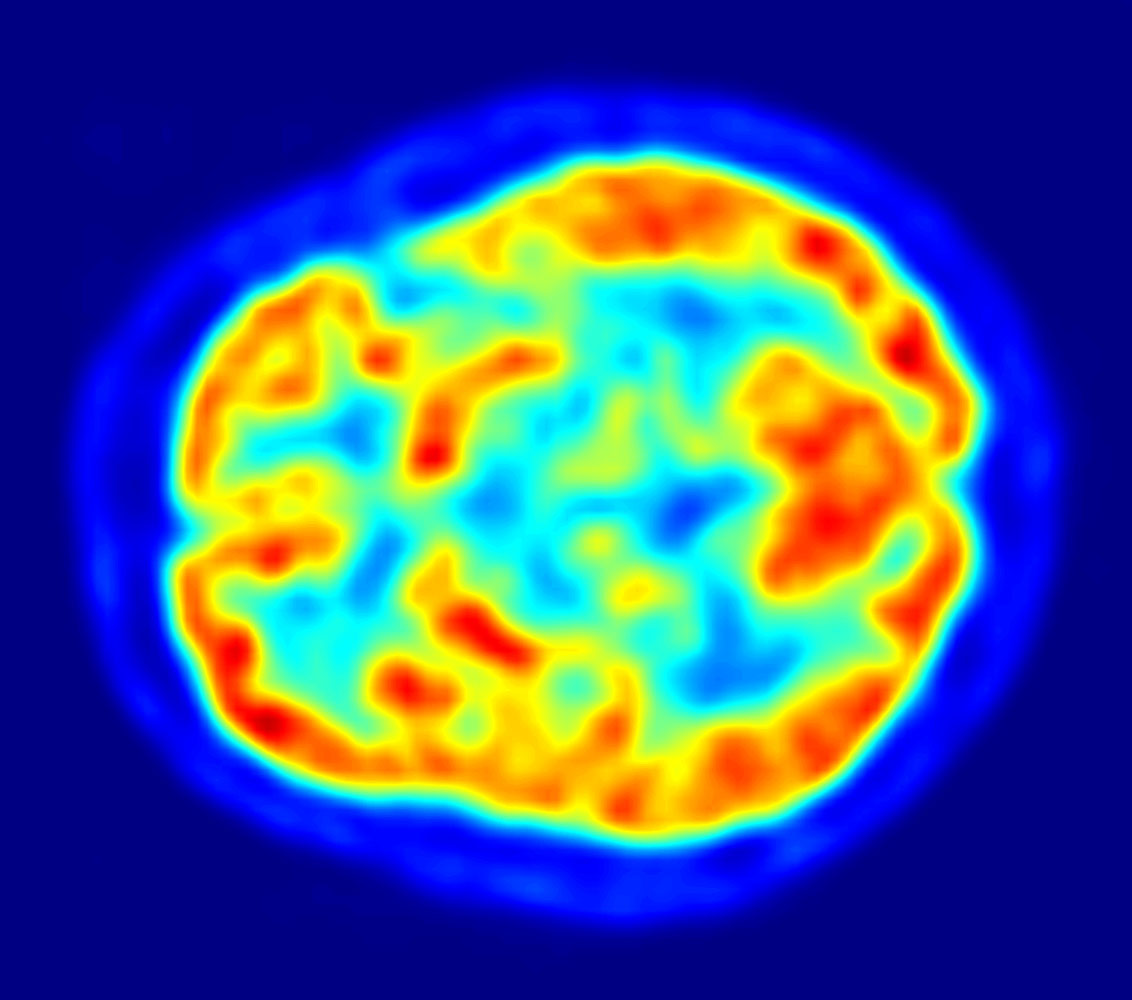 |
| PET scan of the brain |
Basically, PET scans can show those areas of the pituitary that are most metabolically active. Inactive areas are dark. So the idea is that I will have one of these scans while not on any kind of medication, which should show the whole pituitary lit up like a christmas tree, and then have another scan after three months on a higher dose of lanreotide, which should suppress the hormone production in the TSHoma. Any areas that go from being bright blue on the first scan to being dark in the second scan are probably tumour. Then, if the tumour is in an easily-accessible area of my head, I might have surgery again. If it's somewhere tricky to reach, I'll probably just continue to have regular injections of lanreotide indefinitely.
So I'm not having any more lanreotide injections for six weeks, so that it's definitely completely out of my system. And in the meantime they want to have me come in overnight one for some research tests on my metabolism and things. Essentially the hospital are collecting patients with pituitary tumours that produce TSH and studying us, so I am now officially a guinea pig.

_______________________________________________
*How could you ever think such a thing?
**I'm joking, they were very nice.
***Or just the pituitary stalk, but you don't get to use a word like "infundibular" every day.
Monday, 30 April 2012
Characteristics of Thyrotropinoma
I found an article on a website which lists the characteristics of thyrotropinoma (a.k.a TSH-oma, a.k.a the kind of pituitary tumour I have, which secretes thyroid-stimulating hormone) as follows:
"Thyrotropin secretion by thyrotropinomas is characterized by increased pulse frequency, delayed diurnal rhythm, enhanced basal secretion, spikiness, and disorderliness."
I deeply resent this. In fact, I am a very orderly person.
"Thyrotropin secretion by thyrotropinomas is characterized by increased pulse frequency, delayed diurnal rhythm, enhanced basal secretion, spikiness, and disorderliness."
I deeply resent this. In fact, I am a very orderly person.
Friday, 24 February 2012
Health Update
My poor little blog is really looking quite neglected! Fortunately I had a trip to the hospital yesterday. To see a doctor, I mean, not just for fun.
After being weighed and having my blood pressure done, I was called in to see.... a doctor who is not my endocrinologist. My endocrinologist seems to be displaying classic signs of pathological demand avoidance syndrome, in that every time someone arranges an appointment for him to see me, he disappears. He's been my endocrinologist for seven months now and I've only met him once, in passing, while I was having some blood tests. Perhaps he's put off by the possessive way in which I refer to him as "my" endocrinologist, but if so then he really needs to address the problem, or how can our relationship progress to the next level?*
Anyhow, we went through my latest blood test results and, being the marvel of medical science that I undoubtedly am,** my body appears to have pulled off the neat trick of producing higher levels of thyroid hormone during treatment with a thyroid-stimulating-hormone suppressing drug than before treatment. Apparently they're not concerned, because the tumour does produce quite low levels of TSH anyway and all my thyroid hormone results are within the upper normal range, so the only way they can tell what's going on is to look at the alpha subunit, a particular protein which tends to be over-produced by TSH-producing pituitary adenomas. The test result takes 4 weeks to come through, so we have to wait to find out where I am at the moment. Over the last year or so, though, they were:
Before surgery last April: 13.00
After surgery: 8.40
This January: 5.90
What it's meant to be: 1.00 or less.
So it could be worse, could be better! Fingers crossed that the lanreotide injections are doing the trick. I get to have another MRI sometime soon (they forgot to book it in for me, apparently I was supposed to have one in February) and to go back in 2 months. Oh, and they recommended I be referred to the Ear Nose and Throat team for my stupid malingering post-surgery sinusitis. You know. The sinusistis my GP told me couldn't be related at all to the surgery... oh well. I get to explore another hospital department. Whoop whoop!
____________________________________________
*i.e. the level at which he is actually in the room when I am supposed to be meeting him.
**Shut up, I so am.
After being weighed and having my blood pressure done, I was called in to see.... a doctor who is not my endocrinologist. My endocrinologist seems to be displaying classic signs of pathological demand avoidance syndrome, in that every time someone arranges an appointment for him to see me, he disappears. He's been my endocrinologist for seven months now and I've only met him once, in passing, while I was having some blood tests. Perhaps he's put off by the possessive way in which I refer to him as "my" endocrinologist, but if so then he really needs to address the problem, or how can our relationship progress to the next level?*

Anyhow, we went through my latest blood test results and, being the marvel of medical science that I undoubtedly am,** my body appears to have pulled off the neat trick of producing higher levels of thyroid hormone during treatment with a thyroid-stimulating-hormone suppressing drug than before treatment. Apparently they're not concerned, because the tumour does produce quite low levels of TSH anyway and all my thyroid hormone results are within the upper normal range, so the only way they can tell what's going on is to look at the alpha subunit, a particular protein which tends to be over-produced by TSH-producing pituitary adenomas. The test result takes 4 weeks to come through, so we have to wait to find out where I am at the moment. Over the last year or so, though, they were:
Before surgery last April: 13.00
After surgery: 8.40
This January: 5.90
What it's meant to be: 1.00 or less.
So it could be worse, could be better! Fingers crossed that the lanreotide injections are doing the trick. I get to have another MRI sometime soon (they forgot to book it in for me, apparently I was supposed to have one in February) and to go back in 2 months. Oh, and they recommended I be referred to the Ear Nose and Throat team for my stupid malingering post-surgery sinusitis. You know. The sinusistis my GP told me couldn't be related at all to the surgery... oh well. I get to explore another hospital department. Whoop whoop!
____________________________________________
*i.e. the level at which he is actually in the room when I am supposed to be meeting him.
**Shut up, I so am.
Friday, 3 February 2012
The Silence of the Gland: Diagnosed
It's been a while since I wrote the last post about my previous attempts at diagnosis, so I decided to man up and get the heck on with it. Yeah! USA! USA!*
Obviously my tales of pituitary surgery will be the most enthralling/gross, but who knows, maybe the events leading up to surgery will also be of interest to someone. If worst comes to the worst and I develop dementia in my old age, I guess I can read all about my exciting earlier life!
It had been determined that there was nothing wrong with my heart. My cardiologist ordered several blood tests and referred me to endocrinology.
This is where it gets dull and technical.
What I didn't know was that, up until that point, although I showed symptoms of hyperthyroidism, my doctors had only ordered blood tests which looked at my levels of thyroid-stimulating hormone, rather than the thyroid hormones themselves. TSH is produced by the pituitary, then it travels through the blood and spurs the thyroid gland to produce thyroid hormones. Usually, when hyperthyroidism is caused by a problem with the thyroid gland, you would expect the pituitary gland to produce only very low level of thyroid-stimulating hormone (TSH), as the body is trying to suppress the overproduction of thyroid hormones. However, my TSH tests had always come back within the "normal range", so it was assumed that hyperthyroidism was not the problem.
Then a letter dropped through my door from one of the consultant endocrinologists at the hospital. It informed me that my blood test results were "very unusual", and that they suspected I may have a rare condition called resistance to thyroid hormone (RTH). I was called into the hospital for further tests.
At the hospital, I met the consultant who had written the letter. To this day, he possesses one of the finest moustaches I have ever seen. Whilst I sat wondering what kind of scissors he used to trim it so neatly across his upper lip, he informed me that resistance to thyroid hormone is a rare genetic condition, in which most or all of the body's tissues do not respond normally to thyroid hormone. In some people, there are few symptoms as the whole body is equally resistant to the hormone, resulting in high levels of thyroid hormone in the blood but few issues associated with this; in others, the pituitary is more resistant than other tissues to thyroid hormone, leading to some symptoms of hyperthyroidism.
My blood tests showed that I had normal levels of thyroid stimulating hormone, but high levels of thyroid hormones T3 and T4 in my blood - indicating that my pituitary was not responding normally to the high thyroid levels. I was told that the only other possibility was that I might have a tumour on my pituitary which was producing TSH, a.k.a. a TSH-oma, but that this was even more absurdly rare than resistance to thyroid hormone and it was much more likely to be RTH.
I had more complex blood tests at the hospital, and they even took DNA samples to look for the particular mutation. Everything came back negative. The moustachioed doctor's main area of interest was resistance to thyroid hormone, so he passed my case to a colleague specialising in pituitary issues; it was pretty much certain by then that I had a pituitary adenoma, they just needed an MRI to show the tumour. Which they did - and I've already written a post about the MRI, which you can read here.
I don't really remember the phone call from my endocrinologist informing me that I did indeed have a pituitary macroadenoma, measuring 23mm by 19mm by some other measurement which I've forgotten. By that point I had had a chance to get used to the idea that I had a pituitary tumour, so the phone call was really just official confirmation with additional details. But I do remember calling my mum to tell her the news; I walked home from work the long way, through one of the big parks nearby.
After that it was a bit of a whirl of activity. I got the news just before Christmas 2010 and as soon as I arrived back in town after New Year's, I had to arrange to start lanreotide injections to reduce the amount of TSH the tumour was producing. They wanted me to have injections for three months, then a transsphenoidal hypophysectomy (that's pituitary surgery to you and me) immediately afterwards. I had to spend a day in hospital so that they could check that my pituitary was still producing other hormones at a normal level and wasn't about to collapse due to a lack of adrenocorticotropic hormone or something. It all passed in a bit of a blur; the idea of surgery was definitely what most occupied my mind in the intervening months...
UPDATE: You can click here to read about my experience having an MRI scan, or click here to go back and read about my earlier experiences trying to get a diagnosis.
____________________________________________________________
*Or something...

Obviously my tales of pituitary surgery will be the most enthralling/gross, but who knows, maybe the events leading up to surgery will also be of interest to someone. If worst comes to the worst and I develop dementia in my old age, I guess I can read all about my exciting earlier life!
LAST TIME ON PITUITARY ADEMOANER:
This is where it gets dull and technical.
What I didn't know was that, up until that point, although I showed symptoms of hyperthyroidism, my doctors had only ordered blood tests which looked at my levels of thyroid-stimulating hormone, rather than the thyroid hormones themselves. TSH is produced by the pituitary, then it travels through the blood and spurs the thyroid gland to produce thyroid hormones. Usually, when hyperthyroidism is caused by a problem with the thyroid gland, you would expect the pituitary gland to produce only very low level of thyroid-stimulating hormone (TSH), as the body is trying to suppress the overproduction of thyroid hormones. However, my TSH tests had always come back within the "normal range", so it was assumed that hyperthyroidism was not the problem.
Then a letter dropped through my door from one of the consultant endocrinologists at the hospital. It informed me that my blood test results were "very unusual", and that they suspected I may have a rare condition called resistance to thyroid hormone (RTH). I was called into the hospital for further tests.
At the hospital, I met the consultant who had written the letter. To this day, he possesses one of the finest moustaches I have ever seen. Whilst I sat wondering what kind of scissors he used to trim it so neatly across his upper lip, he informed me that resistance to thyroid hormone is a rare genetic condition, in which most or all of the body's tissues do not respond normally to thyroid hormone. In some people, there are few symptoms as the whole body is equally resistant to the hormone, resulting in high levels of thyroid hormone in the blood but few issues associated with this; in others, the pituitary is more resistant than other tissues to thyroid hormone, leading to some symptoms of hyperthyroidism.

My blood tests showed that I had normal levels of thyroid stimulating hormone, but high levels of thyroid hormones T3 and T4 in my blood - indicating that my pituitary was not responding normally to the high thyroid levels. I was told that the only other possibility was that I might have a tumour on my pituitary which was producing TSH, a.k.a. a TSH-oma, but that this was even more absurdly rare than resistance to thyroid hormone and it was much more likely to be RTH.
I had more complex blood tests at the hospital, and they even took DNA samples to look for the particular mutation. Everything came back negative. The moustachioed doctor's main area of interest was resistance to thyroid hormone, so he passed my case to a colleague specialising in pituitary issues; it was pretty much certain by then that I had a pituitary adenoma, they just needed an MRI to show the tumour. Which they did - and I've already written a post about the MRI, which you can read here.
I don't really remember the phone call from my endocrinologist informing me that I did indeed have a pituitary macroadenoma, measuring 23mm by 19mm by some other measurement which I've forgotten. By that point I had had a chance to get used to the idea that I had a pituitary tumour, so the phone call was really just official confirmation with additional details. But I do remember calling my mum to tell her the news; I walked home from work the long way, through one of the big parks nearby.
After that it was a bit of a whirl of activity. I got the news just before Christmas 2010 and as soon as I arrived back in town after New Year's, I had to arrange to start lanreotide injections to reduce the amount of TSH the tumour was producing. They wanted me to have injections for three months, then a transsphenoidal hypophysectomy (that's pituitary surgery to you and me) immediately afterwards. I had to spend a day in hospital so that they could check that my pituitary was still producing other hormones at a normal level and wasn't about to collapse due to a lack of adrenocorticotropic hormone or something. It all passed in a bit of a blur; the idea of surgery was definitely what most occupied my mind in the intervening months...
UPDATE: You can click here to read about my experience having an MRI scan, or click here to go back and read about my earlier experiences trying to get a diagnosis.
____________________________________________________________
*Or something...
Wednesday, 1 February 2012
The Wonderful Thing About Hormones, Is - SHUT THE HELL UP I HATE YOU
Now, as you may or may not have noticed, I am of the female persuasion. And one of the irritating things about this is that, when you get annoyed, no matter how legitimate your grievance, there are a few gentlemen dotted about the place who will always respond with "LOL IT MUST BE HER TIME OF THE MONTH HAHA WOMEN EH AND THEIR MYSTERIOUS HORMONAL PROBLEMS CAN'T LIVE WITH EM CAN'T KEEP EM ON A CONTINUOUS DIAZEPAM IV TO CORRECT THEIR CRAZY LADY ISSUES".
The trouble with this reaction is not just that it is stupid, but also that there is no way of responding to it that does not justify the accusation in the minds of the accusers. If you remain silent, it implies that you agree. If you punch them in the face, this is taken as further evidence of "hormonal imbalance", when in fact it is self-evidently the correct course of action.
But anyway, my experiences over the last year or so of undergoing treatment for my pituitary macroadenoma have certainly made me appreciate The Power of Hormones. And that's what we're going to learn about today.
So what are hormones? Obviously, as we all kind of slightly know, they're like chemically things that sort of slosh around your body, and if they get imbalanced then you go mental and start shouting at people and probably have a hot flush.
On closer examination, this sounds suspiciously like the theory of the four humours, so I turned to Wikipedia for a delightfully un-technical definition: "A hormone is a chemical released by a cell or gland in one part of the body that send out messages which affect cells in other parts of the organism… In essence, it is a chemical messenger that transports a signal from one cell to another."
The pituitary gland is a little gland at the base of the brain, and it sits around all day secreting nine different types of hormone which help to regulate growth, metabolism, water balance, lactation, aspects of preganancy and childbirth, body temperature, blood pressure and more. Given the complex feedback mechanisms required to keep all these hormones in balance, it's easy to see that when you develop a pituitary adenoma which secretes hormone(s), it throws everything completely out of whack.
Pituitary adenomas may secrete growth hormone (acromegaly), adrenocorticotropic hormone (Cushing's disease), prolactin (prolactinoma), or as in my case thyroid-stimulating hormone (TSH-oma). But then it gets complicated, because each hormone may interact with and affect the levels of other hormones as well. So, for example, in my case my body was producing too much thyroid-stimulating hormone, which caused my body to produce too much thyroid hormone, which had a knock-on effect on other hormones including prolactin and SHBG (technically not a hormone itself but a glycoprotein which affects the levels of other hormones in the body). It's basically like your body has spent ages laying out a complex pattern of dominoes on the floor, in which one starter domino needs to be flicked for them all to neatly fall over, and then some buffon comes tramping in wearing giant boots and stomps right in the middle of them. Lots of the dominoes fall over, some don't, and it's a bloody nightmare trying to set it all up again.
So, this time last year, my hormones were completely messed up and I was experiencing all kinds of crazy symptoms; rapid heartrate, hair falling out, massive appetite etc etc. And then I started treatment with lanreotide injections - the same injections that I'm having at the moment - and started to see an improvement in my TSH levels, which continued for several months and has only just got worse again (damnit!).
I already knew about The Power of Hormones. When your heart's going at 140bpm it's hard to ignore. But I hadn't really been prepared for the fact that when I began treatment, my changing hormone levels would affect me in more ways than simply improving my symptoms. The same thing has happened again in the past week or so since having my first injection. The first thing to arrive, just like last year, was the Crazy Appetite Swings. On Sunday, I had no appetite. I could happily have eaten nothing all day; just having a coffee in the morning made me feel really full. On Monday, I was back to normal; by Tuesday, I was completely ravenous.* There will probably be weeks of me alternately spending days completely uninterested in food, and then making like the Very Hungry Caterpillar and eating my way through anything placed in front of me, up to and including my own desk.
But the Crazy Hunger Swings are not so crazy as the Crazy Cat Lady Mood Swings. I guess I am fortunate in that my mood swings haven't tended too much towards the angry thus far,** but rather to the excessively emotional. For example, yesterday I was walking home from work, listening to my ipod as per usual, when all of a sudden and to my intense embarassment I burst into tears at a Beyonce song. I'm not going to say which song, out of shame, but the fact that I had this sudden surge of emotion struck me as rather hilarious and I then started giggling, so I was walking home laughing and weeping like a complete maniac and generally very glad I didn't see anyone I knew en route. I'm going to try my best not to adopt hundreds of cats and live in a bin liner, but at the rate I'm going the position of local madwoman may well be within my reach very shortly.
After a few more weeks of treatment, hopefully my hormones should be more in balance, but until that happy day every time my eyes well up with tears at the sight of a cute piglet in a teacup, I shall remember The Power Of Hormones.
_______________________________________________________________
*Admittedly not ravenous enough to eat the horrific curried parsnip soup I had for lunch at work, though.
**Although last year I would occasionally find myself becoming suddenly and irrationally furious if someone, say, dared to walk in front of me on the pavement. Happily, as soon as I recognised I was being silly the feeling would go away.***
***And if that didn't work, I used to just push them into the path of oncoming traffic.

The trouble with this reaction is not just that it is stupid, but also that there is no way of responding to it that does not justify the accusation in the minds of the accusers. If you remain silent, it implies that you agree. If you punch them in the face, this is taken as further evidence of "hormonal imbalance", when in fact it is self-evidently the correct course of action.
But anyway, my experiences over the last year or so of undergoing treatment for my pituitary macroadenoma have certainly made me appreciate The Power of Hormones. And that's what we're going to learn about today.
So what are hormones? Obviously, as we all kind of slightly know, they're like chemically things that sort of slosh around your body, and if they get imbalanced then you go mental and start shouting at people and probably have a hot flush.
On closer examination, this sounds suspiciously like the theory of the four humours, so I turned to Wikipedia for a delightfully un-technical definition: "A hormone is a chemical released by a cell or gland in one part of the body that send out messages which affect cells in other parts of the organism… In essence, it is a chemical messenger that transports a signal from one cell to another."
The pituitary gland is a little gland at the base of the brain, and it sits around all day secreting nine different types of hormone which help to regulate growth, metabolism, water balance, lactation, aspects of preganancy and childbirth, body temperature, blood pressure and more. Given the complex feedback mechanisms required to keep all these hormones in balance, it's easy to see that when you develop a pituitary adenoma which secretes hormone(s), it throws everything completely out of whack.
Pituitary adenomas may secrete growth hormone (acromegaly), adrenocorticotropic hormone (Cushing's disease), prolactin (prolactinoma), or as in my case thyroid-stimulating hormone (TSH-oma). But then it gets complicated, because each hormone may interact with and affect the levels of other hormones as well. So, for example, in my case my body was producing too much thyroid-stimulating hormone, which caused my body to produce too much thyroid hormone, which had a knock-on effect on other hormones including prolactin and SHBG (technically not a hormone itself but a glycoprotein which affects the levels of other hormones in the body). It's basically like your body has spent ages laying out a complex pattern of dominoes on the floor, in which one starter domino needs to be flicked for them all to neatly fall over, and then some buffon comes tramping in wearing giant boots and stomps right in the middle of them. Lots of the dominoes fall over, some don't, and it's a bloody nightmare trying to set it all up again.
So, this time last year, my hormones were completely messed up and I was experiencing all kinds of crazy symptoms; rapid heartrate, hair falling out, massive appetite etc etc. And then I started treatment with lanreotide injections - the same injections that I'm having at the moment - and started to see an improvement in my TSH levels, which continued for several months and has only just got worse again (damnit!).
I already knew about The Power of Hormones. When your heart's going at 140bpm it's hard to ignore. But I hadn't really been prepared for the fact that when I began treatment, my changing hormone levels would affect me in more ways than simply improving my symptoms. The same thing has happened again in the past week or so since having my first injection. The first thing to arrive, just like last year, was the Crazy Appetite Swings. On Sunday, I had no appetite. I could happily have eaten nothing all day; just having a coffee in the morning made me feel really full. On Monday, I was back to normal; by Tuesday, I was completely ravenous.* There will probably be weeks of me alternately spending days completely uninterested in food, and then making like the Very Hungry Caterpillar and eating my way through anything placed in front of me, up to and including my own desk.

But the Crazy Hunger Swings are not so crazy as the Crazy Cat Lady Mood Swings. I guess I am fortunate in that my mood swings haven't tended too much towards the angry thus far,** but rather to the excessively emotional. For example, yesterday I was walking home from work, listening to my ipod as per usual, when all of a sudden and to my intense embarassment I burst into tears at a Beyonce song. I'm not going to say which song, out of shame, but the fact that I had this sudden surge of emotion struck me as rather hilarious and I then started giggling, so I was walking home laughing and weeping like a complete maniac and generally very glad I didn't see anyone I knew en route. I'm going to try my best not to adopt hundreds of cats and live in a bin liner, but at the rate I'm going the position of local madwoman may well be within my reach very shortly.
After a few more weeks of treatment, hopefully my hormones should be more in balance, but until that happy day every time my eyes well up with tears at the sight of a cute piglet in a teacup, I shall remember The Power Of Hormones.

_______________________________________________________________
*Admittedly not ravenous enough to eat the horrific curried parsnip soup I had for lunch at work, though.
**Although last year I would occasionally find myself becoming suddenly and irrationally furious if someone, say, dared to walk in front of me on the pavement. Happily, as soon as I recognised I was being silly the feeling would go away.***
***And if that didn't work, I used to just push them into the path of oncoming traffic.
Friday, 20 January 2012
More Famous People With Lumps In Their Head.
So it turns out that by far my most popular post on this blog so far is the one entitled "Russell Watson, It's Not All About You". I don't know whether my readers just happen to have enduring personal grievances with Russell Watson, or are simply opera purists who object to his pop-operatic croonings. Or maybe it's something else.
So, I'm faced with a choice. In my relentless pursuit of pageviews, should I begin writing reams of personal abuse about Mr Watson, or simply continue to shine a spotlight on the other pituitary ademoaners of the world?
I choose the latter option, and not just because of Britain's vast and unyielding libel laws.*
And so, I present:
Once again I must apologise for the preponderance of people with acromegaly on this list! Acromegaly is an extremely rare illness, caused by a tumor on the pituitary gland which produces excessive growth hormone. However, acromegaly's symptoms are so visually striking that, especially if the illness occurs in childhood - when it will lead to massive growth in height (gigantism), as well as the growth of soft tissue and bone which occur in adult acromegaly - its sufferers are very visible. So-called "giants" are in demand for certain roles in the film and television industry, as well as certain sports where their height gives them an advantage. Consequently, it's relatively easy to find famous acromegaly sufferers, while celebrities who suffer from other kinds of pituitary adenoma may keep their diagnosis private.
I certainly think that it would be helpful if there were celebrities who were known to have Cushing's, or prolactinoma; it helps sufferers to feel that they're not alone, and emphasizes the fact that, while a pituitary adenoma can be a significant bloody nuisance, it's not the end of the world - and that there are plenty of other people going through the same problems.
Obviously I think it would be awesome if a famous person was known to have a TSH-oma/thyrotropinoma. But if that doesn't happen, well I guess I'll just have to step up to the celebrity line!**
Anyway, back to the point. Presenting:
Carel Struycken
Carel Struycken is an actor and an acromegaly sufferer; he stands seven foot tall. Born in the Netherlands in 1948, he's now 63 years old. You might recognise him from playing Lurch in the Addams Family films (click here for a picture!); he's also appeared in Star Trek: the Next Generation, Men In Black, and even Sargeant Pepper's Lonely Heart's Club Band. According to my trusty Wikipedia, he's interested in photography and the development of virtual reality systems. A pretty cool guy by all standards!
Richard Kiel
Richard Kiel is another well-known actor who suffers from acromegaly; his most famous role was as Jaws in the James Bond films. He's now largely retired, although he voiced a character in the animated film Tangled which came out in 2010, and he's written two books; one a memoir entitled Making It Big In The Movies, the second a historical novel co-authored with Pamela Wallace, about the life of Cassius Marcellus Clay, a 19th-Century abolitionist.
Scott Hamilton
Scott Hamilton, the Olympic gold medallist figure skater, is a craniopharyngioma sufferer. I've not previously mentioned craniopharyngiomas, but like pituitary adenomas they're a rare kind of benign pituitary tumour. They cause similar symptoms to pituitary adenomas; they can interfere with hormone production, although they will cause hormone deficits rather than overproduction of pituitary hormones, and they cause headaches and vision loss. They're most common in children and middle-aged adults; Scott Hamilton was diagnosed with craniopharyngioma aged 51. A remarkable guy, Hamilton won four consecutive World Championships and created Stars On Ice.
UPDATE: For those of you who just can't get enough of hearing about famous people with pituitary tumours, I've also written a post about famous people with Cushing's Disease, a post about famous women with acromegaly, my original post about Russell Watson that sparked this whole thing off, and my first post about famous tumourheads!
__________________________________________________
*Russell Watson, I love you.
**Admittedly, I haven't quite worked out how I'll achieve fame. Through my own line of edible greetings cards? By streaking at the London Olympics? For my charitable work with walruses? Ideas on a postcard please.
So, I'm faced with a choice. In my relentless pursuit of pageviews, should I begin writing reams of personal abuse about Mr Watson, or simply continue to shine a spotlight on the other pituitary ademoaners of the world?
I choose the latter option, and not just because of Britain's vast and unyielding libel laws.*
And so, I present:
A Panoply of Pituitary Problems, or: More Famous People With Lumps In Their Head.
Once again I must apologise for the preponderance of people with acromegaly on this list! Acromegaly is an extremely rare illness, caused by a tumor on the pituitary gland which produces excessive growth hormone. However, acromegaly's symptoms are so visually striking that, especially if the illness occurs in childhood - when it will lead to massive growth in height (gigantism), as well as the growth of soft tissue and bone which occur in adult acromegaly - its sufferers are very visible. So-called "giants" are in demand for certain roles in the film and television industry, as well as certain sports where their height gives them an advantage. Consequently, it's relatively easy to find famous acromegaly sufferers, while celebrities who suffer from other kinds of pituitary adenoma may keep their diagnosis private.
I certainly think that it would be helpful if there were celebrities who were known to have Cushing's, or prolactinoma; it helps sufferers to feel that they're not alone, and emphasizes the fact that, while a pituitary adenoma can be a significant bloody nuisance, it's not the end of the world - and that there are plenty of other people going through the same problems.
Obviously I think it would be awesome if a famous person was known to have a TSH-oma/thyrotropinoma. But if that doesn't happen, well I guess I'll just have to step up to the celebrity line!**
Anyway, back to the point. Presenting:
Carel Struycken
Carel Struycken is an actor and an acromegaly sufferer; he stands seven foot tall. Born in the Netherlands in 1948, he's now 63 years old. You might recognise him from playing Lurch in the Addams Family films (click here for a picture!); he's also appeared in Star Trek: the Next Generation, Men In Black, and even Sargeant Pepper's Lonely Heart's Club Band. According to my trusty Wikipedia, he's interested in photography and the development of virtual reality systems. A pretty cool guy by all standards!

Richard Kiel
Richard Kiel is another well-known actor who suffers from acromegaly; his most famous role was as Jaws in the James Bond films. He's now largely retired, although he voiced a character in the animated film Tangled which came out in 2010, and he's written two books; one a memoir entitled Making It Big In The Movies, the second a historical novel co-authored with Pamela Wallace, about the life of Cassius Marcellus Clay, a 19th-Century abolitionist.

Scott Hamilton
Scott Hamilton, the Olympic gold medallist figure skater, is a craniopharyngioma sufferer. I've not previously mentioned craniopharyngiomas, but like pituitary adenomas they're a rare kind of benign pituitary tumour. They cause similar symptoms to pituitary adenomas; they can interfere with hormone production, although they will cause hormone deficits rather than overproduction of pituitary hormones, and they cause headaches and vision loss. They're most common in children and middle-aged adults; Scott Hamilton was diagnosed with craniopharyngioma aged 51. A remarkable guy, Hamilton won four consecutive World Championships and created Stars On Ice.
 |
| Hamilton's last performance on Stars On Ice |
UPDATE: For those of you who just can't get enough of hearing about famous people with pituitary tumours, I've also written a post about famous people with Cushing's Disease, a post about famous women with acromegaly, my original post about Russell Watson that sparked this whole thing off, and my first post about famous tumourheads!
__________________________________________________
*Russell Watson, I love you.
**Admittedly, I haven't quite worked out how I'll achieve fame. Through my own line of edible greetings cards? By streaking at the London Olympics? For my charitable work with walruses? Ideas on a postcard please.
Thursday, 5 January 2012
The Future's Orange...
...and not just because I've applied the wrong shade of fake tan.*
Yesterday, while working hard at work/deleting all the pointless emails I got over Christmas/eating the leftover Christmas chocolates brought in by a coworker, I received a phone call from the hospital.
This happens about once a month, and I have developed a clear routine on such ocassions, as follows:
1. Almost choke on my cup of tea in surprise
i. Search for somewhere to put my mug amongst all the paperwork on my desk***
2. Scrabble frantically through my handbag to find my phone, whilst cursing either:
i. my annoyingly raucous ringtone
OR
ii. the piles of crap and receipts filling my bag and obstructing my progress.
3. Sprint out of the room into the corridor whilst both:
i. answering the phone
AND
ii. apologising to my coworkers for disrupting them
4. My endocrinologist says: "Hiya, is now an ok time to talk?"
and
5. I LIE THROUGH MY TEETH and respond "Yes, now is fine, no problem."
Anyhow, the phone duly answered, my endocrinologist informed me that he was calling because, having consulted with his colleagues about me, they have decided that I should start having injections of somatostatin analogue this month - specifically lanreotide (brand name, Somatuline Autogel). They will be at a lower dose than the injections I had previously (I was on 90mg, now I will be on 60mg), which hopefully means fewer side effects. I wasn't too badly affected last time, just had some stomach cramps and nausea for a couple days after each injection - but lanreotide's side effects can be pretty nasty, and I saw on the Pituitary Foundation's forums that some people on these injections have to go on a fat-free diet for the first week after each dose. I am hoping this will not happen, although perhaps I'm more likely to get side effects this time as my thyroid hormones are only slightly above normal, whereas previously they were decidedly eccentric. Interestingly, my endocrinologist mentioned that there's another somatostatin analogue formulation which tends to give people fewer side effects, so if I react badly to it there's the option of switching.
Of course, it all sounds so simple on the phone. "I will call your doctor," my endocrinologist said merrily, "then you can go for blood tests next week and have the injection."
Easy, I hear you cry!
WRONG
These injections are great because they fix me, but they sure are a hassle. Just as with answering my phone, there is an excessively complex procedure to follow before they can begin:
1. I go to my local GP's to get the initial prescription.
2. My doctor looks at me darkly and writes out the lanreotide prescription, muttering "oh my god, it's so expensive... so expensive..." and weeping gently into his rather ugly tie.
3. I take the prescription to the pharmacy and hand it over to the pharmacist, saying "I imagine you'll have to order this one in."
i. The pharmacist gives me a patronising smile and says "No, no, I'll see if we have it in stock first".
ii. The pharmacist looks at the prescription.
iii. The pharacist's brow wrinkles deeply.
iv. The pharmacist orders it in, saying "it'll probably be here in a week. I'll give you a call when we have it."
4. A week and a half later, the pharmacy calls.
5. I go to collect the lanreotide from the pharmacy (it comes in a pre-filled syringe, which I guess is handy).
6. I take the injection straight to the GP's, because it has to be kept refrigerated
i. I explain twice to the receptionist why I'm trying to give it to her
ii. Eventually, she accepts it and puts it in the practice fridge
iii. The receptionist then stops me as I'm walking out of the door, crying, "Have you written your name on it?"
iv. I point to the giant pharmacy sticker on the front of the box, listing my name, age, gender, address, GP's name, GP's address, bank details, sexual preferences and preferred pizza toppings
7. I am finally able to book myself an appointment to actually have the injection
8. Several days later, I return to have the injection, and several blood tests beforehand
i. It is a GIANT needle, I mean literally, even the nurses comment on how giant it is
ii. The nurse has forgotten to leave it out of the fridge to warm it up a bit, and consequently it's like having a stinging-nettle frappe injected into your hip
9. I go home and feel ill for two days
10. REPEAT PROCESS
I realise this is the most whiney post ever about a treatment which hopefully should leave me feeling much better.**** In actual fact, I am genuinely quite looking forward to going on lanreotide again; hopefully it might finally stop my hair falling out, sort out my heartrate and generally leave me feeling both pinky and perky. I just wish the process of getting hold of it didn't involve three trips to the doctors and two to the pharmacy each month.
Interestingly, Wikipedia tells me that in the US, lanreotide is only indicated for the treatment of acromegaly; it seems to imply that it is only used against thyrotropic adenomas/TSHomas in the UK, although I don't know whether that's actually true; it's obviously a logical treatment choice, as somatostatins inhibit the production of thyroid stimulating hormone as well as growth hormone. As well as pituitary adenomas, lanreotide is also used to treat symptoms of neuroendocrine tumours; the kind of tumour that Steve Jobs suffered from.
____________________________________________________
*Incidentally, I don't use fake tan. I am pale and interesting.**
**Well. One out of two isn't bad.
*** I have NO IDEA what most of the paperwork on my desk is. I inherited it from my predecessor and it was never explained to me. Consequently, I don't know if it's too important to throw away.
****Fun fact: when first typing this sentence something broke in my brain and it read "...an injection which should leave me stealing much better". Because at the moment, I am a rubbish pickpocket.

Yesterday, while working hard at work/deleting all the pointless emails I got over Christmas/eating the leftover Christmas chocolates brought in by a coworker, I received a phone call from the hospital.
This happens about once a month, and I have developed a clear routine on such ocassions, as follows:
1. Almost choke on my cup of tea in surprise

i. Search for somewhere to put my mug amongst all the paperwork on my desk***
2. Scrabble frantically through my handbag to find my phone, whilst cursing either:
i. my annoyingly raucous ringtone
OR
ii. the piles of crap and receipts filling my bag and obstructing my progress.
3. Sprint out of the room into the corridor whilst both:
i. answering the phone
AND
ii. apologising to my coworkers for disrupting them
4. My endocrinologist says: "Hiya, is now an ok time to talk?"
and
5. I LIE THROUGH MY TEETH and respond "Yes, now is fine, no problem."
Anyhow, the phone duly answered, my endocrinologist informed me that he was calling because, having consulted with his colleagues about me, they have decided that I should start having injections of somatostatin analogue this month - specifically lanreotide (brand name, Somatuline Autogel). They will be at a lower dose than the injections I had previously (I was on 90mg, now I will be on 60mg), which hopefully means fewer side effects. I wasn't too badly affected last time, just had some stomach cramps and nausea for a couple days after each injection - but lanreotide's side effects can be pretty nasty, and I saw on the Pituitary Foundation's forums that some people on these injections have to go on a fat-free diet for the first week after each dose. I am hoping this will not happen, although perhaps I'm more likely to get side effects this time as my thyroid hormones are only slightly above normal, whereas previously they were decidedly eccentric. Interestingly, my endocrinologist mentioned that there's another somatostatin analogue formulation which tends to give people fewer side effects, so if I react badly to it there's the option of switching.
Of course, it all sounds so simple on the phone. "I will call your doctor," my endocrinologist said merrily, "then you can go for blood tests next week and have the injection."
Easy, I hear you cry!
WRONG
These injections are great because they fix me, but they sure are a hassle. Just as with answering my phone, there is an excessively complex procedure to follow before they can begin:
A Spotter's Guide to Somatuline Autogel Injections:
1. I go to my local GP's to get the initial prescription.
2. My doctor looks at me darkly and writes out the lanreotide prescription, muttering "oh my god, it's so expensive... so expensive..." and weeping gently into his rather ugly tie.

3. I take the prescription to the pharmacy and hand it over to the pharmacist, saying "I imagine you'll have to order this one in."
i. The pharmacist gives me a patronising smile and says "No, no, I'll see if we have it in stock first".
ii. The pharmacist looks at the prescription.
iii. The pharacist's brow wrinkles deeply.
iv. The pharmacist orders it in, saying "it'll probably be here in a week. I'll give you a call when we have it."
4. A week and a half later, the pharmacy calls.
5. I go to collect the lanreotide from the pharmacy (it comes in a pre-filled syringe, which I guess is handy).
6. I take the injection straight to the GP's, because it has to be kept refrigerated
i. I explain twice to the receptionist why I'm trying to give it to her
ii. Eventually, she accepts it and puts it in the practice fridge
iii. The receptionist then stops me as I'm walking out of the door, crying, "Have you written your name on it?"
iv. I point to the giant pharmacy sticker on the front of the box, listing my name, age, gender, address, GP's name, GP's address, bank details, sexual preferences and preferred pizza toppings
7. I am finally able to book myself an appointment to actually have the injection
8. Several days later, I return to have the injection, and several blood tests beforehand
i. It is a GIANT needle, I mean literally, even the nurses comment on how giant it is
ii. The nurse has forgotten to leave it out of the fridge to warm it up a bit, and consequently it's like having a stinging-nettle frappe injected into your hip
9. I go home and feel ill for two days
10. REPEAT PROCESS
I realise this is the most whiney post ever about a treatment which hopefully should leave me feeling much better.**** In actual fact, I am genuinely quite looking forward to going on lanreotide again; hopefully it might finally stop my hair falling out, sort out my heartrate and generally leave me feeling both pinky and perky. I just wish the process of getting hold of it didn't involve three trips to the doctors and two to the pharmacy each month.
Interestingly, Wikipedia tells me that in the US, lanreotide is only indicated for the treatment of acromegaly; it seems to imply that it is only used against thyrotropic adenomas/TSHomas in the UK, although I don't know whether that's actually true; it's obviously a logical treatment choice, as somatostatins inhibit the production of thyroid stimulating hormone as well as growth hormone. As well as pituitary adenomas, lanreotide is also used to treat symptoms of neuroendocrine tumours; the kind of tumour that Steve Jobs suffered from.
____________________________________________________
*Incidentally, I don't use fake tan. I am pale and interesting.**
**Well. One out of two isn't bad.
*** I have NO IDEA what most of the paperwork on my desk is. I inherited it from my predecessor and it was never explained to me. Consequently, I don't know if it's too important to throw away.
****Fun fact: when first typing this sentence something broke in my brain and it read "...an injection which should leave me stealing much better". Because at the moment, I am a rubbish pickpocket.
Saturday, 17 December 2011
My MRI Experience: Stuck In A Moment. And Also A Tube.
Today I thought I'd continue my story of diagnosis and treatment, admittedly with a slight gap in continuity from my last post, by talking about the first MRI (Magnetic Resonance Imaging) scan I had. Brain MRI scans are pretty cool; it seems very weird to be able to look at a picture of the internal apparatus with which you are looking at the picture of the internal apparatus that you're using to - well, you know what I mean. Brain MRIs get recursive fast!
Around this time last year, having had my introduction to my local endocrinology department, blood tests had decreed that I did not suffer from Resistance to Thyroid Hormone and therefore the doctors knew that I almost certainly had a pituitary adenoma producing Thyroid Stimulating Hormone (TSH-oma).
Endocrinologists tend to leave off MRI scanning of the pituitary gland when diagnosing these conditions until they've ruled out all other options. This isn't a Daily Mail-worthy example of NHS cutbacks; it's because small, harmless pituitary tumours are quite common. Finding one on an MRI scan might lead doctors to wrongly diagnose a pituitary condition like TSH-oma or Cushing's disease, when in fact the tumor is not what's causing the problem.*
I knew that things must be reasonably serious when my endocrinologists allowed me to jump the queue for MRIs at the hospital. In fact, I jumped it so completely that the NHS paid for me to have my MRI done immediately at a nearby private hospital, because there were no scanners available at the NHS hospital for a few weeks. It was slightly disconcerting, not just for the speed at which it all happened, but also because I had to travel to the mystery hospital on my own, by bus, to the middle of the countryside. The bus driver dropped me off with another girl who was fortunately also headed for the private hospital, and we were left in a random village with no signposts or map. Eventually we got there, and I heartily thanked the paranoia which had led me to leave home an hour earlier than I needed to.
Before my MRI, I didn't know much about them, apart from the fact that, as the scans work through big old magnets - hence "magnetic resonance imaging" - you have to remove all metal from your body or risk it moving around in the magnetic field; consequently, no pacemakers allowed. I wanted to know what to expect, so I scoured the NHS website and interrogated family members who had already had one. They said: you take off your watch, you lie in a tube, it's loud, you have to stay still, the technician shouts "stay still, damn you!", you leave.
NOW JUST HOLD YOUR HORSES.
An account such as the one above leaves out some crucial information for folk like me. For one thing, I didn't realise that, as it was my general cranial area being scanned, they would trap my head in a box stuffed with cushions to prevent it from wiggling. Then, head duly caged, you slowly roll backwards into the MRI scanner. Anyone who is claustrophobic would not be a fan, although they gave me a panic button which I could beep if I needed rescuing.
In fairness, the staff know that this is a freaky experience and repeatedly asked "Are you ok?". Towards the end of the scan, I also realised that the machine had a reassuring mirror placed just above my eyes, which means that patients can see the MRI technicians at work through a window at the back of the room. Or at least, patients who aren't stupidly and entirely blind without their glasses, like me. I am wildly shortsighted and consequently, even once I had realised that it was a mirror, and even though it was really pretty close to my face, all I could see was pinkish blurs.
The radiography folk gave me some sexy earplugs to wear, to block out the noise of the MRI scanner going mental with magnets. Unfortunately, these kept falling out and, because my head was wedged in with cushions, there was no way of putting them back in. MRI scanners really are incredibly loud, and it's not just the loudness that's the issue - the noises they make are weird and erratic, much like a young Kate Bush. When it all goes quiet, you find yourself tensing in anticipation of the next staccato burst of noise, and when it suddenly starts shrieking in your ears it's pretty tricky not to jump out of your skin, especially if you're pumped up with thyroid hormone and thus pretty jumpy anyway.
The technicians do not like this.
Partway through (the MRI took about 40 minutes, I think) I was pulled out of the machine. My heart leapt - time goes a bit screwy when you're in a weird screaming machine - perhaps it was finished? But no, they just wanted to inject contrast dye into my arm and bung me back in.
I whiled away the time by trying to remember and recite poems in my head. I did "The Jabberwocky" a couple of times, the prologue to Romeo and Juliet, my favourite speech from Macbeth, a couple of poems and odd verses from Siegfried Sassoon, and pretty much anything else I could remember. I was very bored. Pro-tip: learn some new poetry before having an MRI and then take advantage of the time to test your memory.
Anyhow, I realise I may have made my MRI scan sound like a horrific experience** but actually it was totally fine, and I much preferred it to having endless blood tests at the hospital. I admit I was irrationally afraid that there would be a previously unknown bit of metal embedded somewhere in my body that would rip out in a bloody mess.
Fortunately, this did not occur.
________________________________________________________________
*Such tumours are known as "incidentalomas".
**Or I may have just made myself sound like a massive whinger...
Around this time last year, having had my introduction to my local endocrinology department, blood tests had decreed that I did not suffer from Resistance to Thyroid Hormone and therefore the doctors knew that I almost certainly had a pituitary adenoma producing Thyroid Stimulating Hormone (TSH-oma).
Endocrinologists tend to leave off MRI scanning of the pituitary gland when diagnosing these conditions until they've ruled out all other options. This isn't a Daily Mail-worthy example of NHS cutbacks; it's because small, harmless pituitary tumours are quite common. Finding one on an MRI scan might lead doctors to wrongly diagnose a pituitary condition like TSH-oma or Cushing's disease, when in fact the tumor is not what's causing the problem.*

I knew that things must be reasonably serious when my endocrinologists allowed me to jump the queue for MRIs at the hospital. In fact, I jumped it so completely that the NHS paid for me to have my MRI done immediately at a nearby private hospital, because there were no scanners available at the NHS hospital for a few weeks. It was slightly disconcerting, not just for the speed at which it all happened, but also because I had to travel to the mystery hospital on my own, by bus, to the middle of the countryside. The bus driver dropped me off with another girl who was fortunately also headed for the private hospital, and we were left in a random village with no signposts or map. Eventually we got there, and I heartily thanked the paranoia which had led me to leave home an hour earlier than I needed to.

Before my MRI, I didn't know much about them, apart from the fact that, as the scans work through big old magnets - hence "magnetic resonance imaging" - you have to remove all metal from your body or risk it moving around in the magnetic field; consequently, no pacemakers allowed. I wanted to know what to expect, so I scoured the NHS website and interrogated family members who had already had one. They said: you take off your watch, you lie in a tube, it's loud, you have to stay still, the technician shouts "stay still, damn you!", you leave.
NOW JUST HOLD YOUR HORSES.
An account such as the one above leaves out some crucial information for folk like me. For one thing, I didn't realise that, as it was my general cranial area being scanned, they would trap my head in a box stuffed with cushions to prevent it from wiggling. Then, head duly caged, you slowly roll backwards into the MRI scanner. Anyone who is claustrophobic would not be a fan, although they gave me a panic button which I could beep if I needed rescuing.

In fairness, the staff know that this is a freaky experience and repeatedly asked "Are you ok?". Towards the end of the scan, I also realised that the machine had a reassuring mirror placed just above my eyes, which means that patients can see the MRI technicians at work through a window at the back of the room. Or at least, patients who aren't stupidly and entirely blind without their glasses, like me. I am wildly shortsighted and consequently, even once I had realised that it was a mirror, and even though it was really pretty close to my face, all I could see was pinkish blurs.
The radiography folk gave me some sexy earplugs to wear, to block out the noise of the MRI scanner going mental with magnets. Unfortunately, these kept falling out and, because my head was wedged in with cushions, there was no way of putting them back in. MRI scanners really are incredibly loud, and it's not just the loudness that's the issue - the noises they make are weird and erratic, much like a young Kate Bush. When it all goes quiet, you find yourself tensing in anticipation of the next staccato burst of noise, and when it suddenly starts shrieking in your ears it's pretty tricky not to jump out of your skin, especially if you're pumped up with thyroid hormone and thus pretty jumpy anyway.
The technicians do not like this.
Partway through (the MRI took about 40 minutes, I think) I was pulled out of the machine. My heart leapt - time goes a bit screwy when you're in a weird screaming machine - perhaps it was finished? But no, they just wanted to inject contrast dye into my arm and bung me back in.

I whiled away the time by trying to remember and recite poems in my head. I did "The Jabberwocky" a couple of times, the prologue to Romeo and Juliet, my favourite speech from Macbeth, a couple of poems and odd verses from Siegfried Sassoon, and pretty much anything else I could remember. I was very bored. Pro-tip: learn some new poetry before having an MRI and then take advantage of the time to test your memory.
Anyhow, I realise I may have made my MRI scan sound like a horrific experience** but actually it was totally fine, and I much preferred it to having endless blood tests at the hospital. I admit I was irrationally afraid that there would be a previously unknown bit of metal embedded somewhere in my body that would rip out in a bloody mess.
Fortunately, this did not occur.
________________________________________________________________
*Such tumours are known as "incidentalomas".
**Or I may have just made myself sound like a massive whinger...
Thursday, 15 December 2011
Famous People with Cushing's Disease?
Being a blogger with a TSHoma (a.k.a. TSH-oma,* a.k.a. thyrotropinoma, a.k.a. a freak) has its pros and cons. On the plus side, as far as I can tell I have definitely found a niche in the market - no mean feat, given the number of enthusiastic and generally excellent blogs written by people with everything from diabetes to acromegaly. On the down side, there's none of that nice cosy caring and chit-chat over tea and lanreotide injections that you get from support groups with other people. People who understand how rubbish it is that your heart's going too fast/your hands have grown enormously/your nose just fell off. So being me, I have been ambling around the internet, happily barging into other people's support groups and demanding to be paid attention because I have a tumour on my pituitary gland too.
A little while ago I found the lovely Acromegaly Bloggers, and more recently bumbled across a blogging group for people with Cushing's disease, called Cushie Bloggers. People with Cushing's disease can at least console themselves with the fact that referring to themselves as "cushies" makes them sound incredibly cute and fluffy and generally charming.
But anyway, finding the blog and reading the experiences of some of the bloggers got me thinking: in an earlier post, I went on a hunt for famous people with pituitary adenomas. Obviously there were no cases of TSHoma/thyrotropinoma - that would be too much to hope for. But there's Russell Watson with his unspecified adenoma, and numerous celebs with acromegaly - even more than I included in my post, in fact: acromegalovelies are all over the shop, from Andre the Giant to Pio Pico.
But where are all the famous Cushing's sufferers?
I've found it difficult to find information specifically on the incidence** of Cushing's Disease, probably due in part to the fact that it's a subtype, as it were, of Cushing's Syndrome, accounting for about 70% of endogenous Cushing's syndrome cases. I have found the incidence of such new cases quoted as about 13 cases per million, so we're talking 9 new cases per million per year, compared to an incidence of 3 - 4 new cases of acromegaly per million, per year. So it is seemingly rather more common than acomegaly, although the massive tendency towards underdiagnosis of both illnesses (and TSH-omas as well) makes these rather shaky figures.
Given that it's relatively easy to find well-known figures suffering from acromegaly (even outside the field of sports, where young sufferers' large frames could be considered to give them an attractive advantage in sports like basketball or wrestling) and given that Cushing's is more common, you'd think it would be easier to find a celebrity with Cushing's. (You'd also expect to find people with prolactinomas, but I suspect that (particularly male) celebrities might prefer to generalise prolactinomas as "tumours" rather than publicly imply that they're leaking milk from their manboobs.) Celebrities diagnosed with Cushing's, on the other hand, are (I would have thought) surely be more likely to publicise their condition, to explain that any excess weight gain was not due to greed or laziness but a medical condition.
So where are they all? I've looked around the place and all I can find is a vague hint that Elvis may have had Cushing's syndrome (as distinct from the disease, Cushing's syndrome does not necessarily imply a pituitary tumour, but could be caused by steroid overdose or adrenal tumours etc). If true it would certainly be something of a PR coup for cushies, but one article in the Daily Mail is not much to go on. The Daily Mail seems to have a little bit of a penchant for Cushing's Disease (is there a sufferer amongst the editorial staff?) and I've also found an article suggesting that King Henry VIII may have had Cushing's Disease. Who knows? When it comes to historical figures, it's fun to speculate, but speculation is all it can remain.
The only - literally the only - modern-day sufferer I've found who comes close to the designation of "celebrity" is J. Jordan Bruns, an artist featured in this article - but he's not exactly a household name, lovely though his art is.
Come on cushies, come out from the woodwork!
UPDATE: If you're interested in reading about famous people who suffer from pituitary tumours, see my other posts looking at famous pituitary ademoaners here and here; my post about Russell Watson, the opera singer who had a pituitary tumour; or check out my post looking at famous women with acromegaly.
___________________________________________________
*Never doubt the power of punctuation. If you search for the wrong one, Google will offer you Tshoki Tshoma's naked photos. Nice.
** I would prefer to write about prevalance but I've found it harder to find figures for that.
A little while ago I found the lovely Acromegaly Bloggers, and more recently bumbled across a blogging group for people with Cushing's disease, called Cushie Bloggers. People with Cushing's disease can at least console themselves with the fact that referring to themselves as "cushies" makes them sound incredibly cute and fluffy and generally charming.

But anyway, finding the blog and reading the experiences of some of the bloggers got me thinking: in an earlier post, I went on a hunt for famous people with pituitary adenomas. Obviously there were no cases of TSHoma/thyrotropinoma - that would be too much to hope for. But there's Russell Watson with his unspecified adenoma, and numerous celebs with acromegaly - even more than I included in my post, in fact: acromegalovelies are all over the shop, from Andre the Giant to Pio Pico.
But where are all the famous Cushing's sufferers?
I've found it difficult to find information specifically on the incidence** of Cushing's Disease, probably due in part to the fact that it's a subtype, as it were, of Cushing's Syndrome, accounting for about 70% of endogenous Cushing's syndrome cases. I have found the incidence of such new cases quoted as about 13 cases per million, so we're talking 9 new cases per million per year, compared to an incidence of 3 - 4 new cases of acromegaly per million, per year. So it is seemingly rather more common than acomegaly, although the massive tendency towards underdiagnosis of both illnesses (and TSH-omas as well) makes these rather shaky figures.
Given that it's relatively easy to find well-known figures suffering from acromegaly (even outside the field of sports, where young sufferers' large frames could be considered to give them an attractive advantage in sports like basketball or wrestling) and given that Cushing's is more common, you'd think it would be easier to find a celebrity with Cushing's. (You'd also expect to find people with prolactinomas, but I suspect that (particularly male) celebrities might prefer to generalise prolactinomas as "tumours" rather than publicly imply that they're leaking milk from their manboobs.) Celebrities diagnosed with Cushing's, on the other hand, are (I would have thought) surely be more likely to publicise their condition, to explain that any excess weight gain was not due to greed or laziness but a medical condition.
So where are they all? I've looked around the place and all I can find is a vague hint that Elvis may have had Cushing's syndrome (as distinct from the disease, Cushing's syndrome does not necessarily imply a pituitary tumour, but could be caused by steroid overdose or adrenal tumours etc). If true it would certainly be something of a PR coup for cushies, but one article in the Daily Mail is not much to go on. The Daily Mail seems to have a little bit of a penchant for Cushing's Disease (is there a sufferer amongst the editorial staff?) and I've also found an article suggesting that King Henry VIII may have had Cushing's Disease. Who knows? When it comes to historical figures, it's fun to speculate, but speculation is all it can remain.
The only - literally the only - modern-day sufferer I've found who comes close to the designation of "celebrity" is J. Jordan Bruns, an artist featured in this article - but he's not exactly a household name, lovely though his art is.
Come on cushies, come out from the woodwork!
UPDATE: If you're interested in reading about famous people who suffer from pituitary tumours, see my other posts looking at famous pituitary ademoaners here and here; my post about Russell Watson, the opera singer who had a pituitary tumour; or check out my post looking at famous women with acromegaly.
___________________________________________________
*Never doubt the power of punctuation. If you search for the wrong one, Google will offer you Tshoki Tshoma's naked photos. Nice.
** I would prefer to write about prevalance but I've found it harder to find figures for that.
Tuesday, 13 December 2011
Let's Get Technical, Baby
Apologies for my lack of posting lately! I have been doing exams. They are now over, and my new excuse is that it's Christmas (in case you hadn't noticed). But, as of a phone call from the hospital on Wednesday last week, I have been meaning to give an update on my health. In short: my thyroid stimulating hormone levels are still normal, but I will have to start new treatment shortly... because I have high levels of the TSH alpha subunit.
"The what-now? What in god's name is that?" I hear you cry.
Don't cry.
My endocrinologists have always been cagey whenever I've tried to get them to explain what the alpha subunit actually is,* although in fairness, my shrewd personal judgement leads me to believe that this is probably less because it's a dark and terrible secret and more because they're not paid to teach biochemistry.
Anyway, the combined powers of Wikipedia and Google have provided me with the answer: it turns out that thyroid-stimulating hormone (TSH) is a dimer; a chemical compound of two identical or similar monomers: in this case, the alpha subunit, and the beta subunit. No-one wants to get bogged down in the detail, so at this point I promise not to use the word "glycoprotein" without extreme provocation.**
So: TSH is made of two kinds of stuff. And as it turns out, TSHomas (pituitary tumours which produce TSH) have a bit of a habit of producing more of the alpha subunit than would normally be expected. Normally you would expect the ratio of free alpha subunit to TSH to be less than 1. Before my surgery in April, my ratio of alpha subunit to TSH was 14:1. Currently, it's 7:1.
Obviously, 7:1 is better than 14:1. However, it is equally obviously Not Quite Right.*** Consequently it seems likely that the TSHoma is still active, and even though my total thyroid-stimulating hormone levels are within normal limits, it may still be secreting some TSH as well. Active tumour = growing tumour.
So I'm going to start having injections of some kind of somatostatin analogue again. I haven't really written about this up to now (it's on my list, promise) but for three months before my operation last year I was having monthly injections of Somatuline, the brand name for lanreotide. It's a synthetic form of a hormone naturally released by the hypothalamus,**** which inhibits the production of TSH and growth hormone, and which is used to treat pituitary adenomas which are releasing either one of those hormones. If you're lucky, it can shrink the tumours a bit - at the least, it should check their growth and can also help to make their structure less fibrous, which makes it easier for surgeons to chop them up.
It's also super expensive. When my GP first looked up how much it cost after my endocrinologist had requested a prescription, he laughed in a slightly manic way for about five minutes at the price. Awkward.
I'm going to start the injections again, probably in January, for three months, to assess whether they shrink the tumour at all and whether they bring down the high levels of alpha subunit in my blood. I'm not massively looking forward to starting again - the injections mess with your body a bit, last time I felt nauseous for three days after the first one, and they're a bit of a hassle because you have to order the injections a week in advance from the pharmacy, then drop them off at your GP's because they have to be kept in the fridge. The injections sting, they have to use a massive needle because the stuff is so thick, and you end up with a lump in your hip - basically it's injected under the skin where it sits and slowly decreases in size over the month as it gets absorbed into your system.
On the plus side, having these injections should (in theory) get rid of the last of my symptoms. And that would be very nice. I am really quite bored now of my hair falling out/heart randomly getting overexcited/headaches. As for what happens after three months, who knows. The injections are a possible long term treatment option although they are an expensive hassle and they're quite likely to give you gallstones sooner or later. So that brings you back to surgery/radiotherapy. Oi vey.
____________________________________
*Apart from an excellent title for some kind of spy film.
**Incidentally, the α subunit is thought to be the effector region responsible for stimulation of adenylate cyclase
***I must stop using these technical medical phrases.
****Somatostatin.Lol.
"The what-now? What in god's name is that?" I hear you cry.
Don't cry.

My endocrinologists have always been cagey whenever I've tried to get them to explain what the alpha subunit actually is,* although in fairness, my shrewd personal judgement leads me to believe that this is probably less because it's a dark and terrible secret and more because they're not paid to teach biochemistry.
Anyway, the combined powers of Wikipedia and Google have provided me with the answer: it turns out that thyroid-stimulating hormone (TSH) is a dimer; a chemical compound of two identical or similar monomers: in this case, the alpha subunit, and the beta subunit. No-one wants to get bogged down in the detail, so at this point I promise not to use the word "glycoprotein" without extreme provocation.**
So: TSH is made of two kinds of stuff. And as it turns out, TSHomas (pituitary tumours which produce TSH) have a bit of a habit of producing more of the alpha subunit than would normally be expected. Normally you would expect the ratio of free alpha subunit to TSH to be less than 1. Before my surgery in April, my ratio of alpha subunit to TSH was 14:1. Currently, it's 7:1.
Obviously, 7:1 is better than 14:1. However, it is equally obviously Not Quite Right.*** Consequently it seems likely that the TSHoma is still active, and even though my total thyroid-stimulating hormone levels are within normal limits, it may still be secreting some TSH as well. Active tumour = growing tumour.
So I'm going to start having injections of some kind of somatostatin analogue again. I haven't really written about this up to now (it's on my list, promise) but for three months before my operation last year I was having monthly injections of Somatuline, the brand name for lanreotide. It's a synthetic form of a hormone naturally released by the hypothalamus,**** which inhibits the production of TSH and growth hormone, and which is used to treat pituitary adenomas which are releasing either one of those hormones. If you're lucky, it can shrink the tumours a bit - at the least, it should check their growth and can also help to make their structure less fibrous, which makes it easier for surgeons to chop them up.
It's also super expensive. When my GP first looked up how much it cost after my endocrinologist had requested a prescription, he laughed in a slightly manic way for about five minutes at the price. Awkward.
I'm going to start the injections again, probably in January, for three months, to assess whether they shrink the tumour at all and whether they bring down the high levels of alpha subunit in my blood. I'm not massively looking forward to starting again - the injections mess with your body a bit, last time I felt nauseous for three days after the first one, and they're a bit of a hassle because you have to order the injections a week in advance from the pharmacy, then drop them off at your GP's because they have to be kept in the fridge. The injections sting, they have to use a massive needle because the stuff is so thick, and you end up with a lump in your hip - basically it's injected under the skin where it sits and slowly decreases in size over the month as it gets absorbed into your system.
On the plus side, having these injections should (in theory) get rid of the last of my symptoms. And that would be very nice. I am really quite bored now of my hair falling out/heart randomly getting overexcited/headaches. As for what happens after three months, who knows. The injections are a possible long term treatment option although they are an expensive hassle and they're quite likely to give you gallstones sooner or later. So that brings you back to surgery/radiotherapy. Oi vey.
____________________________________
*Apart from an excellent title for some kind of spy film.
**Incidentally, the α subunit is thought to be the effector region responsible for stimulation of adenylate cyclase
***I must stop using these technical medical phrases.
****Somatostatin.Lol.
Wednesday, 23 November 2011
Why I Love Blood Tests
One of those occasions where I wrote the post title first, then went "hmm" and sat back, doubtfully stroking the beard I don't have.* And then had to go look up the correct spelling of the word "occasion". I definitely feel it looks better with two S's.
I've never been a massive fan of blood tests, and my opinion of them hasn't exactly improved with much closer acquaintance. And trust me, diagnosing a TSH-secreting pituitary adenoma involves a very close acquaintance with the phlebotomists of your local hospital.
People are weird, so there's probably at least a couple of oddballs out there who positively enjoy having their blood weaseled away by an overgrown thumbtack, but I am not one of them.
Additionally, one of the things they mysteriously forget to mention before you undergo transsphenoidal hypophysectomy surgery - and frankly, who knows if I spellt that right - is that afterwards, you have blood tests every hour for the first six hours, then every two hours for the next twelve hours, then every four hours, etc. In layman's terms, this translates to being repeatedly woken in the middle of the night by a very nice nurse who is attempting the impossible, viz., sticking adirty clean great needle into your arm without waking you up. It is deeply unpleasant.
But I do try to see the sunny side. For instance, blood tests are much more fun than injections, especially injections into muscle. And injections of lanreotide, which really smart; it's a bit like having liquid stinging nettles injected into your hip. Blood tests are also, I imagine, fun than diptheria. In fact, once you start to think about it, blood tests come out looking positively rosy. Plus, when I go in for blood tests I get the chance to catch up with the lovely endocrine nurses at the hospital/the lovely Caribbean & Australian nurses at my GPs.
I do tend to get a bit faint after having my blood stolen, particularly if they've taken a reasonable amount - I'm okay with one vial, but there have been occasions when they've taken fourteen, which does make me a little woozy. But I've had so much practise now that I inadvertently discovered the cure - a drink of Ribena beforehand does wonders, and sugary food afterwards is also good. For best results, return from the hospital to a glass of orange juice and platter of Haribo and chocolate orange slices prepared by a lovely boyfriend <3
________________________________________________
*Actually, following a youthful fall from the monkey bars, I do in fact have a large (yet fortunately solitary) beard hair which grows from the scar tissue in my chin. Sexy.
I've never been a massive fan of blood tests, and my opinion of them hasn't exactly improved with much closer acquaintance. And trust me, diagnosing a TSH-secreting pituitary adenoma involves a very close acquaintance with the phlebotomists of your local hospital.
People are weird, so there's probably at least a couple of oddballs out there who positively enjoy having their blood weaseled away by an overgrown thumbtack, but I am not one of them.
Additionally, one of the things they mysteriously forget to mention before you undergo transsphenoidal hypophysectomy surgery - and frankly, who knows if I spellt that right - is that afterwards, you have blood tests every hour for the first six hours, then every two hours for the next twelve hours, then every four hours, etc. In layman's terms, this translates to being repeatedly woken in the middle of the night by a very nice nurse who is attempting the impossible, viz., sticking a
But I do try to see the sunny side. For instance, blood tests are much more fun than injections, especially injections into muscle. And injections of lanreotide, which really smart; it's a bit like having liquid stinging nettles injected into your hip. Blood tests are also, I imagine, fun than diptheria. In fact, once you start to think about it, blood tests come out looking positively rosy. Plus, when I go in for blood tests I get the chance to catch up with the lovely endocrine nurses at the hospital/the lovely Caribbean & Australian nurses at my GPs.
I do tend to get a bit faint after having my blood stolen, particularly if they've taken a reasonable amount - I'm okay with one vial, but there have been occasions when they've taken fourteen, which does make me a little woozy. But I've had so much practise now that I inadvertently discovered the cure - a drink of Ribena beforehand does wonders, and sugary food afterwards is also good. For best results, return from the hospital to a glass of orange juice and platter of Haribo and chocolate orange slices prepared by a lovely boyfriend <3
________________________________________________
*Actually, following a youthful fall from the monkey bars, I do in fact have a large (yet fortunately solitary) beard hair which grows from the scar tissue in my chin. Sexy.
Subscribe to:
Posts (Atom)