So there's quite a lot of catching-up to do, given that I have been a bad pituitary blogger for the past month and a half and yet quite a few highly relevant things have happened, including meeting with the neurosurgeon and Ear Nose and Throat people (who are apparently more properly called Otolaryngologists - who knew?) and finally getting a date for surgery. I shall start at the very beginning...
At the beginning of November, my next injection was due. You probably know by now that I need monthly injections of lanreotide, a somatostatin analogue, to suppress the overproduction of thyroid stimulating hormone by my pituitary tumour. These injections are delivered into my hip via the medium of a really big needle. It's so big I'm pretty sure a camel actually could pass through it.*
One of the nurses greeted me when I arrived, took my bloods and then went to get the injection. Then something happened which had never happened before.
"Would you like any freezing spray?" she asked me.
I was nonplussed. Previously, I had always associated freezing spray with childhood trips to the Irish seaside, not hospitals. I had to ask what it was.
"Oh, it's just a spray which freezes the skin before an injection," the nurse explained.
Those who know me well will know that one of the few things I like less than injections is being cold. "Sounds unpleasant," I said.
"Yes, it's quite painful," the nurse said breezily. "But some patients still prefer it."
Now at this point, I admit perhaps I should have smelled a rat. No other nurse had ever offered me freezing spray prior to one of these injections. But I wasn't worried.
Like a fool.
Most nurses, when they do this injection, hold the needle (did I mention it's massive?) against your skin and then gently press it in. Not this nurse. Instead, she opted to hold the needle some distance away from the injection site, then take a great swing and stab me with it. It was considerably more painful than usual, and I bled a lot more than normal as well.
I can see why her patients usually ask for freeze spray.
So, I promptly became the proud owner of an excitingly multi-coloured hip bruise, which lasted for three weeks before finally fading just before I was due the next injection. I actually did try to take a photo to show you all but it just came out as a blurry smoosh. For a couple of days I couldn't even lie in bed on that side without wincing.
Anyway, that anecdote was by way of being an aperitif to the main cock-up that I encountered on that trip to the hospital. While my hip was bleeding gently, one of the endocrine nurses asked if I'd heard
anything from the Neurosurgery or Ear Nose & Throat departments, who were supposed to be getting in touch with me about my impending surgery. I explained that I'd still heard nothing and that despite my attempts to call them I'd never got through to speak to an actual human being, and they'd never returned any of my messages. The nurse went off, had a look at her computer, and returned to tell me that I'd had an appointment with ENT. On the 26th October. Which was four days previously.
I also had an appointment booked in on the 5th November with Neurosurgery which I knew nothing about, and ENT had written to me to rearrange my missed appointment for the 6th November.
They'd been writing to my old address.
I still don't have the faintest idea how it happened. As soon as I moved house, I duly phoned the hospital and updated them with my new address. Not long afterwards, I received an appointment from the MRI Department at my new house. I sighed a deep sigh of relief in the happy knowledge
that my details had been successfully updated... and it never occurred to me that they might be sending appointments to my old address.
Obviously I am also slightly put out at my former housemates, who knew I was going to have surgery and who I'd asked to forward on any hospital-looking letters, or even just let me know if they arrived so that I could drop by to pick them up. But how the hospital could get it right... and then revert to getting it wrong, I have no idea. It's not the first time it's happened, either - avid readers will recall that information about a ream of tests I had to have in July was sent to my old address despite the fact that I'd not lived there in four months and all my other letters had gone through correctly.
So obviously, I was very upset about this. I had been doing everything I could to find out
about my appointments, and no-one ever got back to me. You have to wonder how many appointments I would have had to miss before anyone bothered to do so.
__________________________________
* Hell yeah, I'm cultured.
Showing posts with label injections. Show all posts
Showing posts with label injections. Show all posts
Monday, 24 December 2012

Friday, 26 October 2012
Schrödinger's MRI Scan (A Hallowe'en Special)
Some time ago, I received an appointment from the hospital for an MRI scan on the 31st October. I immediately - and diligently - phoned them up to ask whether or not this was a mistake. I had been due to have a scan after three continuous months on my current medication, and due to delays in getting funding for my lanreotide injections, I'd not had one for two months at that point. I was told not to cancel the appointment, and that I would be informed of whether or not to go.
I've reminded them about this twice since, and both times been informed that I almost certainly won't need to have the scan on the 31st - because it would be wildly pointless - but that I shouldn't cancel it, and it will be rearranged.
Well, the scan is next Wednesday (on Hallowe'en, no less!) and I've still heard bugger all. I don't know what the cost of an MRI scan is to the NHS, but I do know that the scanners at my local hospital can sometimes be booked up months in advance, and for me to be hanging on to an appointment I don't need, or to have a scan that won't be particularly useful to my doctors, is stupid.
I was going to attempt to call and remind them about this at lunchtime today, but I was hit by a sudden feeling of futility and hopelessness, so I composed a poem about it instead.
***
My MRI on Wednesday is sure to be a blast
I'll have more scans in future; I've had some in the past.
But this one will be special, for there's something I don't know -
Nobody has informed me whether or not I should go!
I can't say if they're expecting me to turn up on the day,
Or whether they'll be angry if instead I stay away.
I'm caught in a Catch-22, for I've no way of knowing
if I should go (or not) until I am already going.
It's Schrödinger's MRI scan, with my head inside the box
I'm quantumly entangled like a cat (or like a fox.
The fox is very prone to being used in paradoxes
For it's fairly cute and docile, and it wears such tiny sockses.)
My scan is not alive, yet its brain function has not ended
In terms of animation, it is currently suspended.
Like Dracula, there's still a chance it may rise from the grave;
EEG scans indicate disrupted delta waves.
Perhaps, for Hallowe'en, the MRI team has decided
that they're sick of being left out, and cruelly derided
(The other hospital staff tend to laugh and call them names
because, you see, they claim all MRI scans look the same).
And consequently they've now all come up with this little caper
(Which I find about as funny as a piece of plain white paper)
They won't click "confirm appointment", neither will they click "delete"
And when I show up for my scan, they'll all shout: "Trick or treat!"
I've reminded them about this twice since, and both times been informed that I almost certainly won't need to have the scan on the 31st - because it would be wildly pointless - but that I shouldn't cancel it, and it will be rearranged.
Well, the scan is next Wednesday (on Hallowe'en, no less!) and I've still heard bugger all. I don't know what the cost of an MRI scan is to the NHS, but I do know that the scanners at my local hospital can sometimes be booked up months in advance, and for me to be hanging on to an appointment I don't need, or to have a scan that won't be particularly useful to my doctors, is stupid.
I was going to attempt to call and remind them about this at lunchtime today, but I was hit by a sudden feeling of futility and hopelessness, so I composed a poem about it instead.
***
My MRI on Wednesday is sure to be a blast
I'll have more scans in future; I've had some in the past.
But this one will be special, for there's something I don't know -
Nobody has informed me whether or not I should go!
I can't say if they're expecting me to turn up on the day,
Or whether they'll be angry if instead I stay away.
I'm caught in a Catch-22, for I've no way of knowing
if I should go (or not) until I am already going.
It's Schrödinger's MRI scan, with my head inside the box
I'm quantumly entangled like a cat (or like a fox.
The fox is very prone to being used in paradoxes
For it's fairly cute and docile, and it wears such tiny sockses.)
My scan is not alive, yet its brain function has not ended
In terms of animation, it is currently suspended.
Like Dracula, there's still a chance it may rise from the grave;
EEG scans indicate disrupted delta waves.
Perhaps, for Hallowe'en, the MRI team has decided
that they're sick of being left out, and cruelly derided
(The other hospital staff tend to laugh and call them names
because, you see, they claim all MRI scans look the same).
And consequently they've now all come up with this little caper
(Which I find about as funny as a piece of plain white paper)
They won't click "confirm appointment", neither will they click "delete"
And when I show up for my scan, they'll all shout: "Trick or treat!"
Thursday, 25 October 2012
Pituitary Awareness Quiz: Day 8
I received one incredibly excellent poem in response to yesterday's question, I thoroughly encourage you all to go check it out! (And remember; it's never too late to respond!)
Today's question will be rather more staid and run-of-the-mill, however it may require a little detective work to find the right answer. Equally though, you have a fifty-fifty chance of getting it right without doing the legwork! But if you get it wrong, you'll look kind of foolish right? Hmm... tricksy.
Q.8: I'm currently receiving monthly lanreotide injections. These are somatostatin analogues - hormone injections - which counteract the effect of my pituitary adenoma producing too much thyroid hormone.
Assuming this is the only medication I'm taking, and assuming I live in England... am I allowed to donate blood?
a) Yes
b) No
Today's question will be rather more staid and run-of-the-mill, however it may require a little detective work to find the right answer. Equally though, you have a fifty-fifty chance of getting it right without doing the legwork! But if you get it wrong, you'll look kind of foolish right? Hmm... tricksy.
Pituitary Awareness Quiz
Day 8, Question 8
Q.8: I'm currently receiving monthly lanreotide injections. These are somatostatin analogues - hormone injections - which counteract the effect of my pituitary adenoma producing too much thyroid hormone.
Assuming this is the only medication I'm taking, and assuming I live in England... am I allowed to donate blood?
a) Yes
b) No
Sunday, 21 October 2012
Growth Hormone and Creutzfeldt-Jakob Disease
It's National Pituitary Awareness Month, and I thought I should look for an interesting pituitary-related story to tell you all. As it turned out, I didn't have to look too far.
Most people living in Britain today will remember the 1996 scare about "mad cow disease" or BSE (in cows the disease is called Bovine Spongiform Encephalopathy; when it's passed to humans it's variant Creutzfeldt-Jakob Disease or vCJD). It’s an extremely nasty degenerative brain disease, invariably fatal, and there was huge concern that beef contaminated with the disease had been in the food chain for some time. The illness can have a latency period of up to ten years before symptoms appear (or much, much longer according to some researchers), making it very difficult to trace the cause of the illness - and meaning that no-one has any definite idea how many people could have been infected. As of October 2009, there had been 166 identified cases of the illness in the UK.
It was a huge scandal in the UK, and I remember as a child being disappointed that I wasn't allowed to eat roast beef for what felt like a very long time - although admittedly this was less because I loved roast beef and more because I loved the accompanying Yorkshire pudding my mum served with it. But until recently I was not aware of a similar, albeit smaller-scale scandal that had occurred several years earlier.
Between 1963 and 1985, the US Government funded a programme which provided human growth hormone to children across the US who had failed to grow as expected. Failure to grow in children is sometimes due to a deficiency in growth hormone (surprise!) and this is still a treatment for children today; the difference is that these days it's made in a lab, while at that time it was extracted directly from the pituitary glands of human cadavers.
In 1985, it came to light that three of the people treated with human growth hormone (hGH) had gone on to die of Creutzfeldt-Jakob Disease. This is not the same illness as vCJD but it is similar - and it's very, very rare. The programme was stopped immediately and an investigation launched.
To date, 29 of the people treated with hGH in the US before 1977 have been diagnosed with CJD. That's about one in 95. The rates were much higher in some other countries; in the UK, which produced its own hGH, 64 of the 1849 people treated developed CJD; and in France, which also produced its own hGH, 119 out of 1700 patients went on to develop the disease. There have been cases reported in numerous other countries; the variation in incidence is likely due to the variation in the way the hormone was extracted and processed.
The longest latency period recorded between someone receiving human Growth Hormone and going on to develop CJD is 38 years. The shortest period before developing symptoms with these kind of diseases is usually around 2 - 3 years. The symptoms progress very quickly, within just a few months, from dizziness, difficulty balancing and clumsiness to memory loss, seizures and death.
Most disturbingly of all, however, it later came to light that far more of the patients who had been treated with hGH went on to die of adrenal crisis - an entirely treatable problem - than of CJD. This problem isn't caused by the hGH treatment, it's simply the case that people with a growth hormone deficiency are more likely to also be deficient in other pituitary hormones, such as ACTH. Without sufficient ACTH, you will die - but safe and effective hormone replacement is available for people whose bodies don't produce enough ACTH. It's simply that their doctors failed to pick up on the fact that these people were ACTH-deficient until it was too late.
Most people living in Britain today will remember the 1996 scare about "mad cow disease" or BSE (in cows the disease is called Bovine Spongiform Encephalopathy; when it's passed to humans it's variant Creutzfeldt-Jakob Disease or vCJD). It’s an extremely nasty degenerative brain disease, invariably fatal, and there was huge concern that beef contaminated with the disease had been in the food chain for some time. The illness can have a latency period of up to ten years before symptoms appear (or much, much longer according to some researchers), making it very difficult to trace the cause of the illness - and meaning that no-one has any definite idea how many people could have been infected. As of October 2009, there had been 166 identified cases of the illness in the UK.
 |
| Beware! This could be a mad cow. |
Between 1963 and 1985, the US Government funded a programme which provided human growth hormone to children across the US who had failed to grow as expected. Failure to grow in children is sometimes due to a deficiency in growth hormone (surprise!) and this is still a treatment for children today; the difference is that these days it's made in a lab, while at that time it was extracted directly from the pituitary glands of human cadavers.
In 1985, it came to light that three of the people treated with human growth hormone (hGH) had gone on to die of Creutzfeldt-Jakob Disease. This is not the same illness as vCJD but it is similar - and it's very, very rare. The programme was stopped immediately and an investigation launched.
To date, 29 of the people treated with hGH in the US before 1977 have been diagnosed with CJD. That's about one in 95. The rates were much higher in some other countries; in the UK, which produced its own hGH, 64 of the 1849 people treated developed CJD; and in France, which also produced its own hGH, 119 out of 1700 patients went on to develop the disease. There have been cases reported in numerous other countries; the variation in incidence is likely due to the variation in the way the hormone was extracted and processed.
The longest latency period recorded between someone receiving human Growth Hormone and going on to develop CJD is 38 years. The shortest period before developing symptoms with these kind of diseases is usually around 2 - 3 years. The symptoms progress very quickly, within just a few months, from dizziness, difficulty balancing and clumsiness to memory loss, seizures and death.
Most disturbingly of all, however, it later came to light that far more of the patients who had been treated with hGH went on to die of adrenal crisis - an entirely treatable problem - than of CJD. This problem isn't caused by the hGH treatment, it's simply the case that people with a growth hormone deficiency are more likely to also be deficient in other pituitary hormones, such as ACTH. Without sufficient ACTH, you will die - but safe and effective hormone replacement is available for people whose bodies don't produce enough ACTH. It's simply that their doctors failed to pick up on the fact that these people were ACTH-deficient until it was too late.
Tuesday, 16 October 2012
October's Injection
I went to the hospital on the first of October to have my latest lanreotide injection. It feels like ages ago now! They're a long-acting formulation, so they last for about four weeks in your system, meaning that the next one is due on or around the 29th October. Of course, I don't have a date or an appointment to get the next one. That would make life far too easy!
I have slightly begun to wonder whether the hospital has enrolled me in some kind of secret government trial without my knowledge and against my will, where they gradually increase their level of administrative incompetence every month, and see how long it takes before I start frothing at the mouth.
Anyway, I went for the injection and dragged my boyfriend along to the hospital with me, to keep me company during the (usually fairly lengthy) wait. Of course, this was the one time that there was virtually no hanging around, and I was whisked away into the endocrine nurses' lair almost as soon as I arrived. I did request that he get me a coffee while he waited - but as he is not a drinker of hot caffeinated beverages, he became overwhelmed by the variety of -accinos on offer, and consequently I had to buy it myself afterwards. So I decided to publicly shame him on this blog. Friends and family, be warned.
The injection itself wasn't too bad, I'm not going to repeat my usual "sweet jesus guys it's a MASSIVE FREAKING NEEDLE" post (oh wait; yes I am. It's HUGE). The nurse giving me the injection was very apologetic and really somewhat incensed by the delays that I'd had in trying to get it - apparently not only had it taken longer than usual to garner various signatures because everyone had been on holiday, but they also managed to lose the paperwork at some point. Ah, the NHS at its finest.
The long and the short of it is that I'm pretty well determined to write a letter of complaint to the hospital, finally. I don't enjoy writing letters and I've kind of been putting it off, but I really should do it. As anyone who reads this blog regularly must be aware, I spend a frankly alarming amount of time chasing the hospital up about things they've promised to arrange and then entirely failed or forgotten to deliver - and aside from anything else, even ignoring their track history, it really can't be acceptable that patients' treatment is delayed by a month because a doctor goes on holiday. If I go on holiday from my [insert mystery job here] and something needs to get signed off, my colleagues can sign it off for me after checking my notes. I appreciate that medicine is a rather more high-risk calling than [insert lowly job here] but I refuse to believe that in hospitals across the country no-one gets treatment in August because half the doctors are sunning themselves in the south of France.
Post-hospital (and post-coffee) we trudged back to my house, limping slightly (well, I was limping). Unfortunately, having to go all the way to the hospital for these injections means much more walking immediately afterwards, and my leg is quite sore for a few hours. By the evening though, I was fully recovered and even went dancing, which was excellent!
I have slightly begun to wonder whether the hospital has enrolled me in some kind of secret government trial without my knowledge and against my will, where they gradually increase their level of administrative incompetence every month, and see how long it takes before I start frothing at the mouth.
Anyway, I went for the injection and dragged my boyfriend along to the hospital with me, to keep me company during the (usually fairly lengthy) wait. Of course, this was the one time that there was virtually no hanging around, and I was whisked away into the endocrine nurses' lair almost as soon as I arrived. I did request that he get me a coffee while he waited - but as he is not a drinker of hot caffeinated beverages, he became overwhelmed by the variety of -accinos on offer, and consequently I had to buy it myself afterwards. So I decided to publicly shame him on this blog. Friends and family, be warned.
The injection itself wasn't too bad, I'm not going to repeat my usual "sweet jesus guys it's a MASSIVE FREAKING NEEDLE" post (oh wait; yes I am. It's HUGE). The nurse giving me the injection was very apologetic and really somewhat incensed by the delays that I'd had in trying to get it - apparently not only had it taken longer than usual to garner various signatures because everyone had been on holiday, but they also managed to lose the paperwork at some point. Ah, the NHS at its finest.
The long and the short of it is that I'm pretty well determined to write a letter of complaint to the hospital, finally. I don't enjoy writing letters and I've kind of been putting it off, but I really should do it. As anyone who reads this blog regularly must be aware, I spend a frankly alarming amount of time chasing the hospital up about things they've promised to arrange and then entirely failed or forgotten to deliver - and aside from anything else, even ignoring their track history, it really can't be acceptable that patients' treatment is delayed by a month because a doctor goes on holiday. If I go on holiday from my [insert mystery job here] and something needs to get signed off, my colleagues can sign it off for me after checking my notes. I appreciate that medicine is a rather more high-risk calling than [insert lowly job here] but I refuse to believe that in hospitals across the country no-one gets treatment in August because half the doctors are sunning themselves in the south of France.
Post-hospital (and post-coffee) we trudged back to my house, limping slightly (well, I was limping). Unfortunately, having to go all the way to the hospital for these injections means much more walking immediately afterwards, and my leg is quite sore for a few hours. By the evening though, I was fully recovered and even went dancing, which was excellent!
Thursday, 11 October 2012
Return of the Living Head
And I'm back! Apologies for another long delay. I have not forsaken you, dear reader. As you may remember, I started a new job in September and am somewhat busier than in my previous job - consequently, while I used to spend my lunchtimes peacefully penning delightful (and lengthy) blogposts, I now spend them staring blankly at stories about singing mice on BBC News and resting my poor beleaguered brain. I also moved house around the same time, and so instead of spending my evenings huddled at my desk typing furiously, I now spend them watching Heroes (curse you, housemates!).*
At my workplace this morning, however, I spent twenty minutes looking for a room that didn't exist. I didn't find it, but the experience has left me feeling the need to express myself. And that, dear reader, is where you come in.
However, as it's been so long I thought maybe instead of boring you all with a massive post catching up on everything that's happened, I would provide a quick summary on my progress with my various medical issues. So here goes:
Getting lanreotide injection: 100% complete
Getting funding for future injections: Data insufficient
Getting surgery date: 0% complete
Getting appointment with surgeon: 0% complete
Getting appointment with ENT re. sinusitis: 0% complete
Getting pissed off with all the delays: 100% complete
Writing a letter to the hospital to complain about it: 0% complete
Being cured: 0% complete
As you can see, great progress has not been made, although I have at least had a lanreotide injection now. It was a month late because things kept managing to go wrong at the hospital's end, which is frustrating enough, but worse is the fact that no-one ever bothered to update me on what was happening, which meant that I had to keep calling to try to find out what was going on.
Anyway, more on that another time, this is meant to be my super-quick return of the jedi from the deadi post. Adieu!
____________________________________________________
* I should point out that I don't just watch Heroes at home. Since moving in, I have also gone stiltwalking, learned how to spin a plate on a stick, covered my own leg in henna tattoos and made the world's worst lemon drizzle cake. But Heroes has featured quite heavily.
At my workplace this morning, however, I spent twenty minutes looking for a room that didn't exist. I didn't find it, but the experience has left me feeling the need to express myself. And that, dear reader, is where you come in.
However, as it's been so long I thought maybe instead of boring you all with a massive post catching up on everything that's happened, I would provide a quick summary on my progress with my various medical issues. So here goes:
Getting lanreotide injection: 100% complete
Getting funding for future injections: Data insufficient
Getting surgery date: 0% complete
Getting appointment with surgeon: 0% complete
Getting appointment with ENT re. sinusitis: 0% complete
Getting pissed off with all the delays: 100% complete
Writing a letter to the hospital to complain about it: 0% complete
Being cured: 0% complete
As you can see, great progress has not been made, although I have at least had a lanreotide injection now. It was a month late because things kept managing to go wrong at the hospital's end, which is frustrating enough, but worse is the fact that no-one ever bothered to update me on what was happening, which meant that I had to keep calling to try to find out what was going on.
Anyway, more on that another time, this is meant to be my super-quick return of the jedi from the deadi post. Adieu!
____________________________________________________
* I should point out that I don't just watch Heroes at home. Since moving in, I have also gone stiltwalking, learned how to spin a plate on a stick, covered my own leg in henna tattoos and made the world's worst lemon drizzle cake. But Heroes has featured quite heavily.
Thursday, 20 September 2012
The (Im)Patient Patient
I've always had a problem with the phrase "caught like a rat in a trap". I feel it could be improved upon. Rats are smart. Rats, once caught, sometimes make it out of traps.
But they never make it out of cats.
I currently feel much like a rat in a cat. It has now been six weeks since I had an injection of lanreotide. They only last for a month. During that month I did feel much better. At one point I ran upstairs and my heartrate barely increased, even though I hadn't taken my medication that day. For me, that is a medial coup indeed.
Alas, those halcyon days are gone. I'm back to taking two or three propranolol tablets a day to keep my heartrate as normal as possible. My moments of hypoglycaemia (brought on by the lanreotide injections) have been replaced by finding the six flights of stairs to my desk much more challenging in the morning.*
As you can imagine, I am chafing under this new and irritating regime, rendered all the more irritating by the fact that if my stupid former GP's surgery didn't have such nonsensical rules then I would have had my second injection by now and all would be hunky dory. Consequently, I'm calling the hospital every week to find out what's going on. I contact one of the nurses in the endocrine department, who is lovely, and then we have a mutual guilt festival, whereby she feels guilty for not being able to give me good news and I feel guilty for making her feel guilty considering that it's not her fault in the slightest.
I called last Wednesday, at the five-weeks-since-last-injection mark, and the nurse said that she could confirm all the paperwork had finally been submitted, and she seemed optimistic that it would get approved quickly and I'd get the injection soon. I called again today but the atmosphere of optimism had sadly been replaced with uncertainty over exactly how long this would take. Apparently, if your life is not immediately threatened by the lack of medication, then it doesn’t matter that you're symptomatic and the tumour in your head could well be growing happily like an evil, greedy mushroom.** You just have to be patient.
If ever I had wondered how the word "patient" had come to have two such different meanings - meaning in the first instance, a calm endurance of difficulty, and in the second, a person receiving medical treatment - I stopped wondering some time ago, because it seems that extreme feats of patience are required pretty much as soon as you become a patient.
_________________________________________________
*I should point out that my desk is in an office which is accessed by climbing six flights of stairs and then walking along a corridor. I don't just have a desk sitting atop a massive staircase, although that would be quite awesome.
** I don't like mushrooms.
But they never make it out of cats.
I currently feel much like a rat in a cat. It has now been six weeks since I had an injection of lanreotide. They only last for a month. During that month I did feel much better. At one point I ran upstairs and my heartrate barely increased, even though I hadn't taken my medication that day. For me, that is a medial coup indeed.
Alas, those halcyon days are gone. I'm back to taking two or three propranolol tablets a day to keep my heartrate as normal as possible. My moments of hypoglycaemia (brought on by the lanreotide injections) have been replaced by finding the six flights of stairs to my desk much more challenging in the morning.*
As you can imagine, I am chafing under this new and irritating regime, rendered all the more irritating by the fact that if my stupid former GP's surgery didn't have such nonsensical rules then I would have had my second injection by now and all would be hunky dory. Consequently, I'm calling the hospital every week to find out what's going on. I contact one of the nurses in the endocrine department, who is lovely, and then we have a mutual guilt festival, whereby she feels guilty for not being able to give me good news and I feel guilty for making her feel guilty considering that it's not her fault in the slightest.
I called last Wednesday, at the five-weeks-since-last-injection mark, and the nurse said that she could confirm all the paperwork had finally been submitted, and she seemed optimistic that it would get approved quickly and I'd get the injection soon. I called again today but the atmosphere of optimism had sadly been replaced with uncertainty over exactly how long this would take. Apparently, if your life is not immediately threatened by the lack of medication, then it doesn’t matter that you're symptomatic and the tumour in your head could well be growing happily like an evil, greedy mushroom.** You just have to be patient.
If ever I had wondered how the word "patient" had come to have two such different meanings - meaning in the first instance, a calm endurance of difficulty, and in the second, a person receiving medical treatment - I stopped wondering some time ago, because it seems that extreme feats of patience are required pretty much as soon as you become a patient.
_________________________________________________
*I should point out that my desk is in an office which is accessed by climbing six flights of stairs and then walking along a corridor. I don't just have a desk sitting atop a massive staircase, although that would be quite awesome.
** I don't like mushrooms.
Saturday, 8 September 2012
Denied
My god! Apparently I haven't published a post since the 31st of August and it's now the 8th September! I am well behind schedule. In fairness, in the past week I have been to a wedding, started a new job and moved house so I feel like I have some kind of excuse for my laxness. On the other hand, excuse schmoose! Shame on me.
I do in fact have an update on my health situation, although not a particularly jolly one. Regular readers will remember that the NHS is proving remarkably loath to pay for the treatment that fixes me. I need regular injections, one every month, which normalise my hormone levels and make me feel much more chirpy, and also possibly stop the tumour growing which would be A Good Thing. They also cost about £750 a pop.
I got the first injection just over a month ago. The hospital then had a month to wrangle who was going to pay for the next one. I was booked in to go back on Wednesday morning for the next injection. Surprise, surprise, on Tuesday afternoon I got a phone call from one of the nurses informing me that they had not sorted out the funding issue and it would be "one or two weeks" before I could have the next one. Past experience would suggest that "one or two weeks" could be anything up to several months.
It's very frustrating, because the injections make such a difference to my symptoms. I massively cut down on the amount of medication I was taking for my heart, to the point where some days I didn't need it at all. I was sleeping better, my nails were better, my eyelashes got thicker (weirdly when my thyroid hormone levels are too high they tend to thin out!), everything was improving. And now I just have to wait, slowly feeling worse and worse all the time.
It's hard not to feel annoyed at my new GP for starting this whole mess by refusing to prescribe it despite letters from the hospital asking her to. I know that she was just playing by the book. But if the tumour in my head goes untreated and keeps growing and makes me more ill it's just more hassle for the NHS in the long run. I really don't care who pays for it. But can SOMEONE please get it sorted?
I do in fact have an update on my health situation, although not a particularly jolly one. Regular readers will remember that the NHS is proving remarkably loath to pay for the treatment that fixes me. I need regular injections, one every month, which normalise my hormone levels and make me feel much more chirpy, and also possibly stop the tumour growing which would be A Good Thing. They also cost about £750 a pop.
I got the first injection just over a month ago. The hospital then had a month to wrangle who was going to pay for the next one. I was booked in to go back on Wednesday morning for the next injection. Surprise, surprise, on Tuesday afternoon I got a phone call from one of the nurses informing me that they had not sorted out the funding issue and it would be "one or two weeks" before I could have the next one. Past experience would suggest that "one or two weeks" could be anything up to several months.
It's very frustrating, because the injections make such a difference to my symptoms. I massively cut down on the amount of medication I was taking for my heart, to the point where some days I didn't need it at all. I was sleeping better, my nails were better, my eyelashes got thicker (weirdly when my thyroid hormone levels are too high they tend to thin out!), everything was improving. And now I just have to wait, slowly feeling worse and worse all the time.
It's hard not to feel annoyed at my new GP for starting this whole mess by refusing to prescribe it despite letters from the hospital asking her to. I know that she was just playing by the book. But if the tumour in my head goes untreated and keeps growing and makes me more ill it's just more hassle for the NHS in the long run. I really don't care who pays for it. But can SOMEONE please get it sorted?
Wednesday, 15 August 2012
Girl with Acromegaly Sues NHS
A story broke some time ago about a young lady with acromegaly who sued the NHS, and won. I've been meaning to write about her for a while but I wanted to take the time to create an interesting and informative post contrasting her case with that of Kane Gorny. Alas, I have not had the time, so you'll just have to deal with a dull and uninformative post instead. Hurrah!
The story is this: Kate Woodward, an aspiring actress, developed acromegaly (i.e. a pituitary tumour secreting growth hormone, which lead to uncontrolled growth of her body) as a child, which went untreated between 2001 and 2005 as medics failed to spot the condition. She attained a final height of 6'5" aged 20, and sued the NHS for £2 million. She was awarded compensation of £1.3m.
Incidentally, the award for "least sensitive headline about this story" goes to Healthcare Today UK, which went with "Freak Growth Woman Sues NHS".*
Nice.
Her case for being awarded this level of compensation was that, as a result of her condition being untreated for so long:
- Her height and "ugliness" meant that she could no longer go into a career as an actress.
- She has psychological difficulties and feels like a "freak" because of her condition.
- She has significant problems with her bones, knees and teeth, and cannot buy normal-sized clothes.
- The condition affected her childhood, schooling and friendships.
And, most significantly:
- She wishes to receive all future treatment in the private sector.
Now, not long after this story was first brought to my attention (by a colleague, thank you!) I noticed that it had also popped up as a topic of discussion on the Pituitary Foundation's forum. For those of you who don't subscribe, one member created a poll entited something like "Should Kate Woodward be ashamed of herself?" The results of the poll were overwhelmingly that she should (although in fairness by "overwhelmingly", I mean "there were four votes in total").
Why the anger? Surely she has a fairly good case, right? Undoubtedly, when a doctor is presented with a girl who measured 5'9" at just eleven years old and keeps growing, you'd hope that it wouldn't take four years to just Google it and think "hmm, maybe we should rule out acromegaly". Although we can't know that faster treatment would have effected a cure, it might have controlled or reduced the symptoms. She will have to live with injections and monitoring and joint problems and feeling self-conscious for her whole life.
BUT.
The problem is that this is not, actually, an unusual case - at least, not within the magical world of pituitary tumours. If every person with acromegaly decided to sue the NHS for delayed diagnosis, it would be one hell of a bonus day for lawyers. If you threw in people with other often-missed pituitary conditions like Cushing's Disease and TSHoma, it would probably result in a sudden UK lawyer shortage as they all retired to small Caribbean islands. If you based the level of compensation awarded on the number of years the condition went undiagnosed, the small Caribbean islands would probably reinvent themselves as world financial hubs.
I exagerate. But the mean length of time from onset of symptoms to diagnosis of acromegaly is, according to this MedScape article, around 12 years. Even if that estimate is too high, the point is that pituitary tumour conditions can be hard to diagnose, and they are often missed because they're rare enough that doctors don't see them often, and often don't expect to see them either. Four years to diagnose a patient with acromegaly is, sadly, not uncommon. I first showed symptoms of my TSH-secreting pituitary tumour aged 17, and I didn't get a diagnosis until I was 22. (In case you're bad at maths, that's five years). Even after my superfast heartrate made it clear that Something Was Wrong, it took a year to work out what that something was.
So if there's a slight lack of sympathy from other acromegalomaniacs,** it could be because they're thinking "Damn, £2m! Wish I'd thought of that."
But I doubt it. And I'm not just saying that because they're bigger than me.***
Now I want to note right off the bat that where there is evidence of medical negligence or it takes a long time to get a diagnosis, you should complain. Vociferously. You should complain in the hope that procedures can be improved. Otherwise there's nothing to stop future patients from suffering through the same tortuous process to find out what's wrong with them. But there's a difference between seeing a problem, taking a complaint as far as necessary to fix that problem for future patients, and just suing to get as much as you can out of them. Through the normal complaints process, the hospital in question offered Miss Woodward compensation of £700k, no court appearance required. If she lives to the age of 90, that would be £10,000 medical expenses covered every year. Additionally, according to the Daily Mail, which I personally take with a pinch of salt and under the supervision of a doctor, the hospital trust had already spent £288,000 on Miss Woodward for "treatment, dental care, holidays and special footwear".
Even the £500k difference between what she was offered and what the court awarded is a big chunk of money. £500k that could have gone towards treating other patients. I need somatostatin analogue injections (probably much like those Miss Woodward takes), and if you've been reading this blog lately, you'll know that it is proving slightly tricky to persuade someone to fund them. £500k could pay for 666-and-a-bit doses of those injections. Which doesn't sound like that much, until you realise that each dose lasts for a month, so £500k worth of injections would last me for fifty-five years. And six months. Assuming I needed them continuously. And of course by that point I would be 79-and-a-half, so chances are I could be dead by then anyway.
And here's the thing. If the NHS messes up and, as a result, you end up incurring further costs in your daily life (eg. you're a professional tap dancer going into hospital for an appendectomy, and you wake up with a leg missing) then yep, you should get compensation and if they won't agree to pay it, sue them with my blessing and encouragement. If the clinical negligence of your child at birth leads to brain damage which will affect that child for their entire life, then sue for the money needed to support them. And if/when the NHS messes up so badly that it becomes a danger to other patients, and you follow through that complaints process and nothing changes, sue them until they sit up and pay attention and mend their ways.
But I am somewhat uncomfortable with suing the NHS for the loss of a career that did not yet exist, and for the costs of having exactly the same treatment as the NHS provides, but done privately. (I'm also intrigued by the concept, since she presumably did not have private health insurance before diagnosis and consequently insurers would be unlikely to cover her pre-existing condition?). I've had an MRI scan done by a private provider and done by the NHS and the experience was almost exactly the same - except the private hospital was a lot harder to get to on public transport.
I guess in some way I think that when the NHS messes up, part of the compensation is the NHS. The very fact that you live in a country where you don't have to worry about the cost of healthcare means that when the NHS makes a mistake, it - not you - ends up bearing any increased costs of your care as a result of its mistake. Perhaps in some countries when a patient gets a hospital-acquired infection, their bill from the hospital is increased - but in the UK, if a hospital gives you an infection, it has to foot the bill to try and fix it.
But it also means that when you sue an NHS hospital in the UK, you're not taking lobster off the table of a fat cat investor (well... not yet... comments about Mr Lansley on a postcard, please). You are taking money away from that hospital. Any sensible hospital trust will have a big old stash of contingency fund to cover the cost of lawsuits, but I still confess I'm uncomfortable with the idea of suing the NHS for anything less than an ironclad reason, because that money could be put to better use. It could be used to help treat someone just like you.
I don't think Kate Woodward is a bad person, and I don't think she should be ashamed of herself. I simply don't have sufficient details to form an opinion on this case, and she may well be entirely justified. But she sparks off an interesting debate. That's my opinion. What's yours?
______________________________________
*I noticed Jon Danzig, a journalist with acromegaly, took them to task for this in the comments section of the article, good on him!
** I don't know what the collective noun for "a group of people with acromegaly" is, but it should really be this.
***Common misconception: people with acromegaly only become very tall if the condition develops during childhood/adolescence. If it develops in adulthood, it will lead to bone and soft tissue growth but usually won't increase height much, if at all.
The story is this: Kate Woodward, an aspiring actress, developed acromegaly (i.e. a pituitary tumour secreting growth hormone, which lead to uncontrolled growth of her body) as a child, which went untreated between 2001 and 2005 as medics failed to spot the condition. She attained a final height of 6'5" aged 20, and sued the NHS for £2 million. She was awarded compensation of £1.3m.
Incidentally, the award for "least sensitive headline about this story" goes to Healthcare Today UK, which went with "Freak Growth Woman Sues NHS".*
Nice.
Her case for being awarded this level of compensation was that, as a result of her condition being untreated for so long:
- Her height and "ugliness" meant that she could no longer go into a career as an actress.
- She has psychological difficulties and feels like a "freak" because of her condition.
- She has significant problems with her bones, knees and teeth, and cannot buy normal-sized clothes.
- The condition affected her childhood, schooling and friendships.
And, most significantly:
- She wishes to receive all future treatment in the private sector.
Now, not long after this story was first brought to my attention (by a colleague, thank you!) I noticed that it had also popped up as a topic of discussion on the Pituitary Foundation's forum. For those of you who don't subscribe, one member created a poll entited something like "Should Kate Woodward be ashamed of herself?" The results of the poll were overwhelmingly that she should (although in fairness by "overwhelmingly", I mean "there were four votes in total").
Why the anger? Surely she has a fairly good case, right? Undoubtedly, when a doctor is presented with a girl who measured 5'9" at just eleven years old and keeps growing, you'd hope that it wouldn't take four years to just Google it and think "hmm, maybe we should rule out acromegaly". Although we can't know that faster treatment would have effected a cure, it might have controlled or reduced the symptoms. She will have to live with injections and monitoring and joint problems and feeling self-conscious for her whole life.
BUT.
The problem is that this is not, actually, an unusual case - at least, not within the magical world of pituitary tumours. If every person with acromegaly decided to sue the NHS for delayed diagnosis, it would be one hell of a bonus day for lawyers. If you threw in people with other often-missed pituitary conditions like Cushing's Disease and TSHoma, it would probably result in a sudden UK lawyer shortage as they all retired to small Caribbean islands. If you based the level of compensation awarded on the number of years the condition went undiagnosed, the small Caribbean islands would probably reinvent themselves as world financial hubs.
I exagerate. But the mean length of time from onset of symptoms to diagnosis of acromegaly is, according to this MedScape article, around 12 years. Even if that estimate is too high, the point is that pituitary tumour conditions can be hard to diagnose, and they are often missed because they're rare enough that doctors don't see them often, and often don't expect to see them either. Four years to diagnose a patient with acromegaly is, sadly, not uncommon. I first showed symptoms of my TSH-secreting pituitary tumour aged 17, and I didn't get a diagnosis until I was 22. (In case you're bad at maths, that's five years). Even after my superfast heartrate made it clear that Something Was Wrong, it took a year to work out what that something was.
So if there's a slight lack of sympathy from other acromegalomaniacs,** it could be because they're thinking "Damn, £2m! Wish I'd thought of that."
But I doubt it. And I'm not just saying that because they're bigger than me.***
Now I want to note right off the bat that where there is evidence of medical negligence or it takes a long time to get a diagnosis, you should complain. Vociferously. You should complain in the hope that procedures can be improved. Otherwise there's nothing to stop future patients from suffering through the same tortuous process to find out what's wrong with them. But there's a difference between seeing a problem, taking a complaint as far as necessary to fix that problem for future patients, and just suing to get as much as you can out of them. Through the normal complaints process, the hospital in question offered Miss Woodward compensation of £700k, no court appearance required. If she lives to the age of 90, that would be £10,000 medical expenses covered every year. Additionally, according to the Daily Mail, which I personally take with a pinch of salt and under the supervision of a doctor, the hospital trust had already spent £288,000 on Miss Woodward for "treatment, dental care, holidays and special footwear".
Even the £500k difference between what she was offered and what the court awarded is a big chunk of money. £500k that could have gone towards treating other patients. I need somatostatin analogue injections (probably much like those Miss Woodward takes), and if you've been reading this blog lately, you'll know that it is proving slightly tricky to persuade someone to fund them. £500k could pay for 666-and-a-bit doses of those injections. Which doesn't sound like that much, until you realise that each dose lasts for a month, so £500k worth of injections would last me for fifty-five years. And six months. Assuming I needed them continuously. And of course by that point I would be 79-and-a-half, so chances are I could be dead by then anyway.
And here's the thing. If the NHS messes up and, as a result, you end up incurring further costs in your daily life (eg. you're a professional tap dancer going into hospital for an appendectomy, and you wake up with a leg missing) then yep, you should get compensation and if they won't agree to pay it, sue them with my blessing and encouragement. If the clinical negligence of your child at birth leads to brain damage which will affect that child for their entire life, then sue for the money needed to support them. And if/when the NHS messes up so badly that it becomes a danger to other patients, and you follow through that complaints process and nothing changes, sue them until they sit up and pay attention and mend their ways.
But I am somewhat uncomfortable with suing the NHS for the loss of a career that did not yet exist, and for the costs of having exactly the same treatment as the NHS provides, but done privately. (I'm also intrigued by the concept, since she presumably did not have private health insurance before diagnosis and consequently insurers would be unlikely to cover her pre-existing condition?). I've had an MRI scan done by a private provider and done by the NHS and the experience was almost exactly the same - except the private hospital was a lot harder to get to on public transport.
I guess in some way I think that when the NHS messes up, part of the compensation is the NHS. The very fact that you live in a country where you don't have to worry about the cost of healthcare means that when the NHS makes a mistake, it - not you - ends up bearing any increased costs of your care as a result of its mistake. Perhaps in some countries when a patient gets a hospital-acquired infection, their bill from the hospital is increased - but in the UK, if a hospital gives you an infection, it has to foot the bill to try and fix it.
But it also means that when you sue an NHS hospital in the UK, you're not taking lobster off the table of a fat cat investor (well... not yet... comments about Mr Lansley on a postcard, please). You are taking money away from that hospital. Any sensible hospital trust will have a big old stash of contingency fund to cover the cost of lawsuits, but I still confess I'm uncomfortable with the idea of suing the NHS for anything less than an ironclad reason, because that money could be put to better use. It could be used to help treat someone just like you.
I don't think Kate Woodward is a bad person, and I don't think she should be ashamed of herself. I simply don't have sufficient details to form an opinion on this case, and she may well be entirely justified. But she sparks off an interesting debate. That's my opinion. What's yours?
______________________________________
*I noticed Jon Danzig, a journalist with acromegaly, took them to task for this in the comments section of the article, good on him!
** I don't know what the collective noun for "a group of people with acromegaly" is, but it should really be this.
***Common misconception: people with acromegaly only become very tall if the condition develops during childhood/adolescence. If it develops in adulthood, it will lead to bone and soft tissue growth but usually won't increase height much, if at all.
Tuesday, 14 August 2012
Hypoglycaemia time!
Had my first bout of post-lanreotide hypoglycaemia today. It's silly, you'd really think I would be used to handling it by now but it still catches me unawares now and again. Fortunately I had a delicious and nutritious dried fruit bar with me to help out, although it's not quite as good as Starburst. Mmm, Starburst.*
 In other news, since having my Somatuline Autogel injection last wednesday I have been feeling rather better; I've been able to take fewer beta blockers because my heartrate has been a little slower, which has been reeeally nice - and also slightly surprising, because my heart is usually extremely slow to react to hormone changes, as far as I can tell. Plus it has been noticeably easier to go to sleep and to get up in the mornings which oh my goodness is seriously appreciated.
Also I was reading a newspaper article about the Olympics and I got a little teary-eyed, so I guess the "overemotional" aspect of these injections has also jumped in to play. People who know me in real life, you have been warned! Don't show me pictures of sad animals or I might drown you in my tears.
____________________________________________
* No, I'm not sponsored by Starburst. I'm just hoping if I mention them enough they'll take pity on me and send me some free Starburst.
Mmm, Starburst.

Also I was reading a newspaper article about the Olympics and I got a little teary-eyed, so I guess the "overemotional" aspect of these injections has also jumped in to play. People who know me in real life, you have been warned! Don't show me pictures of sad animals or I might drown you in my tears.
____________________________________________
* No, I'm not sponsored by Starburst. I'm just hoping if I mention them enough they'll take pity on me and send me some free Starburst.
Mmm, Starburst.
Wednesday, 8 August 2012
The Problem WIth Biliary Sludge
Good news at last! The lovely endocrine nurse at the hospital got it sorted and I had my Somatuline Autogel injection this afternoon. Hurrah! They still haven't worked out exactly how my next injection will be funded, but they've got four weeks to do so, and I'm already booked in for the next appointment so I will be turning up expecting it to be very much All Sorted Out by then.
The lanreotide injections do have a bunch of possible side effects, my nurse gave me the list. It is a long list so I just picked a few of my favourites:
- biliary dilatation (don't know what that is but it sounds unpleasant)
- alopecia (because so far my hair just hasn't been falling out enough)
- sinus bradycardia a.k.a. slow heartbeat (YES PLEASE)
- general physical weakness (as compared to my usual muscular state)
I've had these lanreotide injections before, so I know that for me they usually make me nauseous for the first couple of days. Then after that they tend to make me quite prone to bouts of hypoglycaemia so I have to carry around sugary things (usually I'm bad and carry sweets but this time I have invested in some tasty dried fruit). Some people get gallstones and diarrhoea and headaches and all sorts so I guess I am fairly lucky.
I was chatting to my endocrinologist about going back on the injections and he asked if I had any bad side effects so I explained the above and said that the last time I went on the injections I read online that eating an extremely low fat diet for the first few days after having an injection can help reduce side effects, and that since doing so I found I didn't get so nauseated.
I also mentioned how the first time I had them, I was led to expect they would be so awful that it was actually kind of a pleasant surprise just to feel sick for a few days. But obviously they had to tell everyone it might be as bad as the worst case scenario, just in case.
He nodded sagely and said, "Ah yes, the old biliary sludge problem."
I had no idea what he was talking about, although it did occur to me that Biliary Sludge sounds like the name of a character from Dickens.*
Maybe that's just me.
As it goes, it turns out that biliary sludge is the precursor to developing gallstones if you're on this medication, it's like lots of teeny gallstones which build up and slosh around in the pancreas. It's caused by a low turnover of bile in the pancreas (which this medication can cause) and it can be improved by eating a low fat diet. But you're much more at risk if you're overweight or obese, so hopefully I should be fine.
_________________________________________________
*He would have many jowls, and a faded red velvet coat, and his whiskers would be full of yesterday's dinner.
The lanreotide injections do have a bunch of possible side effects, my nurse gave me the list. It is a long list so I just picked a few of my favourites:
- biliary dilatation (don't know what that is but it sounds unpleasant)
- alopecia (because so far my hair just hasn't been falling out enough)
- sinus bradycardia a.k.a. slow heartbeat (YES PLEASE)
- general physical weakness (as compared to my usual muscular state)
I've had these lanreotide injections before, so I know that for me they usually make me nauseous for the first couple of days. Then after that they tend to make me quite prone to bouts of hypoglycaemia so I have to carry around sugary things (usually I'm bad and carry sweets but this time I have invested in some tasty dried fruit). Some people get gallstones and diarrhoea and headaches and all sorts so I guess I am fairly lucky.
I was chatting to my endocrinologist about going back on the injections and he asked if I had any bad side effects so I explained the above and said that the last time I went on the injections I read online that eating an extremely low fat diet for the first few days after having an injection can help reduce side effects, and that since doing so I found I didn't get so nauseated.
I also mentioned how the first time I had them, I was led to expect they would be so awful that it was actually kind of a pleasant surprise just to feel sick for a few days. But obviously they had to tell everyone it might be as bad as the worst case scenario, just in case.
He nodded sagely and said, "Ah yes, the old biliary sludge problem."
I had no idea what he was talking about, although it did occur to me that Biliary Sludge sounds like the name of a character from Dickens.*
Maybe that's just me.
As it goes, it turns out that biliary sludge is the precursor to developing gallstones if you're on this medication, it's like lots of teeny gallstones which build up and slosh around in the pancreas. It's caused by a low turnover of bile in the pancreas (which this medication can cause) and it can be improved by eating a low fat diet. But you're much more at risk if you're overweight or obese, so hopefully I should be fine.
_________________________________________________
*He would have many jowls, and a faded red velvet coat, and his whiskers would be full of yesterday's dinner.
Tuesday, 7 August 2012
Please Sir, Can I Have My Medication?
Regular readers will remember that earlier in the year I was lamenting the fact that my stupid GP's forced me to change GP surgery after I moved a few minutes down the road, due to their weird practice boundaries. At first I thought this was just Massively Inconvenient And Stupid, but in fact it's gone on to have far more serious ramifications.
At present I am thyrotoxic; I have way too much thyroid hormone sloshing around my body, because my pituitary tumour is producing a hormone which is overstimulating my thyroid gland. It has been getting noticeably worse recently; over the past few weeks I have had to up my dose of the beta blockers I take to control my excessively fast heartbeat from 1 - 2 per day to 2 or more frequently 3 per day. I'm noticeably more jittery, I get shaky hands sometimes, I'm getting much more tired more easily. I feel pretty rubbish right now.
The medical universe strongly agree that I need to go on lanreotide injections to stop the tumour producing thyroid stimulating hormone immediately. Like right now. Like actually we should probably have put you back on them at the start of July.
They do not agree on who should pay for it.
My injections are expensive; they cost about £750 a pop (one injection lasts for four weeks, so they cost about £27 a day). My old GP noted that they were more expensive than uranium, but he went on and prescribed them anyway.
My new GP noted that they were more expensive than uranium, and that they are now on our PCT Red List.
The Red List is a list of drugs that should only be prescribed by a specialist, not a general practitioner. It has been suggested that more PCTs are red-listing more drugs to make savings cuts. I could not possibly comment on that. What I do know is that despite the fact that my specialist endocrinologist requested my new GP prescribe them, this is apparently not enough, and after consulting with the PCT (primary care trust) she was unable to do so. The problem is complicated by the fact that the long-acting form of the drug I need (Somatuline Autogel) is not technically licensed for my condition (TSHoma). The older, short-acting form is licensed, but it only lasts ten days, and who wants injections every ten days? Essentially this is just wrangling, but my GP doesn't want to be held responsible for prescribing an unlicensed drug for me, should anything go wrong. She is playing by the book, which is a stance I can sympathise with.
Fortunately the day after I first found out about this issue, I went into the hospital for an appointment and informed my various endocrinologists of the problem. They immediately requested that the specialist nurses order in the first dose of the drug for me so that I could have it administered as soon as possible.
The nurses already have the syringe full of delicious lanreotide. It came in yesterday.
I could have had the injection yesterday. I could have had it today. I could even have it tomorrow, but I don't know if I will - because even though the first dose has been bought and paid for and is SITTING IN A FRIDGE WAITING FOR ME, they are wrangling about who should pay for the next dose.
The next dose.
WHICH I DON'T NEED TO HAVE FOR FOUR WEEKS.
The nurse was super apologetic when I called up to find out what the heck was going on (as I had been told I would probably have it yesterday or today but hadn't heard anything) and she's basically spent the whole afternoon trying to find out if she can just give me the damn injection already and work out where the next one is coming from afterwards.
There is no question that the NHS wants me to have this drug. It's the drug I need, I've had it before, plenty of other patients with my condition have had it before, it works, the licensing issue is really just a wrangle and they reckon the drug company is hoping to get it licensed for TSHoma soon anyway. All the people actually involved in my care want me to have this drug as soon as possible because being this thyrotoxic is Not A Good Thing. But no-one wants to pay for it. Which is ridiculous because it's public damn money. If the hospital pays for it, if my GP's pay for it, it doesn't matter - the net effect on the public purse is exactly the same.*
So please can I just have the damn injection already?
________________________________________________
*Although in fact, it would probably be cheaper to the NHS overall for me to have it administered by a nurse at my GP's practice rather than an expensive and specialist endocrine nurse at the hospital whose time is probably more valuable.**
** And more expensive if my thyroid gland goes into overdrive while I'm hanging around waiting and sends me into a coma.***
***Very unlikely but actually not entirely impossible.
At present I am thyrotoxic; I have way too much thyroid hormone sloshing around my body, because my pituitary tumour is producing a hormone which is overstimulating my thyroid gland. It has been getting noticeably worse recently; over the past few weeks I have had to up my dose of the beta blockers I take to control my excessively fast heartbeat from 1 - 2 per day to 2 or more frequently 3 per day. I'm noticeably more jittery, I get shaky hands sometimes, I'm getting much more tired more easily. I feel pretty rubbish right now.
The medical universe strongly agree that I need to go on lanreotide injections to stop the tumour producing thyroid stimulating hormone immediately. Like right now. Like actually we should probably have put you back on them at the start of July.
They do not agree on who should pay for it.
My injections are expensive; they cost about £750 a pop (one injection lasts for four weeks, so they cost about £27 a day). My old GP noted that they were more expensive than uranium, but he went on and prescribed them anyway.
My new GP noted that they were more expensive than uranium, and that they are now on our PCT Red List.
The Red List is a list of drugs that should only be prescribed by a specialist, not a general practitioner. It has been suggested that more PCTs are red-listing more drugs to make savings cuts. I could not possibly comment on that. What I do know is that despite the fact that my specialist endocrinologist requested my new GP prescribe them, this is apparently not enough, and after consulting with the PCT (primary care trust) she was unable to do so. The problem is complicated by the fact that the long-acting form of the drug I need (Somatuline Autogel) is not technically licensed for my condition (TSHoma). The older, short-acting form is licensed, but it only lasts ten days, and who wants injections every ten days? Essentially this is just wrangling, but my GP doesn't want to be held responsible for prescribing an unlicensed drug for me, should anything go wrong. She is playing by the book, which is a stance I can sympathise with.
Fortunately the day after I first found out about this issue, I went into the hospital for an appointment and informed my various endocrinologists of the problem. They immediately requested that the specialist nurses order in the first dose of the drug for me so that I could have it administered as soon as possible.
The nurses already have the syringe full of delicious lanreotide. It came in yesterday.
I could have had the injection yesterday. I could have had it today. I could even have it tomorrow, but I don't know if I will - because even though the first dose has been bought and paid for and is SITTING IN A FRIDGE WAITING FOR ME, they are wrangling about who should pay for the next dose.
The next dose.
WHICH I DON'T NEED TO HAVE FOR FOUR WEEKS.
The nurse was super apologetic when I called up to find out what the heck was going on (as I had been told I would probably have it yesterday or today but hadn't heard anything) and she's basically spent the whole afternoon trying to find out if she can just give me the damn injection already and work out where the next one is coming from afterwards.
There is no question that the NHS wants me to have this drug. It's the drug I need, I've had it before, plenty of other patients with my condition have had it before, it works, the licensing issue is really just a wrangle and they reckon the drug company is hoping to get it licensed for TSHoma soon anyway. All the people actually involved in my care want me to have this drug as soon as possible because being this thyrotoxic is Not A Good Thing. But no-one wants to pay for it. Which is ridiculous because it's public damn money. If the hospital pays for it, if my GP's pay for it, it doesn't matter - the net effect on the public purse is exactly the same.*
So please can I just have the damn injection already?
________________________________________________
*Although in fact, it would probably be cheaper to the NHS overall for me to have it administered by a nurse at my GP's practice rather than an expensive and specialist endocrine nurse at the hospital whose time is probably more valuable.**
** And more expensive if my thyroid gland goes into overdrive while I'm hanging around waiting and sends me into a coma.***
***Very unlikely but actually not entirely impossible.
Wednesday, 25 July 2012
I Need More Surgery
I just had a phone call from the hospital and it's official: I'm going to be having more pituitary surgery. The results of the tests I had at the beginning of the month show that I'm still "thyrotoxic" as they call it (my thyroid hormone levels are too high) - which to be honest I could have told them myself, as I'm still having symptoms aplenty. The sad news though is that they think the pituitary tumour has grown since my previous MRI scan. My last scan was in March. For it to have noticeably grown in just three months is kind of worrying to me (and also makes me slightly more pissed off that they stopped my injections for four months when I was told it would be half that time - the tumour had been stable while I was on the injections...).
So, that sucks. I am reeeeeally not looking forward to more surgery. Last time I didn't know what to expect; this time I know exactly how many blood tests and needles and rubbish things will be involved, plus oh god when they take out the bandages from your nose! I believe it's slightly more risky the second time around, plus I'm going up against the same odds of ending up with diabetes inspidus/hypothyroidism/addisons disease/other pituitary fail.
I am also slightly concerned because I have had a slight sinus infection since last August thanks to the surgery and it just occurred to me that I don't know if they will even be able to operate unless they get rid of that first?
Here are the bright sides:
- Surgery at least carries with it the possibility of cure.
- I am marginally more in shape than I was last time around, so you never know - my crappy muscles might recover a little faster
- More time off work? (Admittedly, it's just time off to lie on the sofa complaining, but still)
- This time I will remember to ask about painkillers that I am not allergic to and am able to take.
- This time I will take photos in hospital and show them to YOU, dear reader.
So, here we go. Brain Surgery, Round 2!
So, that sucks. I am reeeeeally not looking forward to more surgery. Last time I didn't know what to expect; this time I know exactly how many blood tests and needles and rubbish things will be involved, plus oh god when they take out the bandages from your nose! I believe it's slightly more risky the second time around, plus I'm going up against the same odds of ending up with diabetes inspidus/hypothyroidism/addisons disease/other pituitary fail.
I am also slightly concerned because I have had a slight sinus infection since last August thanks to the surgery and it just occurred to me that I don't know if they will even be able to operate unless they get rid of that first?
Here are the bright sides:
- Surgery at least carries with it the possibility of cure.
- I am marginally more in shape than I was last time around, so you never know - my crappy muscles might recover a little faster
- More time off work? (Admittedly, it's just time off to lie on the sofa complaining, but still)
- This time I will remember to ask about painkillers that I am not allergic to and am able to take.
- This time I will take photos in hospital and show them to YOU, dear reader.
So, here we go. Brain Surgery, Round 2!
Tuesday, 24 July 2012
Acromegaly Drug Trial - Oral Octreolin
I noticed on the Pituitary Foundation's website that a drug trial is recruiting for acromegaly patients. It's the phase 3 testing of oral octreolin, taking place at centres across the UK, including Oxford, Manchester and London.
This trial is a pretty exciting prospect! Currently, the somatostatin analogues which are used to treat acromegaly are only available in an injectable form, both as daily injections and in a long-lasting preparation that's injected once a month. This means regular visits to the nurse, plus all the hassle of ordering and storing the prescription, as the drug has to be kept refrigerated. Being able to simply take two pills every day would be so much more convenient (not to mention less painful... those needles are huge), especially for patients who travel or move around a lot.
The biopharma company carrying out the trial is Chiasma, a company specialising in turning injectable drugs into oral formulations. Octreolin is their lead product, but their website indicates they're also working on a drug to treat complications of chronic kidney disease.
It appears Chiasma are conducting clinical trials on the use of octreolin to treat neuroendocrine tumours. In addition to this and acromegaly, octreotide (the injectable somatostatin analogue that octreolin emulates) is used to treat carcinoid syndrome, TSHomas/thyrotropinomas and an extremely rare tumour called a VIPoma. VIP actually stands for vasoactive intestinal peptide, a hormone which the tumour produces in excess, but these tumours are so rare - estimated annual incidence of one per ten million people - that the other meaning of VIP is strangely apposite. A press release from Chiasma also suggested that octreolin was being investigated as a treatment for portal hypertension. So if octreolin is found to be as safe and effective as octreotide, it could benefit people suffering from a whole range of conditions.
This trial is a pretty exciting prospect! Currently, the somatostatin analogues which are used to treat acromegaly are only available in an injectable form, both as daily injections and in a long-lasting preparation that's injected once a month. This means regular visits to the nurse, plus all the hassle of ordering and storing the prescription, as the drug has to be kept refrigerated. Being able to simply take two pills every day would be so much more convenient (not to mention less painful... those needles are huge), especially for patients who travel or move around a lot.
The biopharma company carrying out the trial is Chiasma, a company specialising in turning injectable drugs into oral formulations. Octreolin is their lead product, but their website indicates they're also working on a drug to treat complications of chronic kidney disease.
It appears Chiasma are conducting clinical trials on the use of octreolin to treat neuroendocrine tumours. In addition to this and acromegaly, octreotide (the injectable somatostatin analogue that octreolin emulates) is used to treat carcinoid syndrome, TSHomas/thyrotropinomas and an extremely rare tumour called a VIPoma. VIP actually stands for vasoactive intestinal peptide, a hormone which the tumour produces in excess, but these tumours are so rare - estimated annual incidence of one per ten million people - that the other meaning of VIP is strangely apposite. A press release from Chiasma also suggested that octreolin was being investigated as a treatment for portal hypertension. So if octreolin is found to be as safe and effective as octreotide, it could benefit people suffering from a whole range of conditions.
Tuesday, 10 July 2012
Human Guinea Pig: Part 4 - Pituitary MRI Scan
This is the fourth part of the story about my overnight stay in the hospital's research department, having lots of tests to look at the effect my pituitary tumour is having on my body and metabolism. You can read the first part here, the second part here and the third part here.
Pituitary MRI Scan
After my Actiheart was fitted, they had to take it right off again as I went straight down to have my pituitary MRI, another scan where no metal is allowed. I was strangely comforted by the fact that the MRI receptionist was fairly rude to Dr Olive when she asked to speak to the technicians - not because I dislike Dr Olive, who is lovely, but just because it's nice to know it's not only patients that bear the brunt of receptionists' bad days. I have a theory that in every hospital the receptionist recruitment protocol calls for exactly 50% completely lovely, can't-do-enough-to-help-you staff, and 50% short-tempered and angry people. That or they slip some kind of Jekyll-and-Hyde potion into their coffees.
"Have you come from Norway today?" the technician asked me.
I think she was quite disappointed that I had not, though I've no idea why.
I was still dressed in the giant scrubs and they keep scanning rooms pretty cool, as the equipment needs low temperatures. Fortunately the technician was both lovely and observant, and she gave me a blanket to keep me warm in the scanner. The usual ritual of ear plugs and glasses removal was observed, and packing was duly stuffed into the strange helmet thing you have to put your head in. Then I was drawn backwards into the machine.
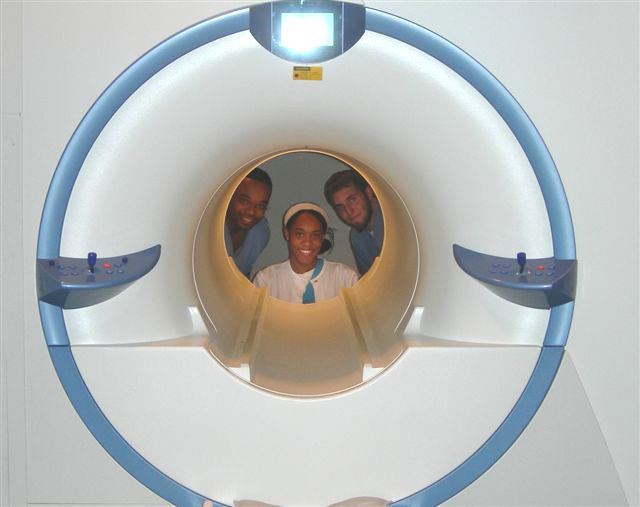 |
| I didn't get a photo, so here's a cheesy stock image of some people smiling through an MRI scanner |
Then came the contrast injection, at which point I was given my panic button - usually they give you one at the start of the scan, but I was so happy under my blanket I hadn't even noticed I didn't have it - in case you have a reaction to the contrast dye (unlikely unless you have undiagnosed kidney failure, but still). Then another set of scans - each set took about ten minutes, I would guess - and then freedom! Easy as pre-packaged pie.
The strangest part of the scan actually happened after it was all over. There was another patient with the same condition as me who was having the tests at the same time - this meant we could both have our PET scans on the same day, as the hospital prefers doing two of the same type at once to save money. We'll call him Bob. I hadn't met him at that point, but he was having his pituitary MRI immediately after me, and so I stayed in the waiting room with a very sweet Filipino nurse waiting for his scan to be finished so we could all go back to the research department together.
I was, as I have mentioned before, still wearing scrubs. I was however wearing a pair of exclusive "I'M A PATIENT" bracelets detailing my name, age, hospital no. etc. and my allergies (trimethoprim = brings me out in an attractive full-body rash). The waiting room was pretty full, so I was sitting off to one side, flipping through an elderly magazine,* when a woman came up to me and asked me how much longer the current scan would take.
Well initially, I admit, I gave her a "woman, you crazy!" look, until I suddenly realised that in my current garb I probably looked like a member of staff.
"Sorry, I'm not a doctor, I'm a patient," I said.
"So how long will it take?" she asked.
I got out my "woman, you crazy!" face again. "Er, I don't know…"
"Well, I think it's really bad that we're not being given any information," she told me. "How long do you think it will take?"
"It probably depends on the type of scan?" I suggested.
And with that, she stamped off, muttering angrily to herself.
On the way back to the research department, I got to meet Bob! He is the first ever person I have met who also has a TSHoma, which is not surprising as there's only about 20 of us across the whole of the UK, Ireland and, apparently, Norway (this may explain the MRI technician's cryptic question). Bob was a bit of a legend and had sensibly rejected the scrubs they had suggested he wear, in favour of pyjamas with Animal from the Muppets on; obviously the preferable sartorial choice.
.png)
You might think that, on finally meeting someone else with the same incredibly rare pituitary tumour, we would discuss symptoms, or treatment. But no! People with TSH secreting pituitary adenomas are nothing if not polite, and of course we would not want the lovely Filipino nurse feeling left out of the conversation. So, as she most likely had no brain tumours of any sort, we instead discussed the best way to travel to Cardiff by public transport.
And a very educational conversation it was too.
My pituitary MRI scan experience:
Hassle: 2/5
Fun: 2/5 (extra point for meeting Bob!)
Weirdness: 3/5
Results: 2/5
Total Score: 9/20
I fear I've just had too many MRIs to find them exciting any more!
________________________________________________
*The magazine was old... it wasn't a magazine for old people.
Tuesday, 10 April 2012
Quick Update
Hello! Here is another short post - I know, I know, I'm a reprobate. Obviously what the internet really needs is another one of my long rambly posts about injections and hand dryers. But the internet will have to wait.
So as I hinted previously, I was sick last Tuesday, having managed to pick up some kind of stomach bug that just made me throw up all the time. Any time I got out of bed, I threw up. So I made the sensible decision to stay there for the day. Admittedly, since childhood I have been notoriously prone to vomiting at the least provocation - car journeys, overexcitement, eating too many of those sweets shaped like flying saucers with sherbet in the middle. When I was about twelve, I went through a phase that lasted a couple of years where I just threw up every time I stayed around a friend's house. There was no apparent cause (I don't know if my parents thought I was just drinking excessive quantities of alcopops, but in honesty I wasn't). Eventually I grew out of it. But even for me, I think that being sick seven times in eleven hours is some kind of record. I actually managed to pull a muscle in my stomach slightly from it. Nice.
Oh by the way, heads up - if you're grossed out by talk of me being sick, you probably shouldn't have read that last paragraph. Just a warning.
Anyway, the point is that although I was a bit pathetic for a few days given that I hadn't been able to eat or drink on Tuesday, I am now fine! Raring to go, in fact. Except obviously I have to catch up on all the work I didn't get done, and more importantly having given up chocolate for Easter I now have a whole lot of catching up to do on that front as well.
I've not yet heard from the hospital regarding my latest set of blood tests or the MRI I had, but my next appointment with my endocrinologist (well, in theory it's with him. In practice, past experience tells me it could be literally any endocrinologist) is on the 3rd of May so I'm assuming I'll get everything then.
Interestingly, I've realised that now I'm back on the lanreotide injections, which have slowed my heart down again now - there's a bit of a time lag, but after two months' worth of injections it has slowed down significantly even without medication - my heartrate has become an accurate predictor of me getting ill. It's happened before with colds that my heartrate started to go up noticeably about a day or so before I felt the symptoms, and again with this bug I had last week. So next time instead of just being annoyed when my heartrate rises for no apparent reason, I shall run around telling people that I'm psychic and I foresee that I will come down with a cold in the immediate future.... Sweet!
So as I hinted previously, I was sick last Tuesday, having managed to pick up some kind of stomach bug that just made me throw up all the time. Any time I got out of bed, I threw up. So I made the sensible decision to stay there for the day. Admittedly, since childhood I have been notoriously prone to vomiting at the least provocation - car journeys, overexcitement, eating too many of those sweets shaped like flying saucers with sherbet in the middle. When I was about twelve, I went through a phase that lasted a couple of years where I just threw up every time I stayed around a friend's house. There was no apparent cause (I don't know if my parents thought I was just drinking excessive quantities of alcopops, but in honesty I wasn't). Eventually I grew out of it. But even for me, I think that being sick seven times in eleven hours is some kind of record. I actually managed to pull a muscle in my stomach slightly from it. Nice.
Oh by the way, heads up - if you're grossed out by talk of me being sick, you probably shouldn't have read that last paragraph. Just a warning.
Anyway, the point is that although I was a bit pathetic for a few days given that I hadn't been able to eat or drink on Tuesday, I am now fine! Raring to go, in fact. Except obviously I have to catch up on all the work I didn't get done, and more importantly having given up chocolate for Easter I now have a whole lot of catching up to do on that front as well.
I've not yet heard from the hospital regarding my latest set of blood tests or the MRI I had, but my next appointment with my endocrinologist (well, in theory it's with him. In practice, past experience tells me it could be literally any endocrinologist) is on the 3rd of May so I'm assuming I'll get everything then.
Interestingly, I've realised that now I'm back on the lanreotide injections, which have slowed my heart down again now - there's a bit of a time lag, but after two months' worth of injections it has slowed down significantly even without medication - my heartrate has become an accurate predictor of me getting ill. It's happened before with colds that my heartrate started to go up noticeably about a day or so before I felt the symptoms, and again with this bug I had last week. So next time instead of just being annoyed when my heartrate rises for no apparent reason, I shall run around telling people that I'm psychic and I foresee that I will come down with a cold in the immediate future.... Sweet!
Friday, 30 March 2012
The Mysterious MRIs
So last night I headed back to the hospital for an MRI scan. As my appointment was at 7pm at night, I was unimpressed - not only because I didn't particularly want to spend my evening at the hospital, but also because I feared that if delays accumulated during the day, there would be an epic backlog of people waiting to be scanned. Happily, my fears proved to be little more than paranoid ravings. Firstly my good friend Havana, who is a medical student, stayed late at the hospital to meet me and cooked a delicious chilli for us to share. And secondly, the entire MRI department was eerily deserted and I was ushered straight through for my scan.
Locating the department was the first problem, even though I have been there once before. Fortunately the signage was fairly good - although I was amused to discover that, despite having been a student at the hospital for a couple of years, Havana hadn't realised that the signs referred to the MRI department and not a mysterious organisation known only by the acronym M.R.I.S.
As we went along I realised that I had unwittingly committed a terrible libel against the hospital on this blog by accusing them in a previous post of keeping their MRI scanning service tucked away in a terrifying basement full of doors with signs saying things like "DO NOT ENTER: DANGER OF DEATH" and "COWER NOW, BRIEF MORTALS". This is not in fact the case. The MRI department is located in a pleasant and airy wing on the ground floor. It's actually the bone density unit that's in the terrifying basement.
But you can see how I might get confused; in the past two years I've been to quite a startling variety of different departments at the hospital, including:
Accident & Emergency (Good crisps in the vending machine)
Bone Density Unit (Terrifying basement)
Cardiology (I was the youngest patient by about half a century)
Endocrinology (TVs in the waiting area are always playing The Jeremy Kyle Show)
MRI Dept. (Easily confused with Bone Density Unit)
MRI/CT Dept. (Never actually had my CT scan in the end, so it was more of a day trip)
Neurosurgery (Why do they assume everyone having brain surgery wants to read Country Life?)
Opthalmology (Seething with human life; not enough seating)
Phlebotomy (Offer you tea if you nearly pass out)
So you can see how I get confused. Anyway: I was called in, took off all my metal and bundled it into a locker, then had to answer a set of questions designed to flag up any random bits of metal that might feasibly in my body. Almost a year after my operation, it still feels weird that the answer to the question "Have you had any form of brain or head surgery" is actually now "yes". I signed the consent form indicating that I'd not lied about my non-bionic status, and we went in.
I went in, took my shoes off and realised I'd made a terrible mistake. I was wearing slightly aged socks with holes in them.* Ladies and gentlemen, when you are going for an MRI scan it is imperative to wear good socks. They are the only part of you that is visible outside the machine. When the nurse comes in to give you an injection of contrast dye, they will judge you not on the content of your character, but by the colour of your socks. So wear nice ones.
Anyhow, I put in my earplugs, lay on the table and had the padding put in the MRI helmet and rolled backwards into the machine. I didn't feel at all claustrophobic this time, and I found it a lot easier to lie still, probably because I now have (hopefully) much lower levels of thyroid hormone sloshing around my body; previously I couldn't even keep my hands steady normally and was ultra jumpy, so expecting me to be able to lie completely still while sudden loud noises went off all around me was a vain hope indeed. That's probably one of the reasons that the scan went so quickly, it was over in about twenty minutes or even less.
The injection of the contrast dye is really weird, it feels really cold as it's going into your arm, which is pretty freaky - add to that the fact that your head is trapped in a cage while they're giving you the inkection and you're worried that the nurse is judging your poor choice of socks, and it's a disconcerting experience.
One of the things that occurred to me in there was - what the hell does the back of an MRI machine look like? I've had three scans and seen plenty of classic hospital drama, but I only know what they look like from the front. For all I know, behind each machine is a large gnome smashing bits of metal together to make the noises.
_____________________________________________________
*Although admittedly pretty much all my socks have holes in them.
Locating the department was the first problem, even though I have been there once before. Fortunately the signage was fairly good - although I was amused to discover that, despite having been a student at the hospital for a couple of years, Havana hadn't realised that the signs referred to the MRI department and not a mysterious organisation known only by the acronym M.R.I.S.
As we went along I realised that I had unwittingly committed a terrible libel against the hospital on this blog by accusing them in a previous post of keeping their MRI scanning service tucked away in a terrifying basement full of doors with signs saying things like "DO NOT ENTER: DANGER OF DEATH" and "COWER NOW, BRIEF MORTALS". This is not in fact the case. The MRI department is located in a pleasant and airy wing on the ground floor. It's actually the bone density unit that's in the terrifying basement.

But you can see how I might get confused; in the past two years I've been to quite a startling variety of different departments at the hospital, including:
Accident & Emergency (Good crisps in the vending machine)
Bone Density Unit (Terrifying basement)
Cardiology (I was the youngest patient by about half a century)
Endocrinology (TVs in the waiting area are always playing The Jeremy Kyle Show)
MRI Dept. (Easily confused with Bone Density Unit)
MRI/CT Dept. (Never actually had my CT scan in the end, so it was more of a day trip)
Neurosurgery (Why do they assume everyone having brain surgery wants to read Country Life?)
Opthalmology (Seething with human life; not enough seating)
Phlebotomy (Offer you tea if you nearly pass out)
So you can see how I get confused. Anyway: I was called in, took off all my metal and bundled it into a locker, then had to answer a set of questions designed to flag up any random bits of metal that might feasibly in my body. Almost a year after my operation, it still feels weird that the answer to the question "Have you had any form of brain or head surgery" is actually now "yes". I signed the consent form indicating that I'd not lied about my non-bionic status, and we went in.
I went in, took my shoes off and realised I'd made a terrible mistake. I was wearing slightly aged socks with holes in them.* Ladies and gentlemen, when you are going for an MRI scan it is imperative to wear good socks. They are the only part of you that is visible outside the machine. When the nurse comes in to give you an injection of contrast dye, they will judge you not on the content of your character, but by the colour of your socks. So wear nice ones.
Anyhow, I put in my earplugs, lay on the table and had the padding put in the MRI helmet and rolled backwards into the machine. I didn't feel at all claustrophobic this time, and I found it a lot easier to lie still, probably because I now have (hopefully) much lower levels of thyroid hormone sloshing around my body; previously I couldn't even keep my hands steady normally and was ultra jumpy, so expecting me to be able to lie completely still while sudden loud noises went off all around me was a vain hope indeed. That's probably one of the reasons that the scan went so quickly, it was over in about twenty minutes or even less.
The injection of the contrast dye is really weird, it feels really cold as it's going into your arm, which is pretty freaky - add to that the fact that your head is trapped in a cage while they're giving you the inkection and you're worried that the nurse is judging your poor choice of socks, and it's a disconcerting experience.
One of the things that occurred to me in there was - what the hell does the back of an MRI machine look like? I've had three scans and seen plenty of classic hospital drama, but I only know what they look like from the front. For all I know, behind each machine is a large gnome smashing bits of metal together to make the noises.

_____________________________________________________
*Although admittedly pretty much all my socks have holes in them.

Thursday, 22 March 2012
My Last Injection... For Now
On Tuesday morning at 10.15 I had my latest lanreotide injection, and as the initial decision was that I would have them for three months and then review, I'm now waiting to hear back from my endocrinologist as to whether he wants me to continue with the injections. The answer to that will almost certainly be yes, unless the next MRI scan shows that my pituitary tumour has fallen out of my nose at some point in the last two months;* the real question is whether the dosage needs to be increased, and if they're thinking about sending me in for more surgery.
Actually getting the injection was fun, because it was administered by my favourite nurse. I know it's wrong to have favourites, but I was almost heartbroken last month when both she and her lovely Australian colleague were away at injection time and I had to book in with The Rubbish Nurse. She's not a bad nurse, I should clarify, she's very competent, but she hasn't got the hang of Making Injections Fun yet. This is a valuable skill and, in case there are any nurses out there, it goes like this:
1. Recognise the patient. If you don't recognise the patient, you can just pretend. This is an acceptable fiction and they will almost certainly pretend back.
Pro tip: Once you are practised at this deception, or if you are interested in a career in acting, consider taking this a step further and invent a complete backstory to your relationship with each patient. Imagining that you are administering an injection to the wife of the man with whom you had a torrid affair in pre-independence Kiribati will add spice to an otherwise dull day.
2. Greet the patient. Do not disappear down the corridor so quickly that they can't work out which dread medical portal you emerged from.
Pro tip: Alternatively, if you really can't bear to wait for your patients to pick up their coats before exiting the waiting room, why not turn this into a game of Hide and Seek (Nurse Edition)? There's nothing like the sight of confused patients blundering into the wrong consulting room to raise a belly laugh in the morning.
3. Put The Patient At Ease. When unwrapping the syringe of lanreotide, remember to refrain from comments such as "Bloody hell, that's a big needle!"
Pro tip: Consider tapping in to your patients' latent competitive natures by introducing a leaderboard of Bravest Patient of the Week. That way, they'll be practically queuing up to be spiked by giant needles, instead of fleeing you in terror.
4. Be Awesome. This guideline may be difficult for new practitioners to grasp immediately. Examples of Being Awesome include (but are not limited to): telling patients interesting medical facts (this week I learned about the sciatic nerve), having an awesome accent, telling amusing family anecdotes, laughing frequently, and adopting unusual pet names for each patient.
Pro tip: Like the finest cuisine, the best pet names are based around animals and vegetables. Everyone's been called "duck" or "pumpkin" - why not mix it up? Try referring to patients as "prarie dog" or "aubergine".
In other news, I had a bit of minor drama trying to get hold of my beloved Somatuline Autogel injection this month; when I got the prescription, I headed straight to Boots Pharmacy as usual, who always have to order it in directly from their supplier because it's a pretty unusual item. I happily skipped to the counter, only to be informed that their supplier didn't have any in stock, and they couldn't say when they might have it, so I should go elsewhere.
Somewhat surprised, I decided to transfer my business to the Superdrug pharmacy. "I'll have to check with our supplier," said the young man behind the counter. He immediately phoned them, while standing in front of me. Apparently everything was fine and they'd have it in the next day. Impressed by this speedy service, I skipped off on my merry way.** Of course, next day I got a phone call from them saying that their supplier didn't have any and they couldn't say when it would next be in stock. Heaven only knows who the bloke behind the counter had actually phoned while I was watching; perhaps he's the chap keeping the Speakng Clock in business.
So I picked up my prescription and, feeling a little panicked, decided to try Boots again before walking miles to another pharmacy. And lo! the bloke behind the counter looked at my script and quoth: "Oh yes, we've got that for you." I assumed he was confused - perhaps a relation of the guy in Superdrug. But no! Boots had lovingly ordered in my medication even though they had encouraged me to look elsewhere, just on the offchance I would return for it. So that was nice.
____________________________________________________
*Just to clarify for any non-medically-qualified readers: this is unlikely.
**I was doing a lot of skipping that day.
Actually getting the injection was fun, because it was administered by my favourite nurse. I know it's wrong to have favourites, but I was almost heartbroken last month when both she and her lovely Australian colleague were away at injection time and I had to book in with The Rubbish Nurse. She's not a bad nurse, I should clarify, she's very competent, but she hasn't got the hang of Making Injections Fun yet. This is a valuable skill and, in case there are any nurses out there, it goes like this:
The Idiot's Guide To Making Injections Fun:
1. Recognise the patient. If you don't recognise the patient, you can just pretend. This is an acceptable fiction and they will almost certainly pretend back.
Pro tip: Once you are practised at this deception, or if you are interested in a career in acting, consider taking this a step further and invent a complete backstory to your relationship with each patient. Imagining that you are administering an injection to the wife of the man with whom you had a torrid affair in pre-independence Kiribati will add spice to an otherwise dull day.
2. Greet the patient. Do not disappear down the corridor so quickly that they can't work out which dread medical portal you emerged from.
Pro tip: Alternatively, if you really can't bear to wait for your patients to pick up their coats before exiting the waiting room, why not turn this into a game of Hide and Seek (Nurse Edition)? There's nothing like the sight of confused patients blundering into the wrong consulting room to raise a belly laugh in the morning.
3. Put The Patient At Ease. When unwrapping the syringe of lanreotide, remember to refrain from comments such as "Bloody hell, that's a big needle!"
Pro tip: Consider tapping in to your patients' latent competitive natures by introducing a leaderboard of Bravest Patient of the Week. That way, they'll be practically queuing up to be spiked by giant needles, instead of fleeing you in terror.
4. Be Awesome. This guideline may be difficult for new practitioners to grasp immediately. Examples of Being Awesome include (but are not limited to): telling patients interesting medical facts (this week I learned about the sciatic nerve), having an awesome accent, telling amusing family anecdotes, laughing frequently, and adopting unusual pet names for each patient.
Pro tip: Like the finest cuisine, the best pet names are based around animals and vegetables. Everyone's been called "duck" or "pumpkin" - why not mix it up? Try referring to patients as "prarie dog" or "aubergine".
***
In other news, I had a bit of minor drama trying to get hold of my beloved Somatuline Autogel injection this month; when I got the prescription, I headed straight to Boots Pharmacy as usual, who always have to order it in directly from their supplier because it's a pretty unusual item. I happily skipped to the counter, only to be informed that their supplier didn't have any in stock, and they couldn't say when they might have it, so I should go elsewhere.
Somewhat surprised, I decided to transfer my business to the Superdrug pharmacy. "I'll have to check with our supplier," said the young man behind the counter. He immediately phoned them, while standing in front of me. Apparently everything was fine and they'd have it in the next day. Impressed by this speedy service, I skipped off on my merry way.** Of course, next day I got a phone call from them saying that their supplier didn't have any and they couldn't say when it would next be in stock. Heaven only knows who the bloke behind the counter had actually phoned while I was watching; perhaps he's the chap keeping the Speakng Clock in business.
So I picked up my prescription and, feeling a little panicked, decided to try Boots again before walking miles to another pharmacy. And lo! the bloke behind the counter looked at my script and quoth: "Oh yes, we've got that for you." I assumed he was confused - perhaps a relation of the guy in Superdrug. But no! Boots had lovingly ordered in my medication even though they had encouraged me to look elsewhere, just on the offchance I would return for it. So that was nice.
____________________________________________________
*Just to clarify for any non-medically-qualified readers: this is unlikely.
**I was doing a lot of skipping that day.
Friday, 24 February 2012
Health Update
My poor little blog is really looking quite neglected! Fortunately I had a trip to the hospital yesterday. To see a doctor, I mean, not just for fun.
After being weighed and having my blood pressure done, I was called in to see.... a doctor who is not my endocrinologist. My endocrinologist seems to be displaying classic signs of pathological demand avoidance syndrome, in that every time someone arranges an appointment for him to see me, he disappears. He's been my endocrinologist for seven months now and I've only met him once, in passing, while I was having some blood tests. Perhaps he's put off by the possessive way in which I refer to him as "my" endocrinologist, but if so then he really needs to address the problem, or how can our relationship progress to the next level?*
Anyhow, we went through my latest blood test results and, being the marvel of medical science that I undoubtedly am,** my body appears to have pulled off the neat trick of producing higher levels of thyroid hormone during treatment with a thyroid-stimulating-hormone suppressing drug than before treatment. Apparently they're not concerned, because the tumour does produce quite low levels of TSH anyway and all my thyroid hormone results are within the upper normal range, so the only way they can tell what's going on is to look at the alpha subunit, a particular protein which tends to be over-produced by TSH-producing pituitary adenomas. The test result takes 4 weeks to come through, so we have to wait to find out where I am at the moment. Over the last year or so, though, they were:
Before surgery last April: 13.00
After surgery: 8.40
This January: 5.90
What it's meant to be: 1.00 or less.
So it could be worse, could be better! Fingers crossed that the lanreotide injections are doing the trick. I get to have another MRI sometime soon (they forgot to book it in for me, apparently I was supposed to have one in February) and to go back in 2 months. Oh, and they recommended I be referred to the Ear Nose and Throat team for my stupid malingering post-surgery sinusitis. You know. The sinusistis my GP told me couldn't be related at all to the surgery... oh well. I get to explore another hospital department. Whoop whoop!
____________________________________________
*i.e. the level at which he is actually in the room when I am supposed to be meeting him.
**Shut up, I so am.
After being weighed and having my blood pressure done, I was called in to see.... a doctor who is not my endocrinologist. My endocrinologist seems to be displaying classic signs of pathological demand avoidance syndrome, in that every time someone arranges an appointment for him to see me, he disappears. He's been my endocrinologist for seven months now and I've only met him once, in passing, while I was having some blood tests. Perhaps he's put off by the possessive way in which I refer to him as "my" endocrinologist, but if so then he really needs to address the problem, or how can our relationship progress to the next level?*

Anyhow, we went through my latest blood test results and, being the marvel of medical science that I undoubtedly am,** my body appears to have pulled off the neat trick of producing higher levels of thyroid hormone during treatment with a thyroid-stimulating-hormone suppressing drug than before treatment. Apparently they're not concerned, because the tumour does produce quite low levels of TSH anyway and all my thyroid hormone results are within the upper normal range, so the only way they can tell what's going on is to look at the alpha subunit, a particular protein which tends to be over-produced by TSH-producing pituitary adenomas. The test result takes 4 weeks to come through, so we have to wait to find out where I am at the moment. Over the last year or so, though, they were:
Before surgery last April: 13.00
After surgery: 8.40
This January: 5.90
What it's meant to be: 1.00 or less.
So it could be worse, could be better! Fingers crossed that the lanreotide injections are doing the trick. I get to have another MRI sometime soon (they forgot to book it in for me, apparently I was supposed to have one in February) and to go back in 2 months. Oh, and they recommended I be referred to the Ear Nose and Throat team for my stupid malingering post-surgery sinusitis. You know. The sinusistis my GP told me couldn't be related at all to the surgery... oh well. I get to explore another hospital department. Whoop whoop!
____________________________________________
*i.e. the level at which he is actually in the room when I am supposed to be meeting him.
**Shut up, I so am.
Friday, 3 February 2012
The Silence of the Gland: Diagnosed
It's been a while since I wrote the last post about my previous attempts at diagnosis, so I decided to man up and get the heck on with it. Yeah! USA! USA!*
Obviously my tales of pituitary surgery will be the most enthralling/gross, but who knows, maybe the events leading up to surgery will also be of interest to someone. If worst comes to the worst and I develop dementia in my old age, I guess I can read all about my exciting earlier life!
It had been determined that there was nothing wrong with my heart. My cardiologist ordered several blood tests and referred me to endocrinology.
This is where it gets dull and technical.
What I didn't know was that, up until that point, although I showed symptoms of hyperthyroidism, my doctors had only ordered blood tests which looked at my levels of thyroid-stimulating hormone, rather than the thyroid hormones themselves. TSH is produced by the pituitary, then it travels through the blood and spurs the thyroid gland to produce thyroid hormones. Usually, when hyperthyroidism is caused by a problem with the thyroid gland, you would expect the pituitary gland to produce only very low level of thyroid-stimulating hormone (TSH), as the body is trying to suppress the overproduction of thyroid hormones. However, my TSH tests had always come back within the "normal range", so it was assumed that hyperthyroidism was not the problem.
Then a letter dropped through my door from one of the consultant endocrinologists at the hospital. It informed me that my blood test results were "very unusual", and that they suspected I may have a rare condition called resistance to thyroid hormone (RTH). I was called into the hospital for further tests.
At the hospital, I met the consultant who had written the letter. To this day, he possesses one of the finest moustaches I have ever seen. Whilst I sat wondering what kind of scissors he used to trim it so neatly across his upper lip, he informed me that resistance to thyroid hormone is a rare genetic condition, in which most or all of the body's tissues do not respond normally to thyroid hormone. In some people, there are few symptoms as the whole body is equally resistant to the hormone, resulting in high levels of thyroid hormone in the blood but few issues associated with this; in others, the pituitary is more resistant than other tissues to thyroid hormone, leading to some symptoms of hyperthyroidism.
My blood tests showed that I had normal levels of thyroid stimulating hormone, but high levels of thyroid hormones T3 and T4 in my blood - indicating that my pituitary was not responding normally to the high thyroid levels. I was told that the only other possibility was that I might have a tumour on my pituitary which was producing TSH, a.k.a. a TSH-oma, but that this was even more absurdly rare than resistance to thyroid hormone and it was much more likely to be RTH.
I had more complex blood tests at the hospital, and they even took DNA samples to look for the particular mutation. Everything came back negative. The moustachioed doctor's main area of interest was resistance to thyroid hormone, so he passed my case to a colleague specialising in pituitary issues; it was pretty much certain by then that I had a pituitary adenoma, they just needed an MRI to show the tumour. Which they did - and I've already written a post about the MRI, which you can read here.
I don't really remember the phone call from my endocrinologist informing me that I did indeed have a pituitary macroadenoma, measuring 23mm by 19mm by some other measurement which I've forgotten. By that point I had had a chance to get used to the idea that I had a pituitary tumour, so the phone call was really just official confirmation with additional details. But I do remember calling my mum to tell her the news; I walked home from work the long way, through one of the big parks nearby.
After that it was a bit of a whirl of activity. I got the news just before Christmas 2010 and as soon as I arrived back in town after New Year's, I had to arrange to start lanreotide injections to reduce the amount of TSH the tumour was producing. They wanted me to have injections for three months, then a transsphenoidal hypophysectomy (that's pituitary surgery to you and me) immediately afterwards. I had to spend a day in hospital so that they could check that my pituitary was still producing other hormones at a normal level and wasn't about to collapse due to a lack of adrenocorticotropic hormone or something. It all passed in a bit of a blur; the idea of surgery was definitely what most occupied my mind in the intervening months...
UPDATE: You can click here to read about my experience having an MRI scan, or click here to go back and read about my earlier experiences trying to get a diagnosis.
____________________________________________________________
*Or something...

Obviously my tales of pituitary surgery will be the most enthralling/gross, but who knows, maybe the events leading up to surgery will also be of interest to someone. If worst comes to the worst and I develop dementia in my old age, I guess I can read all about my exciting earlier life!
LAST TIME ON PITUITARY ADEMOANER:
This is where it gets dull and technical.
What I didn't know was that, up until that point, although I showed symptoms of hyperthyroidism, my doctors had only ordered blood tests which looked at my levels of thyroid-stimulating hormone, rather than the thyroid hormones themselves. TSH is produced by the pituitary, then it travels through the blood and spurs the thyroid gland to produce thyroid hormones. Usually, when hyperthyroidism is caused by a problem with the thyroid gland, you would expect the pituitary gland to produce only very low level of thyroid-stimulating hormone (TSH), as the body is trying to suppress the overproduction of thyroid hormones. However, my TSH tests had always come back within the "normal range", so it was assumed that hyperthyroidism was not the problem.
Then a letter dropped through my door from one of the consultant endocrinologists at the hospital. It informed me that my blood test results were "very unusual", and that they suspected I may have a rare condition called resistance to thyroid hormone (RTH). I was called into the hospital for further tests.
At the hospital, I met the consultant who had written the letter. To this day, he possesses one of the finest moustaches I have ever seen. Whilst I sat wondering what kind of scissors he used to trim it so neatly across his upper lip, he informed me that resistance to thyroid hormone is a rare genetic condition, in which most or all of the body's tissues do not respond normally to thyroid hormone. In some people, there are few symptoms as the whole body is equally resistant to the hormone, resulting in high levels of thyroid hormone in the blood but few issues associated with this; in others, the pituitary is more resistant than other tissues to thyroid hormone, leading to some symptoms of hyperthyroidism.

My blood tests showed that I had normal levels of thyroid stimulating hormone, but high levels of thyroid hormones T3 and T4 in my blood - indicating that my pituitary was not responding normally to the high thyroid levels. I was told that the only other possibility was that I might have a tumour on my pituitary which was producing TSH, a.k.a. a TSH-oma, but that this was even more absurdly rare than resistance to thyroid hormone and it was much more likely to be RTH.
I had more complex blood tests at the hospital, and they even took DNA samples to look for the particular mutation. Everything came back negative. The moustachioed doctor's main area of interest was resistance to thyroid hormone, so he passed my case to a colleague specialising in pituitary issues; it was pretty much certain by then that I had a pituitary adenoma, they just needed an MRI to show the tumour. Which they did - and I've already written a post about the MRI, which you can read here.
I don't really remember the phone call from my endocrinologist informing me that I did indeed have a pituitary macroadenoma, measuring 23mm by 19mm by some other measurement which I've forgotten. By that point I had had a chance to get used to the idea that I had a pituitary tumour, so the phone call was really just official confirmation with additional details. But I do remember calling my mum to tell her the news; I walked home from work the long way, through one of the big parks nearby.
After that it was a bit of a whirl of activity. I got the news just before Christmas 2010 and as soon as I arrived back in town after New Year's, I had to arrange to start lanreotide injections to reduce the amount of TSH the tumour was producing. They wanted me to have injections for three months, then a transsphenoidal hypophysectomy (that's pituitary surgery to you and me) immediately afterwards. I had to spend a day in hospital so that they could check that my pituitary was still producing other hormones at a normal level and wasn't about to collapse due to a lack of adrenocorticotropic hormone or something. It all passed in a bit of a blur; the idea of surgery was definitely what most occupied my mind in the intervening months...
UPDATE: You can click here to read about my experience having an MRI scan, or click here to go back and read about my earlier experiences trying to get a diagnosis.
____________________________________________________________
*Or something...
Subscribe to:
Posts (Atom)