Showing posts with label tests. Show all posts

Saturday, 22 December 2012

Pituitary Awareness Quiz: The Results

I was so impressed by how many of you took part in my little quiz - apologies for the long delay in coming out and praising you for it! Some people dipped in and out for the odd question, while others were with us for the long haul.

Bearing in mind that double points were awarded for witty answers rather than merely correct ones, I present... The Results!

THE RESULTS

The winner is... Clare! With the close runner-up Davey D. Congratulations guys, you may officially brag wildly about your knowledge of the pituitary gland and its inhabitants.

And as I did promise a praise poem for the winner:


There was a young lady named Clare
As wise (and fierce) as an owlbear.
She was a quiz queen
 - quite the answer machine -
she made other contestants despair!

Friday, 21 December 2012

Pituitary Awareness Quiz: The Answers

Hola! Well, I'm just back from a spot of festive carol singing at the local pub with my whole family in tow, and I thought: what better time to finally put up the answers to October's National Pituitary Month quiz?

THE ANSWERS:

Q.1: Acromegaly is a rare disease caused by a growth-hormone-secreting pituitary tumour, which can lead to gigantism and excessive growth of the body's tissues. But what language is the word "acromegaly" derived from, and what does it literally mean?

Correct answer: c) from the Greek akros "highest; extremity" and megalos "large".

***

Q.2: Approximately how many (normal-sized) human pituitary glands could you fit in an Olympic-sized swimming pool?

Correct answer: Wildly debateable! Although I did have a correct answer, calculated by my lovely boyfriend on the basis of the human pituitary gland being roughly the size of a pea and assuming that the glands on the bottom retained their shape instead of being pulverized by the weight of the ones on top, I decided to award a point to anyone who showed their working; because it's the effort that counts!

***

Q.3: Which of these is an alternative name for the pituitary stalk?

Correct answer: c) The infundibular stem

***

Q.4: The human pituitary gland will vary in size over a person's life. What physiological event (other than untoward tumourousness) causes the pituitary gland to reach its largest natural size... and why?

Correct answer: Pregnancy, although the gland tends to be at its largest shortly after giving birth. This is due to lactotroph hyperplasia; basically that means an increase in the number of cells which secrete the hormone prolactin, which stimulates milk production for breastfeeding.

***

Q.5: Beta-endorphin is used by the body to numb pain, and is found in the anterior pituitary gland, as well as the hypothalamus. From the extracts of which species' pituitary gland was beta-endorphin first discovered?

Correct answer: d) Camel (apparently!)

***
 
Q.6: Only one of the following pituitary-related conditions was first identified by a woman named Cindy. But which one was it?

Correct answer: a) Sheehan Syndrome

***

Q.7: A five point bonus was awarded for writing a poem about the pituitary: there are no wrong answers!

***

Q.8: I'm currently receiving monthly lanreotide injections. These are somatostatin analogues - hormone injections - which counteract the effect of my pituitary adenoma producing too much thyroid hormone. Assuming this is the only medication I'm taking, and assuming I live in England... am I allowed to donate blood?

Correct answer: a) Yes

***

Q.9: Which of the below is the correct spelling of the full name of the pituitary hormone ACTH? (no cheating!)

Correct answer: d) adrenocorticotropic hormone
***

Q.10: What hormone does my pituitary tumour overproduce?

Correct answer: a) Thyroid stimulating hormone

***

Q.11: Who is this man, and what does he have to do with the pituitary gland?

Correct answer: Harvey Cushing, pioneering neurosurgeon and the man who discovered Cushing's Syndrome.

***

So now you know!

The results will be out tomorrow...

Tuesday, 24 July 2012

Acromegaly Drug Trial - Oral Octreolin

I noticed on the Pituitary Foundation's website that a drug trial is recruiting for acromegaly patients. It's the phase 3 testing of oral octreolin, taking place at centres across the UK, including Oxford, Manchester and London.

This trial is a pretty exciting prospect! Currently, the somatostatin analogues which are used to treat acromegaly are only available in an injectable form, both as daily injections and in a long-lasting preparation that's injected once a month. This means regular visits to the nurse, plus all the hassle of ordering and storing the prescription, as the drug has to be kept refrigerated. Being able to simply take two pills every day would be so much more convenient (not to mention less painful... those needles are huge), especially for patients who travel or move around a lot.

The biopharma company carrying out the trial is Chiasma, a company specialising in turning injectable drugs into oral formulations. Octreolin is their lead product, but their website indicates they're also working on a drug to treat complications of chronic kidney disease.

It appears Chiasma are conducting clinical trials on the use of octreolin to treat neuroendocrine tumours. In addition to this and acromegaly, octreotide (the injectable somatostatin analogue that octreolin emulates) is used to treat carcinoid syndrome, TSHomas/thyrotropinomas and an extremely rare tumour called a VIPoma. VIP actually stands for vasoactive intestinal peptide, a hormone which the tumour produces in excess, but these tumours are so rare - estimated annual incidence of one per ten million people - that the other meaning of VIP is strangely apposite. A press release from Chiasma also suggested that octreolin was being investigated as a treatment for portal hypertension. So if octreolin is found to be as safe and effective as octreotide, it could benefit people suffering from a whole range of conditions.

Monday, 16 July 2012

Human Guinea Pig: Part 6 - Resting Energy Expenditure Test

This is the sixth part of the story about my overnight stay in the hospital's research department, having lots of tests to look at the effect my pituitary tumour is having on my body and metabolism. Here are links to: part one, part two, part three, part four and indeed part five.

Resting Energy Expenditure and the GEM Ventilated Hood Indirect Calorimeter

I was woken up at half eight the next morning by the very lovely technician* who did my step test and heart monitor the previous day. She was dragging a large piece of equipment into my room, where it was placed next to my bed; it was time for my resting energy expenditure to be monitored. This has to be done first thing in the morning for maximum accuracy, which is why they kept me in hospital overnight.

 There's a tricky balance to be met with regards to this test; on the one hand, you have to be awake for the whole thing, but equally you're not supposed to get out of bed - or even move, as far as possible. For a sleepy creature like me, this makes it pretty hard to stay awake, but fortunately the whole experience was so surreal that I didn't want to let myself drift off.

Firstly, the equipment is switched on, set up, and left to monitor the room for ten minutes. Essentially, your metabolism is monitored by measuring the amount of carbon dioxide you breathe out. These measurements are then used to calculate your respiratory quotient. The technician explained it to me like this: when you're asleep, you usually breathe out a lower level of carbon dioxide, indicating that your body is metabolising your fat stores to produce energy (RQ = <0.7). When you're out and about, you'll be breathing out a higher level of carbon dioxide, indicating that you're metabolising carbohydrates (RQ= >0.7). I have a pituitary tumour which is messing with my hormones so they want to know what the heck my metabolism is actually doing. Or something.

Anyway - in order to make sure that the readings they take of the air you breathe out is accurate, the composition of the air in the room you're in has to be measured before and after the test. So I lay in bed for ten minutes, listening to it whirring happily next to me.

And then the technician returned with the rest of the equipment.

I am genuinely unspeakably ensorrowed by the fact that I didn't get a picture of me in it, but unfortunately it was early in the morning, my brain was still in first gear, and I wasn't actually allowed to move. So you'll have to use your imagination. Essentially, the rest of the equipment (the "ventilated hood") is a large goldfish bowl with a cape hanging off it, a small hole at the top, and a large pipe or two running out of it. Imagine a giant plastic medical jellyfish and you'll be on the right track.

I did find a picture of the machine all bundled up, but it doesn't look as amusing as it did once it was set up:
This piece of kit is called a GEM (Gas Exchange Measurement) ventilated hood indirect calorimeter. Snappy name, right? The GEM Nutrition website describes it as "an open circuit indirect calorimeter designed for nutritionists needing to measure energy balance and substrate turnover. The compact bedside unit measures gas exchange volumes, respiratory quotient and energy expenditure."

So now you know.

This strange contraption was connected up to the machine, and then placed over my head, at which point I understood why the nurses had double-and-triple checked with me whether or not I had claustrophobia the previous day. Then, safely ensconced in my plastic bubble, the cape was draped around me, and after checking that I wasn't freaking out and providing me with a call button, I was left.

I can't actually remember whether it was for twenty minutes or half an hour, but it didn't feel like very long. I could hear my breathing inside the big clear plastic helmet, which made me feel like a very lazy astronaut. Every now and again someone popped their head around the door to make sure I was ok, but it actually felt quite relaxing. The lights were still off in the room and it was all very chilled. I tried to keep my resting energy expenditure normal.

At some point later, I was freed from my goldfish bowl prison, and the GEM calorimeter sat burbling away in the corner for another ten minutes, measuring the room's air again.

The machine comes complete with a program which shows you the results immediately, along with little graphs showing the levels of carbon dioxide you were breathing out vs. the oxygen you were breathing in, etc. This would have been pretty awesome if I had had any clue what the results meant, but sadly they have to play with them further before they can draw any actual conclusions.

My Experience of the GEM Ventilated Hood Indirect Calorimeter:

Hassle: 1/5 (all I had to do was wake up and keep breathing, which I've managed to do every day of my life so far)
Fun: 3/5
Weirdness: 5/5
Results: 3/5
Total score: 12/20
____________________________________________________
*I don't know what her official job title is, so I'm going with "technician" but I could well be extremely wrong; I just know she was neither a doctor nor a nurse.

Saturday, 14 July 2012

Human Guinea Pig: Part 5 - Dinner at the Hospital

This is the fifth part of the story about my overnight stay in the hospital's research department, having lots of tests to look at the effect my pituitary tumour is having on my body and metabolism. Here are links to: part one, part two, part three and part four (I do go on).

Dinner at the Hospital

After a hurried trot back from the MRI department, I was dropped off at my room, ten minutes late for my dinner. The timing of this dinner was apparently important because it had been prepared just for me, and was apparently perfectly calibrated to contain exactly the right amount of calories for someone of my height and weight. I was allowed to eat the prepared meal only, nothing else, because they planned to monitor my metabolism and blood sugar levels in the morning and needed these to be unaffected by what I had eaten the night before.

I had barely had time to change out of my ridiculous scrubs and re-attach my Actiheart monitor when the night nurse's head appeared around the doorframe. "We're just heating your meal," she said, in a firm, no-nonsense voice. "You will be expected to eat all of it, you understand?"

And, with a stern look at me, she left. A few minutes later, she reappeared, tray in hand.

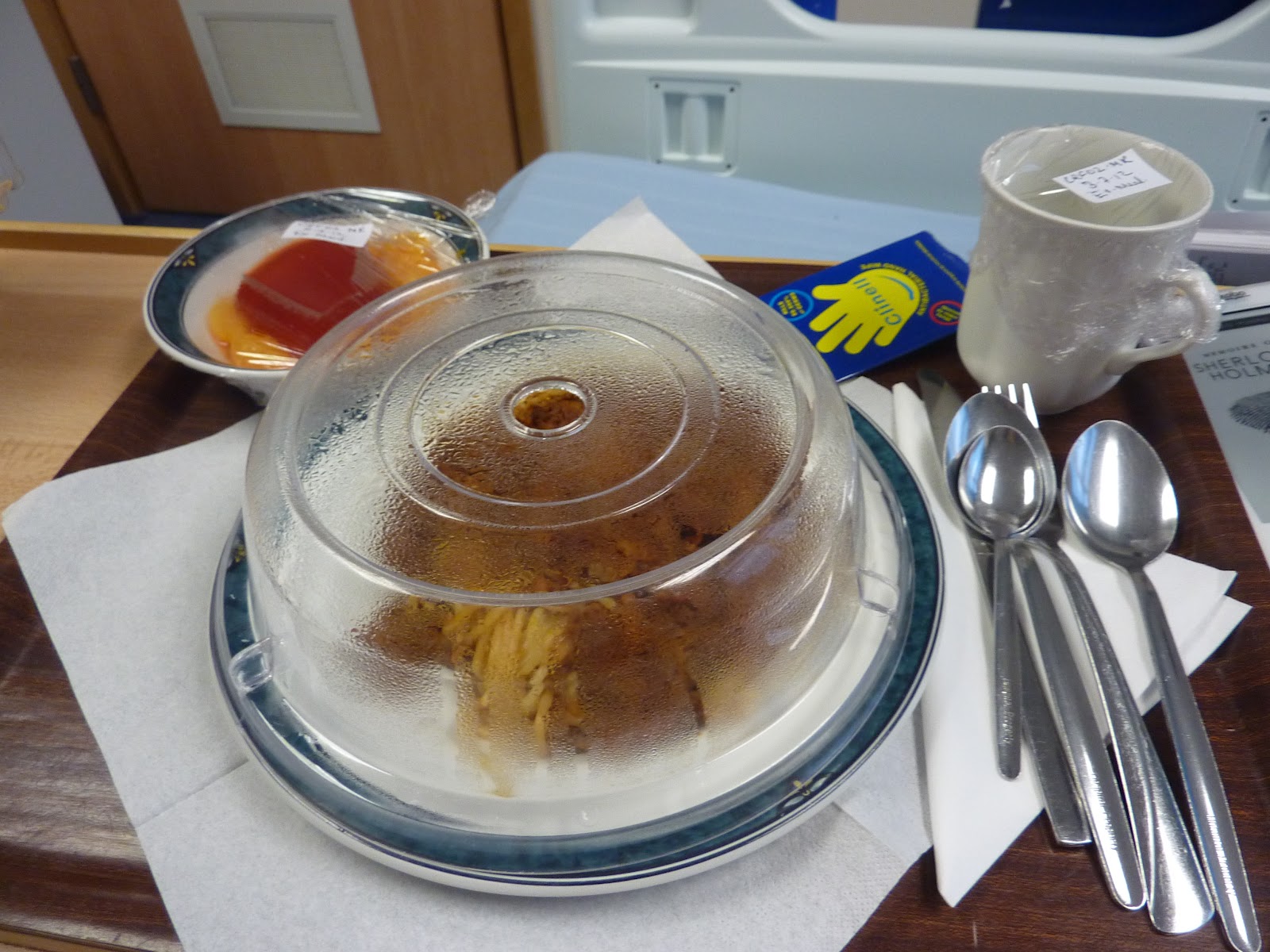
 Every dish had a label to show who it was for and when I should eat it, even to the extent that the milk for my evening (decaff) coffee had been measured out in advance, and I was not permitted any more. The main meal was, happily, spaghetti bolognese, one of my favourites.

But when I saw the dessert, my heart sank.

Close friends and family are aware that when it comes to desserts, I am usually more than enthusiastic in my appreciation of the culinary arts (unless it's cheesecake. Eurgh). However, I have a few basic rules. I don't eat jelly with sponge cake. I don't eat sponge cake with fruit.* And I don't eat fruit with jelly.

Here is a picture of the dessert:

In case you can't tell, it's strawberry jelly with tinned mandarin slices. NOOOOOO!
In fairness, it was partly my fault: the hospital did ask me whether I had any dietary requirements or dislikes, and I said no, because it would be strange and embarassing to have to explain my dessert law triad to a doctor. At least it wasn't cheesecake.

And so, I settled down to sup with good grace and managed to eat the entire thing. I did my utmost to separate the jelly from the mandarin segments wherever possible; where it was not possible, I adopted the approach to eating which has been popularised by the Burmese python, and gulped it down in one bite.

I don't know if the night nurse noticed my face fall when I saw the dessert, or whether she just thought I looked like an untrustworthy character, but she kept sticking her head around the door at unexpected moments while I was eating.

"Take your time," she said, smiling. "But you do have to eat it all."
"Ok, thanks," I replied.
My special tray!
Two minutes later, she popped up again. "You can take your time," she said. "Take as long as you want. But make sure you eat it all."

 And so on. It was very disconcerting. The constant visits created a weird kind of feedback loop where I found myself choking down the mouthfuls as quickly as possible in the hopes that she would finally stop telling me I could eat as slowly as I liked.

Eventually, I was done, and I had the evening to myself. I harassed my parents and boyfriend with text messages about jelly and fruit, read about the exploits of Mr Sherlock Holmes on my Kobo e-reader (which I LOVE), and flicked through TV channels. Eleven o'clock was lights-out and the terrifying night nurse came back again to confiscate my water and order me to pee in a jug overnight,** which was probably the moment I most felt like I was in prison.

Adding to this impression was the fact that my door had a small square window in it which opened onto the corridor and let an annoying amount of light in overnight, and the absurdly thin blanket on the bed. I often get chilly at night and hospitals are not cosy places, so I had brought my warmest hoody to wear in bed over my pyjamas, but I still woke up in the night absolutely freezing and had to ask for another blanket. This is extra annoying considering that hyperthyroidism is supposed to make you too hot, not too cold. In fact, I was given a questionaire about my symptoms, and one of the questions asked me to score my "heat intolerance" on a scale of 0-5, where 0 is no intolerance to heat and 5 is getting easily overheated. I wanted to add a -1 to the scale.

________________________________________________
*For those of you who really care about my pudding pickiness, I should note here that this rule only applies where the fruit makes the sponge cake all damp and hideous. I like fruit baked into cakes just fine. Fruit placed on top of a waterproof layer of icing is also acceptable. Trifle is the devil's pie.

**Not just for her own amusement; they did a 12 hour urine collection to monitor various hormone levels overnight.

Sunday, 8 July 2012

Human Guinea Pig: Part 3 - Actiheart Monitor & Step Test

This is the third part of the story about my overnight stay in the hospital's research department, having lots of tests to look at the effect my pituitary tumour is having on my body and metabolism. You can read the first part here, and the second part here.

Actiheart Monitor & Step Test

Once my body composition scan was finished, there was a certain amount of fretting that I would be late for my MRI scan appointment, so I was immediately whisked off to have my step test and Actiheart monitor fitted. This meant I was still wearing giant scrubs and no bra when I was supposed to be doing mildly athletic deeds, which proved somewhat inconvenient.

The Actiheart monitor is a teeeny tiny heart monitor which attaches to your chest by means of two sticky pads coated in glue so vicious it's almost impossible to wash off without taking the top layer of skin off too. I was informed I would be wearing it until midday Friday (I had not had any kind of advanced warning about that!) and that they wanted to carry out a step test to calibrate it. Essentially, while standing in a room full of cycling machines and a giant treadmill, you have to spend eight minutes stepping alternately onto and off of a purple plastic step, in time with a computerised voice which says "Up. Up. Down. Down." and gradually gets faster. The Actiheart records your heartrate as you do so, and then this is compared to the recording of your heart over the next few days, and used to gauge your activity level against your heartrate.

It's so tiny!
This explanation seemed pretty bizarre to me, because they were recording my exercising heartrate while I was off medication and therefore had an unusually fast heartrate, and then using this to calibrate the results of the heart monitor recording my heartrate when I was back on the medication. I have not yet had a satisfactory explanation of why this isn't stupid, but I live in hope.

Anyway. The computerised voice started up, and after only a minute or so began to take on a strangely hypnotic quality as I stepped endlessly up and down. By 5 minutes 30 seconds, the voice saying "Up. Up." started to sound more like an evil "Ha. Ha." and I became convinced the computer was laughing at me. The whole time, I had to hold up the trouser legs of my giant scrubs because they were too long as well as too wide, and I was concerned I would trip and fall on my (apparently worryingly fat) arse. Pro tip for the creators of Actiheart: I have to say that the whole experience would be vastly improved if you set the "Up. Up. Down. Down." man's voice to trance music.

Having just been told that I was 36% lard, I became quite concerned that I must be hideously unfit and would utterly disgrace myself by being unable to complete the step test, but in fact it was totally fine and even when he got quite fast at the end I was still happilly stepping away.

There was no printout of results to take away with me; I have to wait until the five-day recording has been analysed and then I should get some feedback through the post. I can't believe quite how small and awesome it is, compared to the 24-hour heart monitors which I've had to wear previously, which have invariably been vast, bulky and inconvenient.

My experience of the Actiheart Monitor and Step Test:

Hassle: 5/5
Fun: 3/5
Weirdness: 4/5
Results: 2/5
Total score: 14/20

Friday, 6 July 2012

Human Guinea Pig: Part 1 - The Research Facility

 I turned up at the hospital at 2pm on Tuesday and met up with the endocrinologist who's been in charge of arranging the series of tests which I was due to undergo  (she needs a top secret blogging name; we'll call her Dr Olive). We went to the research department where the tests would be carried out, and I was delighted to be introduced to my private room - complete with en-suite bathroom and free TV (and sharps bin, and cardiac arrest instructions).

My charming room
I think I've mentioned this before, but just in case - the tests which I had done over the past few days were done partly as general research into my condition and partly as a guide on what kind of treatment I should be given next. Firstly, a nurse was called in to do my initial tests; height (5'7"), weight (57.9 kgs), blood pressure (105 over 77), blood oxygen (97%) and resting heartrate (116 beats per minute - normal rate is 70-100 bpm). She had obviously not been informed about my tachycardia, because when she saw how fast my heart was going she looked at me askance and said "Did you come here running?" I assured her I had not, and that 116 bpm was perfectly normal for me. Later when Dr Olive looked at the results I think she was quite surprised; I had explained to her that I had tachycardia but she was surprised that my resting heartrate could be so high; of course, at that point when she took my pulse it was a perfectly standard 79 bpm.

I also had my breathing rate observed which was deeply disconcerting, as it essentially involves a nurse staring at your boobs for a solid minute while you attempt to "breathe normally". It is strangely difficult to breathe normally when you know someone is counting every inhalation.

Next came my ECG (electrocardiogram, a.k.a. EKG), where they put a bunch of incredibly sticky pads on your wrists, ankles, and across your chest around the heart. Then they attach a bunch of wires to the pads, which feed into a machine, which then prints out a trace of your heartbeat. It doesn't take very long but it is a bit of a hassle - the worst part is peeling the sticky pads off afterwards, although as the very nice nurse - let's call her Carla - pointed out afterwards, it's definitely a lot worse for blokes with hairy chests!

After that, I had to give my consent to the various tests that they wanted to do, and answer a few questions about my medication, my pituitary adenoma and any other medical conditions. It wasn't particularly exciting, although when Carla asked me if I ever suffered from any kind of recurrent pain, I said no. It was only after she'd asked me two further questions about pain that I finally remembered the fact that I have hypermobility syndrome and consequently have fairly regular bouts of joint pain, and have done since I was a child. I apologised for apparently being a massive idiot and she laughed and said people often forget these things when it becomes normal for them.

Some people with hypermobility/Ehlers Dahnlos Syndrome are incredibly flexible - later, Dr Olive came to ask me another set of questions, and when I mentioned the hypermobility again I think she was faintly disappointed at my lack of hilariously bendy joints. My little fingers do bend backwards alarmingly, but the joints that are most affected are in my legs and feet so they're not very impressive - and at the moment I can't even get vaguely close to touching my toes thanks to damaging a muscle in my left leg dancing.

Once I had been thoroughly questioned, I was left alone to contemplate my crimes - or at least, someone else's crimes, thanks to Arthur Conan Doyle, Sherlock Holmes and my Kobo e-reader, a birthday present from my parents and an excellent device for anyone planning to spend time in hospital.

Not quite an ocean view...

You can read the next post about my time in the hospital, and my DEXA body density scan, by clicking here.

Tuesday, 3 July 2012

Once More Unto The Breach

Good morning my fine friends! I have now heard back from the endocrinologist about where I'm supposed to be going and at what time. 2 o'clock is zero hour! Also I don't think I mentioned in my last post that on Saturday she also informed me that I was banned from vigorous exercise and caffeinated drinks until I leave the hospital on Wednesday. Obviously I was distraught on both counts, but the lack of tea is starting to take its toll. One of my colleagues very kindly let me drink her herbal red berry tea all day at work yesterday when I realised I'd forgotten to bring in my own decaf alternative to the Altar to Caffeine which is provided by our tea fund, but it's just not quite the same.

Anyway, I won't be blogging in hospital but just you wait til I get out... Hopefully I'll have something halfway interesting to write about.

Sunday, 1 July 2012

Terminal Stupidity

So the endocrinologist managed to send all the information on the metabolic testing I'm due to have on Tuesday-Wednesday to the wrong address. Realising her error she called me and agreed to drop off the information today. When I arrived home an envelope was waiting, but sadly while it does contain some info about the tests I will be undergoing, it does not contain any details of where this testing will take place or indeed at what time on Tuesday I should arrive at this undisclosed location...