Showing posts with label research. Show all posts

Thursday, 24 January 2013

Preparing for Pituitary Surgery

?Aloha! Had a good day today and yesterday. I have managed a gentle potter around the village and a hot chocolate at the local pub with my dad and auntie, which was really nice although it left me totally shattered.

I thought I'd try to keep things in vaguely chronological order and write a bit about preparing for my pituitary surgery. Of course, as discussed previously I'd been doing my MRSA eradication protocol, and I'd packed my bags ready to go in. Super diligent readers may recall that I once published a list of my top tips for people about to have pituitary surgery; number one on the list was  "shave your inside elbows". This is because of the sheer number of blood tests you have after surgery - the tape they put over your elbows is put on and pulled off  until it feels like you're being given an extremely incompetent and lengthy elbow waxing.

Instead of shaving, however, I went one step better and bought some hair removal cream, slapped it on the night before and boom! hair free inside elbows without that stubbly regrowth you get from shaving. By the time I left hospital, despite all the blood tests my arms were so much less painful than last time I had pituitary surgery - highly recommended!

On the morning of my surgery, I got up early - I had to arrive at the hospital at seven am - and took off my nail polish - with regret, because it was awesome.  "But why are you not allowed to have nail polish on during surgery?" I hear you cry? Because a) nail beds changing colour during surgery is a warning sign of Something Wrong, and b) some (but not all!) colours of nail polish may interfere with the machine they use to measure blood oxygen and heart rate (a pulse oximeter), which clips on to a fingertip and works by essentially shining light all the way through your finger.

No matter how awesome, it has to go!

I was quite nervous as we left and drove to the hospital. We were sent to wait in the neurosurgery day room, which was pretty rammed with impatient inpatients. I was the first one to be called through to a ward, given my own bed area, had my bags tagged with my name and hospital number etc. Highly attractive lime-green-and-white compression socks were issued to me, and my legs duly squeezed into them; then came the sexy hospital gown. My hospital is good for having gowns which actually wrap the whole way around and don't leave your arse hanging out the back (technical medical term there), but unfortunately actually tying the tags up is like a complex macrame manouvre.

Next came the doctor parade. I arrived at the hospital at 7am; I was due to be wheeled out to the theatre for my pituitary surgery at a quarter past eight. In that time, I was due to be seen by a neurosurgeon, an anaesthetist, an endocrinologist, another different endocrinologist, and a nurse to run me through giving consent. Plus I had to change into the aforementioned garments and get my hospital and allergy tags.

It might have been fine, but I didn't get seen through to the ward until twenty past, meaning that there was less than an hour to see five different people and change. Unsurprisingly, I ended up late. Most of them were coming to have a quick chat and check that I understood the procedure, so they didn't take too long, but there's no clear timing for each of them, so there were times when two people arrived at the same time and one of them had to leave, and times when I was sitting around kicking my heels with no one there. The additional endocrinologist had requested my permission to keep part of my pituitary tumour after the surgery for research purposes. TSHomas (pituitary adenomas which produce thyroid-stimulating hormone) are extremely rare, so I was happy to consent - but it takes some time to run you through the yays and nays and signatures and things. To be honest, I think it was a little silly that they left it right until the last minute to ask me to take part in the research; they could have gained my consent at any one of my numerous pre-surgery hospital trips.

And the nurse had to take me through a relatively long questionnaire. Because it's neurosurgery, they have to be very careful about whether or not you may have any increased risk of variant Creutzfeldt-Jakob Disease (which you may know as mad cow disease). The prions which are believed to cause this illness are extremely difficult to deactivate, and are potentially transmissible on surgical equipment, so they have to check whether you have any increased risk of vCJD.

Consequently, it was a quarter to nine before I was wheeled out of the ward and off to the operating theatre. The ward nurses were stressed because I was half an hour late and they'd been getting angry phone calls from everyone waiting in the theatre. I said a quick goodbye to my parents. It was pretty nerve-wracking, and also strange because I'd never been through that part before - last time I had surgery I was wheeled off "for a CT scan", and then my surgeon dashed into the scanner waiting room, announced I was supposed to be in surgery, and wheeled me off. The porter who wheeled me off regaled me with tales of his childrens' teenage pregnancies. There was a brief moment of difficulty as they struggled to fit my bed into the lift - apparently I was in an extra large bed usually used by pregnant women and morbidly obese patients: cheers, hospital - and I was off...

Wednesday, 17 October 2012

Back to La Cura

Regular readers who have not grown tired of my recent lack of posting
may recall that a little while ago I posted a link to a website called
Open Source Cure, created by an Italian man, Salvatore Iaconesi, who has
been diagnosed with brain cancer. BBC News has recently done a piece
about the website, which has provoked a huge response in terms of both
medical advice, messages of support and artwork. Apparently the public
reaction to the website and Mr Iaconesi's interactions with various
doctors have influenced the way in which his brain surgery is going to
be carried out, and the Italian government have even picked up on the
site's popularity, and is now looking at opening up patients' medical
records.


It's quite an incredible response to see. Many people, myself included,
turn to blogging as a way of venting the frustrations of being ill and
dealing with hospitals, as a way of updating friends and family on how
we are, and as a way of connecting with other people in similar
situations. When you have a rare illness like thyrotropinoma, it's
seriously unlikely that you'll know anyone who's been through the same
thing in real life, so it's natural to reach out to others online. But the concept of
seeking not only support and tips but also actual medical advice on
treatments and surgical techniques from complete strangers - from the
whole world - is a pretty unique approach. Given the difficulty that
people with rare medical conditions can have in accessing doctors with
sufficient (or indeed any) experience in the treatment of their illness,
perhaps it's something that will become increasingly common.

Monday, 30 July 2012

IMFW: A Functional Cure for HIV?

Exciting news that a French research study may have found a way to allow HIV-infected people to avoid developing full-blown AIDS. In the study, newly-infected patients were treated with antiretroviral drugs very soon after acquiring the infection, which is quite unusual, and after three years of treatment they were able to stop their medication and remain well. It's a functional cure, which isn't quite a "cure" in the traditional sense; they still have the virus in their bodies - it's just kept at extremely low levels. And it only works if the infection is caught quickly. But it's a strong indication that antiretrovirals should be given as soon as possible after initial infection.

Tuesday, 24 July 2012

Acromegaly Drug Trial - Oral Octreolin

I noticed on the Pituitary Foundation's website that a drug trial is recruiting for acromegaly patients. It's the phase 3 testing of oral octreolin, taking place at centres across the UK, including Oxford, Manchester and London.

This trial is a pretty exciting prospect! Currently, the somatostatin analogues which are used to treat acromegaly are only available in an injectable form, both as daily injections and in a long-lasting preparation that's injected once a month. This means regular visits to the nurse, plus all the hassle of ordering and storing the prescription, as the drug has to be kept refrigerated. Being able to simply take two pills every day would be so much more convenient (not to mention less painful... those needles are huge), especially for patients who travel or move around a lot.

The biopharma company carrying out the trial is Chiasma, a company specialising in turning injectable drugs into oral formulations. Octreolin is their lead product, but their website indicates they're also working on a drug to treat complications of chronic kidney disease.

It appears Chiasma are conducting clinical trials on the use of octreolin to treat neuroendocrine tumours. In addition to this and acromegaly, octreotide (the injectable somatostatin analogue that octreolin emulates) is used to treat carcinoid syndrome, TSHomas/thyrotropinomas and an extremely rare tumour called a VIPoma. VIP actually stands for vasoactive intestinal peptide, a hormone which the tumour produces in excess, but these tumours are so rare - estimated annual incidence of one per ten million people - that the other meaning of VIP is strangely apposite. A press release from Chiasma also suggested that octreolin was being investigated as a treatment for portal hypertension. So if octreolin is found to be as safe and effective as octreotide, it could benefit people suffering from a whole range of conditions.

Friday, 20 July 2012

Human Guinea Pig: Part 7 - How To Get Over Your Fear Of Needles

Holy lord! Who would have thought, when I agreed to go into hospital for all this testing, that the experience would prove to be such a rich vein of blog posts?

Anyway! This is the sixth part of the story about my overnight stay in the hospital's research department, having lots of tests to look at the effect my pituitary tumour is having on my body and metabolism. Here are links to: part one, part two, part three, parts four, five and six!

A Whole Lot of Blood Tests

After my GEM ventilated hood calorimetry test was over, and the strange astronaut hood was removed from my person, you might be imagining they'd let me have breakfast. If so, you are imagining wrong. Please stop.

No, it was time for my blood glucose testing! And so I was presented with this:

Yay, breakfast
No, it's not a refreshing beer: it's a pint of Lucozade. At nine in the morning. And I had to drink it all within five minutes.

Basically the idea is that, having eaten/drunk nothing but air for twelve hours, they present you with a massive sugary drink and then do a bunch of blood tests over the next two hours to see how well your body deals with it. I'll be interested to find out the results of this, as I'm pretty sure my body isn't great at coping with sugar; sometimes eating sugary things really noticeably raises my heartrate - and especially when I'm on my lanreotide injections, I have to try to be really careful about eating regularly, and carry around a packet of Starburst (or similar sugary hit) because occassionally I go hypoglycaemic at unexpected moments. Lanreotide messes around with your insulin and glucagon levels, meaning that it can confusingly cause both high and low blood sugar, and it sure is annoying.

I looked it up, and it turns out Lucozade was originally conceived as an Irish health drink and called Glucozade! Who knew! Between that and Guinness, it seems my ancestors had some peculiar ideas about what was "healthy". It also turns out that Lucozade contains 85g of sugar per 500ml, which is almost all of a woman's daily allowance. Holy crap! You can see why they chose it for my morning tipple.

While I was distracted trying to gulp down the hideous stuff, the sneaky nurses set up the trolley ready for my blood tests. Having finally finished all my Lucozade, I turned around to see this:
Oh, dear lord.

Yep. All those tubes were for me. I got to have twenty-three bloods taken in total - lucky me!

First they put an IV cannula into my arm - basically it's a giant needle that stays in your vein and they can attach tubes and things to so that they don't have to re-stab your arm every time they take another blood. They took about 16 of the bloods immediately, and then I had the rest over the next two hours. I still can't really bring myself to look at cannulas in my arm due to being a wuss, so one of the nurses very kindly bandaged it up for me.

Safely hidden away!

The nurses and my endocrinologist formed a sort of production line around my arm for the first sixteen, with one nurse preparing the tubes, Dr Olive taking the blood, and the other nurse stacking them up (some had to go straight into a bucket of ice; some had to be left to clot).

Once they've finished taking one lot of bloods via a cannula, the tube is flushed out with saline solution (i.e. they effectively inject saline into the tube). This clears the blood out of the tube, preventing it from clotting and blocking the tube in-between blood tests. Of course, then the next time they come to take blood, this means that they get half a tube of saline back before the blood starts coming through properly, which is of no use to anybody. Because of this, before taking further bloods, they take an extra tube which comes out as a mix of the saline & blood, then continue with the tests - and then sometimes (if you're having a lot of bloods taken, like me) they'll re-inject the blood and saline, to minimise blood loss.

I've never written the word "blood" so much in my life as I just did in that last paragraph, but I promise I'm not just trying to gross you out; there's an interesting fact coming up. Before re-injecting the blood & saline, I was asked if I was ok with it. I was very much ok with it, because sometimes having lots of blood taken gives me a Funny Turn (in this case I was fine, probably thanks to the pint of Lucozade) and thus I like to hang on to the stuff. Turns out they always have to ask before re-injecting the blood, in case you're a Jehovah's Witness.

I have long been aware that Jehovah's Witnesses are against blood transfusions, but I'd always assumed that this was due to believing that it was wrong to have someone else's blood put into your body; I hadn't appreciated that in fact the problem is with any blood that has left the body at all, even your own. According to Wikipedia, for Jehovah's Witnesses "Blood represents life and is sacred to God. It is reserved for only one special use, the atonement for sins. When a Christian abstains from blood, they are in effect expressing faith that only the shed blood of Jesus Christ can truly redeem them and save their life".

My Lucozade & Blood Tests Experience:

Hassle: 4/5
Fun: 1/5 (It would have been a zero, but I learned an interesting fact!)
Weirdness: 2/5
Results: 2/5
Total Score: 9/20

Saturday, 14 July 2012

Human Guinea Pig: Part 5 - Dinner at the Hospital

This is the fifth part of the story about my overnight stay in the hospital's research department, having lots of tests to look at the effect my pituitary tumour is having on my body and metabolism. Here are links to: part one, part two, part three and part four (I do go on).

Dinner at the Hospital

After a hurried trot back from the MRI department, I was dropped off at my room, ten minutes late for my dinner. The timing of this dinner was apparently important because it had been prepared just for me, and was apparently perfectly calibrated to contain exactly the right amount of calories for someone of my height and weight. I was allowed to eat the prepared meal only, nothing else, because they planned to monitor my metabolism and blood sugar levels in the morning and needed these to be unaffected by what I had eaten the night before.

I had barely had time to change out of my ridiculous scrubs and re-attach my Actiheart monitor when the night nurse's head appeared around the doorframe. "We're just heating your meal," she said, in a firm, no-nonsense voice. "You will be expected to eat all of it, you understand?"

And, with a stern look at me, she left. A few minutes later, she reappeared, tray in hand.

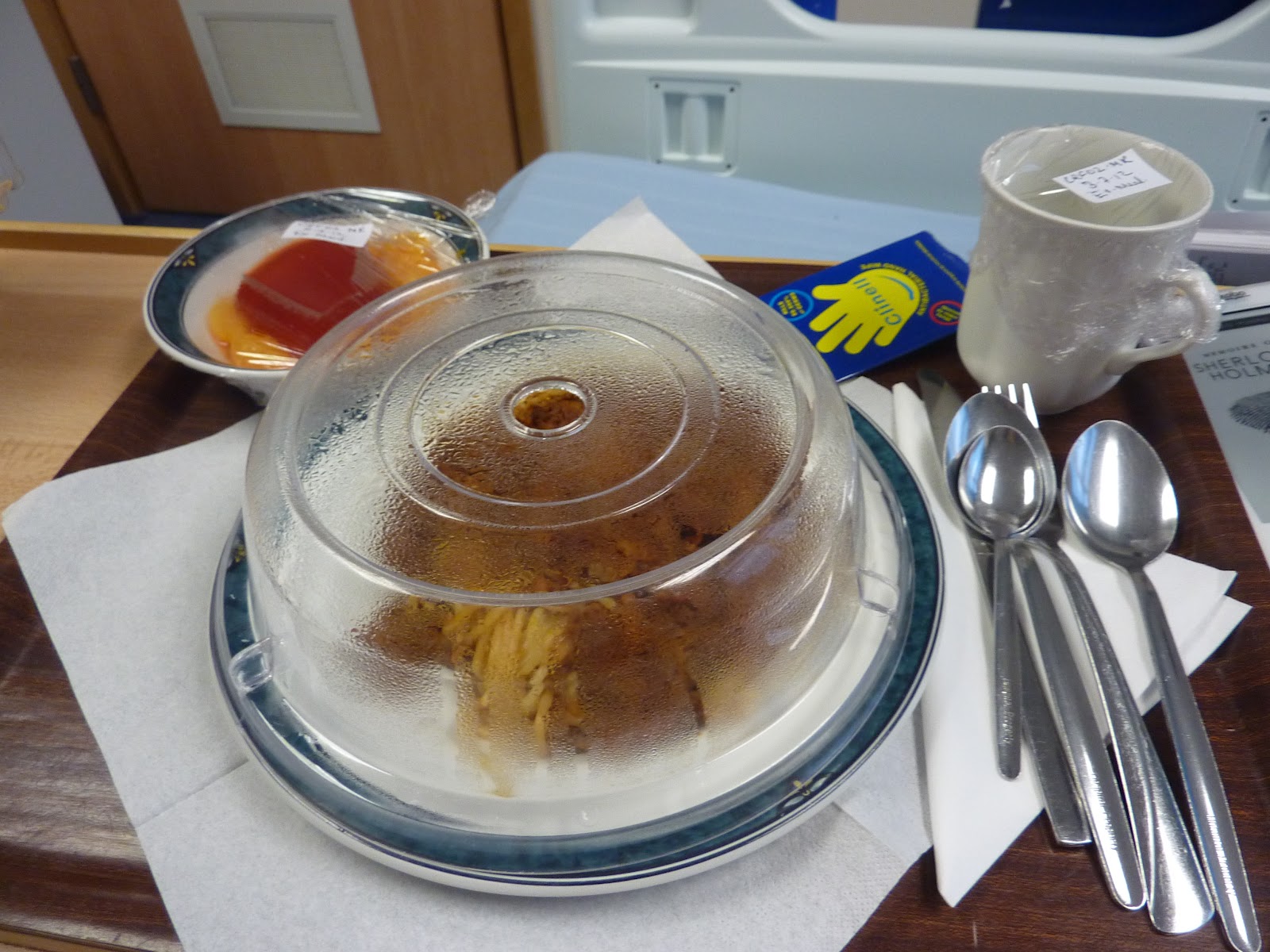
 Every dish had a label to show who it was for and when I should eat it, even to the extent that the milk for my evening (decaff) coffee had been measured out in advance, and I was not permitted any more. The main meal was, happily, spaghetti bolognese, one of my favourites.

But when I saw the dessert, my heart sank.

Close friends and family are aware that when it comes to desserts, I am usually more than enthusiastic in my appreciation of the culinary arts (unless it's cheesecake. Eurgh). However, I have a few basic rules. I don't eat jelly with sponge cake. I don't eat sponge cake with fruit.* And I don't eat fruit with jelly.

Here is a picture of the dessert:

In case you can't tell, it's strawberry jelly with tinned mandarin slices. NOOOOOO!
In fairness, it was partly my fault: the hospital did ask me whether I had any dietary requirements or dislikes, and I said no, because it would be strange and embarassing to have to explain my dessert law triad to a doctor. At least it wasn't cheesecake.

And so, I settled down to sup with good grace and managed to eat the entire thing. I did my utmost to separate the jelly from the mandarin segments wherever possible; where it was not possible, I adopted the approach to eating which has been popularised by the Burmese python, and gulped it down in one bite.

I don't know if the night nurse noticed my face fall when I saw the dessert, or whether she just thought I looked like an untrustworthy character, but she kept sticking her head around the door at unexpected moments while I was eating.

"Take your time," she said, smiling. "But you do have to eat it all."
"Ok, thanks," I replied.
My special tray!
Two minutes later, she popped up again. "You can take your time," she said. "Take as long as you want. But make sure you eat it all."

 And so on. It was very disconcerting. The constant visits created a weird kind of feedback loop where I found myself choking down the mouthfuls as quickly as possible in the hopes that she would finally stop telling me I could eat as slowly as I liked.

Eventually, I was done, and I had the evening to myself. I harassed my parents and boyfriend with text messages about jelly and fruit, read about the exploits of Mr Sherlock Holmes on my Kobo e-reader (which I LOVE), and flicked through TV channels. Eleven o'clock was lights-out and the terrifying night nurse came back again to confiscate my water and order me to pee in a jug overnight,** which was probably the moment I most felt like I was in prison.

Adding to this impression was the fact that my door had a small square window in it which opened onto the corridor and let an annoying amount of light in overnight, and the absurdly thin blanket on the bed. I often get chilly at night and hospitals are not cosy places, so I had brought my warmest hoody to wear in bed over my pyjamas, but I still woke up in the night absolutely freezing and had to ask for another blanket. This is extra annoying considering that hyperthyroidism is supposed to make you too hot, not too cold. In fact, I was given a questionaire about my symptoms, and one of the questions asked me to score my "heat intolerance" on a scale of 0-5, where 0 is no intolerance to heat and 5 is getting easily overheated. I wanted to add a -1 to the scale.

________________________________________________
*For those of you who really care about my pudding pickiness, I should note here that this rule only applies where the fruit makes the sponge cake all damp and hideous. I like fruit baked into cakes just fine. Fruit placed on top of a waterproof layer of icing is also acceptable. Trifle is the devil's pie.

**Not just for her own amusement; they did a 12 hour urine collection to monitor various hormone levels overnight.

Tuesday, 10 July 2012

Human Guinea Pig: Part 4 - Pituitary MRI Scan

This is the fourth part of the story about my overnight stay in the hospital's research department, having lots of tests to look at the effect my pituitary tumour is having on my body and metabolism. You can read the first part here, the second part here and the third part here.

Pituitary MRI Scan

After my Actiheart was fitted, they had to take it right off again as I went straight down to have my pituitary MRI, another scan where no metal is allowed. I was strangely comforted by the fact that the MRI receptionist was fairly rude to Dr Olive when she asked to speak to the technicians - not because I dislike Dr Olive, who is lovely, but just because it's nice to know it's not only patients that bear the brunt of receptionists' bad days. I have a theory that in every hospital the receptionist recruitment protocol calls for exactly 50% completely lovely, can't-do-enough-to-help-you staff, and 50% short-tempered and angry people. That or they slip some kind of Jekyll-and-Hyde potion into their coffees.

"Have you come from Norway today?" the technician asked me.
I think she was quite disappointed that I had not, though I've no idea why.

I was still dressed in the giant scrubs and they keep scanning rooms pretty cool, as the equipment needs low temperatures. Fortunately the technician was both lovely and observant, and she gave me a blanket to keep me warm in the scanner. The usual ritual of ear plugs and glasses removal was observed, and packing was duly stuffed into the strange helmet thing you have to put your head in. Then I was drawn backwards into the machine.

I didn't get a photo, so here's a cheesy stock image of some people smiling through an MRI scanner
MRIs can be quite claustrophobic, even if you're not normally bothered by confined spaces. I guess it is partly down to the fact that you don't have any control over it, partly down to the fact that your head is in a box and you're not allowed to move, and partly down to the weird and incredibly loud noises exploding into existence around you. However, if you do suffer from claustrophobia and you need to have an MRI, I can strongly recommend asking for a blanket. It makes the whole experience seem much more cosy. You can almost believe you're lying in bed on fireworks night. With your head in a box.

Then came the contrast injection, at which point I was given my panic button - usually they give you one at the start of the scan, but I was so happy under my blanket I hadn't even noticed I didn't have it - in case you have a reaction to the contrast dye (unlikely unless you have undiagnosed kidney failure, but still). Then another set of scans - each set took about ten minutes, I would guess - and then freedom! Easy as pre-packaged pie.

The strangest part of the scan actually happened after it was all over. There was another patient with the same condition as me who was having the tests at the same time - this meant we could both have our PET scans on the same day, as the hospital prefers doing two of the same type at once to save money. We'll call him Bob. I hadn't met him at that point, but he was having his pituitary MRI immediately after me, and so I stayed in the waiting room with a very sweet Filipino nurse waiting for his scan to be finished so we could all go back to the research department together.

I was, as I have mentioned before, still wearing scrubs. I was however wearing a pair of exclusive "I'M A PATIENT" bracelets detailing my name, age, hospital no. etc. and my allergies (trimethoprim = brings me out in an attractive full-body rash). The waiting room was pretty full, so I was sitting off to one side, flipping through an elderly magazine,* when a woman came up to me and asked me how much longer the current scan would take.

Well initially, I admit, I gave her a "woman, you crazy!" look, until I suddenly realised that in my current garb I probably looked like a member of staff.
"Sorry, I'm not a doctor, I'm a patient," I said.
"So how long will it take?" she asked.
I got out my "woman, you crazy!" face again. "Er, I don't know…"
"Well, I think it's really bad that we're not being given any information," she told me. "How long do you think it will take?"
"It probably depends on the type of scan?" I suggested.
And with that, she stamped off, muttering angrily to herself.

On the way back to the research department, I got to meet Bob! He is the first ever person I have met who also has a TSHoma, which is not surprising as there's only about 20 of us across the whole of the UK, Ireland and, apparently, Norway (this may explain the MRI technician's cryptic question). Bob was a bit of a legend and had sensibly rejected the scrubs they had suggested he wear, in favour of pyjamas with Animal from the Muppets on; obviously the preferable sartorial choice.


You might think that, on finally meeting someone else with the same incredibly rare pituitary tumour, we would discuss symptoms, or treatment. But no! People with TSH secreting pituitary adenomas are nothing if not polite, and of course we would not want the lovely Filipino nurse feeling left out of the conversation. So, as she most likely had no brain tumours of any sort, we instead discussed the best way to travel to Cardiff by public transport.

And a very educational conversation it was too.

My pituitary MRI scan experience:

Hassle: 2/5
Fun: 2/5 (extra point for meeting Bob!)
Weirdness: 3/5
Results: 2/5
Total Score: 9/20

I fear I've just had too many MRIs to find them exciting any more!

________________________________________________
*The magazine was old... it wasn't a magazine for old people.

Sunday, 8 July 2012

Human Guinea Pig: Part 3 - Actiheart Monitor & Step Test

This is the third part of the story about my overnight stay in the hospital's research department, having lots of tests to look at the effect my pituitary tumour is having on my body and metabolism. You can read the first part here, and the second part here.

Actiheart Monitor & Step Test

Once my body composition scan was finished, there was a certain amount of fretting that I would be late for my MRI scan appointment, so I was immediately whisked off to have my step test and Actiheart monitor fitted. This meant I was still wearing giant scrubs and no bra when I was supposed to be doing mildly athletic deeds, which proved somewhat inconvenient.

The Actiheart monitor is a teeeny tiny heart monitor which attaches to your chest by means of two sticky pads coated in glue so vicious it's almost impossible to wash off without taking the top layer of skin off too. I was informed I would be wearing it until midday Friday (I had not had any kind of advanced warning about that!) and that they wanted to carry out a step test to calibrate it. Essentially, while standing in a room full of cycling machines and a giant treadmill, you have to spend eight minutes stepping alternately onto and off of a purple plastic step, in time with a computerised voice which says "Up. Up. Down. Down." and gradually gets faster. The Actiheart records your heartrate as you do so, and then this is compared to the recording of your heart over the next few days, and used to gauge your activity level against your heartrate.

It's so tiny!
This explanation seemed pretty bizarre to me, because they were recording my exercising heartrate while I was off medication and therefore had an unusually fast heartrate, and then using this to calibrate the results of the heart monitor recording my heartrate when I was back on the medication. I have not yet had a satisfactory explanation of why this isn't stupid, but I live in hope.

Anyway. The computerised voice started up, and after only a minute or so began to take on a strangely hypnotic quality as I stepped endlessly up and down. By 5 minutes 30 seconds, the voice saying "Up. Up." started to sound more like an evil "Ha. Ha." and I became convinced the computer was laughing at me. The whole time, I had to hold up the trouser legs of my giant scrubs because they were too long as well as too wide, and I was concerned I would trip and fall on my (apparently worryingly fat) arse. Pro tip for the creators of Actiheart: I have to say that the whole experience would be vastly improved if you set the "Up. Up. Down. Down." man's voice to trance music.

Having just been told that I was 36% lard, I became quite concerned that I must be hideously unfit and would utterly disgrace myself by being unable to complete the step test, but in fact it was totally fine and even when he got quite fast at the end I was still happilly stepping away.

There was no printout of results to take away with me; I have to wait until the five-day recording has been analysed and then I should get some feedback through the post. I can't believe quite how small and awesome it is, compared to the 24-hour heart monitors which I've had to wear previously, which have invariably been vast, bulky and inconvenient.

My experience of the Actiheart Monitor and Step Test:

Hassle: 5/5
Fun: 3/5
Weirdness: 4/5
Results: 2/5
Total score: 14/20

Friday, 6 July 2012

Human Guinea Pig: Part 1 - The Research Facility

 I turned up at the hospital at 2pm on Tuesday and met up with the endocrinologist who's been in charge of arranging the series of tests which I was due to undergo  (she needs a top secret blogging name; we'll call her Dr Olive). We went to the research department where the tests would be carried out, and I was delighted to be introduced to my private room - complete with en-suite bathroom and free TV (and sharps bin, and cardiac arrest instructions).

My charming room
I think I've mentioned this before, but just in case - the tests which I had done over the past few days were done partly as general research into my condition and partly as a guide on what kind of treatment I should be given next. Firstly, a nurse was called in to do my initial tests; height (5'7"), weight (57.9 kgs), blood pressure (105 over 77), blood oxygen (97%) and resting heartrate (116 beats per minute - normal rate is 70-100 bpm). She had obviously not been informed about my tachycardia, because when she saw how fast my heart was going she looked at me askance and said "Did you come here running?" I assured her I had not, and that 116 bpm was perfectly normal for me. Later when Dr Olive looked at the results I think she was quite surprised; I had explained to her that I had tachycardia but she was surprised that my resting heartrate could be so high; of course, at that point when she took my pulse it was a perfectly standard 79 bpm.

I also had my breathing rate observed which was deeply disconcerting, as it essentially involves a nurse staring at your boobs for a solid minute while you attempt to "breathe normally". It is strangely difficult to breathe normally when you know someone is counting every inhalation.

Next came my ECG (electrocardiogram, a.k.a. EKG), where they put a bunch of incredibly sticky pads on your wrists, ankles, and across your chest around the heart. Then they attach a bunch of wires to the pads, which feed into a machine, which then prints out a trace of your heartbeat. It doesn't take very long but it is a bit of a hassle - the worst part is peeling the sticky pads off afterwards, although as the very nice nurse - let's call her Carla - pointed out afterwards, it's definitely a lot worse for blokes with hairy chests!

After that, I had to give my consent to the various tests that they wanted to do, and answer a few questions about my medication, my pituitary adenoma and any other medical conditions. It wasn't particularly exciting, although when Carla asked me if I ever suffered from any kind of recurrent pain, I said no. It was only after she'd asked me two further questions about pain that I finally remembered the fact that I have hypermobility syndrome and consequently have fairly regular bouts of joint pain, and have done since I was a child. I apologised for apparently being a massive idiot and she laughed and said people often forget these things when it becomes normal for them.

Some people with hypermobility/Ehlers Dahnlos Syndrome are incredibly flexible - later, Dr Olive came to ask me another set of questions, and when I mentioned the hypermobility again I think she was faintly disappointed at my lack of hilariously bendy joints. My little fingers do bend backwards alarmingly, but the joints that are most affected are in my legs and feet so they're not very impressive - and at the moment I can't even get vaguely close to touching my toes thanks to damaging a muscle in my left leg dancing.

Once I had been thoroughly questioned, I was left alone to contemplate my crimes - or at least, someone else's crimes, thanks to Arthur Conan Doyle, Sherlock Holmes and my Kobo e-reader, a birthday present from my parents and an excellent device for anyone planning to spend time in hospital.

Not quite an ocean view...

You can read the next post about my time in the hospital, and my DEXA body density scan, by clicking here.

Thursday, 5 July 2012

Medical Test Top Trumps

In relation to last night's post: Panic over! Turns out the darn thing is completely waterproof after all and I should have just left it on. Another example of my excellent sievebrain: good at draining pasta, not so good at retaining pertinent information about medical devices.

ANYWAY.

I am back from l'hôpital and I did indeed have an interesting time of it. While I did not appreciate waking up to an array of 23 blood tests yesterday morning, I can't deny that they hospital have been pretty darn thorough in their endeavours to understand what my pituitary tumour is doing to my metabolism! They also thoughtfully froze some spare blood - in case they later think of other blood tests they wish they'd done at the time. The tests were partly for research purposes into TSHoma and other rare thyroid conditions, and partly to decide how they want to move forward with my own treatment.

Here is a list of the tests and scans they did:

MRI Scan
CT Scan
PET Scan
DEXA Scans:
     - body composition
     - bone density (spine and hip/femur)
ECG heart trace
Step test
Actiheart 5-day heart rate and activity monitor
12 hour urine collection
Glucose tolerance test
GEM resting metabolic rate testing
TFT bloods
Blood pressure, blood oxygen, etc.
Symptoms/Quality of life questionnaire

Don't know what half of those acronyms stand for? Never fear, neither did I. All will become clear shortly. I had so many tests that there's no way on earth I could describe them all in one post, unless it was the longest and most terrifying blog post in the world, so I figure I'll go through what happened chronologically. In order to introduce an element of competition to the proceedings, I have decided to rate each medical test against a set of four criteria: Hassle (how much hassle the test was to undergo), Fun (how fun the test was. I may have to introduce minus scores), Weirdness (self explanatory) and Results (does the test produce a pretty picture/interesting information once completed).

Each type of test will be scored on a range of 0-5, and by the time I have finished it should be possible to play Emer's Medical Test Top Trumps. Just what you've always wanted!

_____________________________________________
p.s. - forgot to mention, I took my camera with me as promised so I actually finally have a few photos to show you!

Tuesday, 3 July 2012

Once More Unto The Breach

Good morning my fine friends! I have now heard back from the endocrinologist about where I'm supposed to be going and at what time. 2 o'clock is zero hour! Also I don't think I mentioned in my last post that on Saturday she also informed me that I was banned from vigorous exercise and caffeinated drinks until I leave the hospital on Wednesday. Obviously I was distraught on both counts, but the lack of tea is starting to take its toll. One of my colleagues very kindly let me drink her herbal red berry tea all day at work yesterday when I realised I'd forgotten to bring in my own decaf alternative to the Altar to Caffeine which is provided by our tea fund, but it's just not quite the same.

Anyway, I won't be blogging in hospital but just you wait til I get out... Hopefully I'll have something halfway interesting to write about.

Sunday, 1 July 2012

Terminal Stupidity

So the endocrinologist managed to send all the information on the metabolic testing I'm due to have on Tuesday-Wednesday to the wrong address. Realising her error she called me and agreed to drop off the information today. When I arrived home an envelope was waiting, but sadly while it does contain some info about the tests I will be undergoing, it does not contain any details of where this testing will take place or indeed at what time on Tuesday I should arrive at this undisclosed location...

Thursday, 28 June 2012

My Transsphenoidal Pituitary Surgery: Part 1

And so, the day of my pituitary surgery dawned!

Or rather, it didn't. It was still dark when I got up that morning; I had to report to the hospital at 7am and I needed to get up early enough to allow time for paranoid checking and re-checking of my bag. Thank god for the internet - I packed in a rush the night before, but all I had to do was Google "what to pack for hospital" and I was supplied with numerous checklists that helped ensure I did not forget my toothbrush.

I reported in, accompanied by my mum and dad, and was duly supplied with my attractive compression stockings and various leaflets. I was assigned a waiting bed in the neuro day ward, and another lady who was having the same surgery was there as well. One of the nurses ran through the pre-operative assessment form again and I was swabbed for MRSA - apparently if you come up positive they don't cancel your operation but you do get moved to the end of the queue for that day, in case you end up contaminating the patients after you.

It was at this point that I started meeting anaesthetists. A woman walked into the room and introduced herself as my anaesthetist, asked me some questions, and let me ask her any questions I had. Shortly after she left, a man walked into the room, introduced himself as my anaesthetist, seemed surprised when I said I had already met someone claiming to be my anaesthetist, asked if I had any questions, and then left. These two certainly looked and dressed like anaesthetists, but I have to say that the third man to introduce himself as my anaesthetist was the most convincing, as he was sticking a needle into my arm at the time.

There was a lot of sitting around informing people that I wasn't pregnant that morning, plus the signing of various consent forms allowing them to keep slices of tumour for research purposes and promising them not to haunt them if I died. As hospitals are really an ideal setting for poltergeist activity, I for one felt this was pretty harsh.

At some point a nurse asked me to get changed into one of their haute couture hospital gowns, so I did. The lady in the next bed was wheeled off to her surgery. Somewhat later, two young men arrived and announced they had come to take me for a CT scan of my pituitary.* No-one had told me that I was going to have a scan, so this was something of a surprise.

The porters went out to confer with the nurses. There was a considerable amount of to-ing and fro-ing, mind-changing, phonecalls and confusion, but eventually it was decided that yes, I was indeed due to have a CT scan before the surgery. I was told it could take up to an hour, so I cheerily waved my parents goodbye and was wheeled away in my bed by the porters, whose social lives I learned quite a lot about on the way to the distant CT scanner.

I was taken into the scanning waiting room, in the bowels of the hospital, and my bed was parked up. It was not a cheery place; everyone else in there was really not well. I felt strangely fraudulent, sitting up in my wheely bed like a perfectly healthy person, waiting.

And waiting.

There was a bit of a backlog at the scanner, as per usual. I have no idea how long I had been waiting, when all of a sudden, Mr Pout (one of my surgeons - I wrote about him in this post) appeared by the side of my bed, all scrubbed up and out of breath.

"Miss Grey, we've been looking for you!" he cried, in what I felt was an unreasonably reproachful manner given that I had quite clearly not wheeled myself down there. "Everyone's waiting for you in theatre right now!"

Of all the WTF moments that the hospital has given me in our association, that was certainly the strangest to date. Mr Pout grabbed the bed and attempted to wheel me to the operating theatre; not an easy task, plus it was quite a long way away. Hospital beds are like larger, more dangerous supermarket trolleys and require two people for optimum maneouverability. Fortunately we (quite literally) bumped into one of Mr Pout's colleagues along the way, and she lent a hand wheeling me into a lift.

Along the way, Mr Pout breathlessly explained that they had originally been intending to do my pituitary surgery with teeny instruments and the aid of an ENT team (Ear, Norse & Throat; Treebeard doesn't do transsphenoidal surgery), due to my "narrow nasal passages".** In order for this to happen, the ENT people neeed a CT scan. However, when my surgery had been cancelled, they had cancelled the ENT team and had been unable to un-cancel them; consequently they would be doing the surgery the normal way, assuming the instruments would fit up my nose. There was a slight risk, Mr Pout informed me, that they would not.

At this point, Mr Hamstercheeks, the head surgeon appeared. I had never met him before. "

I was just explaining that the surgery might not be able to go ahead if her nose is too small," said Mr Pout.

Mr Hamstercheeks looked at my nose. "No, it'll be fine," he said.

HARSH.

"Can someone please make sure that my parents know I've gone into surgery?" I asked. A nurse asked for their details, picked a phone off the wall and dialled the ward where I had been to request that my parents were told. As I found out later however, somehow the receptionist on the ward managed to get epically confused and my parents were never told, despite asking where I was. They weren't bothered though, they went into town for lunch.

At this point I was still wearing my glasses, hairband, and slippers, which I had to take off; I was super nervous, but in a way the complete muddle over my surgery was kind of good - because it meant I was laughing as they wheeled me into the prep room. I met the third anaesthetist and various people starting sticking needles in my arms. It turns out the third anaesthetist used to live in the same road as me, so we got chatting about the local takeaways. At one point I thought I should just lie back and relax, let the various medical professionals do their thing - but then I suddenly became deeply paranoid that they'd think I was asleep when I wasn't (stupid I know) so I decided to keep talking as long as I was awake.

As this is what I usually do anyway, it was not a problem.

_______________________
*Possibly I should note that they were hospital porters, not kidnappers.

**If you haven't worked it out, transsphenoidal pituitary surgery involves sticking surgical instruments up your nose and drilling through the back of it to gain access to the inside of your skull.

Tuesday, 26 June 2012

Further Phonecall Funtimes With The Hospital

Another hilarious hospital moment: so on Friday I was heading to London for a friend's wedding (congratulations Mrs X!). The wedding wasn't until four, but I was doing the bride's hair and makeup and consequently heading down there nice and early. I felt almost certain that the hospital would attempt to phone me during the ceremony, because their phone call timing is always so hilariously dire. I am happy to report that they did not! Hurrah! Instead they called me just as I was trying to get onto a train, juggling three bags, one of which had to be kept upright at all times, and a cup of hot coffee.

Anyway, I made it to a seat without dropping the phone or spilling hot coffee all over my dress, and very proud I was too. The best part of the phone call was the beginning, which went like this:

ME: Hello?
ENDOCRINOLOGIST: Hiya, is this an OK time to talk?
ME: Yes, now is fine! (I am quite the liar)
ENDOCRINOLOGIST: SO I was just calling to let you know that I've confirmed the date for you to come in for your overnight testing on the 3rd to the 4th July-
ME: I'm sorry, did you say the 3rd to the 4th?
ENDOCRINOLOGIST: Yes, the 3rd to the 4th July, as we agreed on Monday?
ME: On Monday you told me it would be the 2nd to the 3rd...
ENDOCRINOLOGIST: Oh, did I? Sorry, it's actually the 3rd to the 4th. I'm always doing things like that, haha!

FACEPALM

Fortunately I could do the 3rd-4th as well, although I had to cancel plans to have dinner with a couple of my friends on the evening of the 3rd (sorry guys!). But I have to admit I was slightly taken aback at the fact that the endocrinologist didn't even inquire whether the new date suited me, despite the fact I would obviously have to re-clear it with work etc. She just assumed there would be no problems.

Perhaps at this point I should reiterate the fact that the hospital I'm treated at is in the main very good, with regards to treatment, explaining things, liaising across different departments, making sure I'm seen by multiple members of the endocrinology team etc. The nurses there are absolutely lovely, and when I had my surgery they really did look after me well. It's only in the administrative context that they fall down so abysmally, and I guess if it's a choice between a hospital providing very good treatment but being rubbish at arranging appointments, or vice versa, we all know which we'd prefer.

But anyway. The long and the short of it is that I will be going into hospital next Tuesday afternoon and staying in til around four o'clock on Wednesday. They've managed to arrange it so I will have my first PET scan on Wednesday so I won't have to come in again on a different day, which is good news. As for precisely what tests they are going to do, they've been kind of vague on the details but have said they'll send me leaflets on them; it's going to include a further pituitary MRI, some kind of body composition scan (I am now slightly afraid they'll tell me I'm composed of 90% fat), along with another bone density scan I think, and what I believe is technically referred to as a "shitload" of bloodtests.

I'm supposed to come off the beta blockers from the 31st and not take them at all until after my last set of blood tests on the 4th, which is going to SUCK. I have to travel through London on the 31st and I am really not looking forward to it now. I'm frequently finding I have a resting heartrate of about 120bpm at the moment and I've had to double my daily dose of beta blockers compared to what I was taking when I was on the lanreotide. Erk. I have expressed my annoyance on here previously at the fact that doctors really don't understand how rubbish tachycardia can make you feel; it just makes absolutely everything feel like really hard work. I'm also slightly suspicious that when I get there they might try and make me run on a treadmill or something (someone I work with had metabolic testing at the same hospital in the same facility and that's what they made her do) which without beta blockers would beeven less fun than usual!

So I'm going to try to remember to take my camera along with me to the hospital and take some pictures while I'm there, if they'll let me! Other people with medical type blogs always post pictures of their scans or having tests done or whatever and I never do, so I am determined to have a bash at it. If worst comes to worst I shall at least endeavour to get some exciting shots of my hospital bed...

Thursday, 21 June 2012

Progress!

I finally had a phone call from the hospital on Monday. I was offered a timeslot for my overnight stay and all the various tests they want to do on the 2nd-3rd of July. Alas, they can't do the PET scan on that day because the tracer they use comes in batches sufficient for two people, so they have to match you up with someone else who needs the same scan before they do it. So we're looking at doing the PET scan on the 10th July instead.

Good news!

It was a slightly disconcerting phone call; the endocrinologist asked me if I could confirm that the dates would suit me on the spot, and I said that I was pretty sure they would be fine but that I would need to check it out with work before I could be 100% certain. This seemed to genuinely confuse her. Equally strange was when she asked me if I was on any medication; I replied that I'm on propranolol, a beta blocker. She said that it could interfere with the tests and I would have to stop taking it for three days; so I said that although I was willing to give it a go, I would probably find it quite difficult to not take any for three days. This really baffled her - she asked me what I was taking it for. I said tachycardia (fast heartbeat) - but I'm pretty sure if I had said that I was taking it to keep the little green men out of my ears, she couldn't have found that more peculiar. It was strange, because this was something I had already discussed with the endocrinologist who originally asked me to have these tests - and he said that if I found it difficult to get by without it then they'd just not do some of the tests.

Ironically, my heart tends to operate on a bit of a timelag and takes a while to show any effect from my thyroid levels either increasing or decreasing, and it has only started to really go a lot faster in the last two weeks or so - which means that if they'd just organised the damn tests when they said they would, I might have been able to cautiously get by. However, I will be travelling through London on the 1st July with heavy bags and that is stressful enough even when your resting heartrate's not 120bpm.

Anyway, the long and the short of it is that she said that these dates "still need to be confirmed" with the clinical research facility place where I will be going (how exciting) and that she would call me back and let me know when they're definite and also tell me more about what exact tests they will be doing. That was on Monday. Today is Thursday. I am really hoping that doesn't mean there is a problem with the dates.

Monday, 18 June 2012

IMFW: Autism Research Defrosted

In a previous post about brain injuries in sport, I wrote about the Centre for Traumatic Encephalopathy, which collects and studies brain tissue from athletes involved in high-contact sports. Recently another "brain bank" has been in the news; the Harvard Brain Tissue Research Center at McLean Hospital, where a freezer malfunction damaged one-third of the world's largest collection of brain tissue donated for autism research.

150 brains were prematurely thawed as a result of the broken freezer, with alarm systems and daily inspections failing to alert staff to the malfunction until it was too late. Some of the tissue may still be useable for genetic research, but it's considered to be a huge setback in the field of autism research generally. Postmortem research has previously led to breakthroughs in the study of Huntingdon's disease and Parkinsons.

The loss of the potential research opportunities afforded by the collection is devastating not only to the medical community, but to the families of those whose brains were donated for research. The hospital is conducting two investigations into the fault, with a third carried out by a charity, Autism Speaks.

Monday, 14 May 2012

IMFW: Brain Injuries in Sport

An interesting story that has been popping up now and again for the last few months concerns brain injuries in the US NFL (National [American] Football League), so that's what we're focusing on in this week's Interesting Medical Fact of the Week.

American Football is obviously a high-contact sport, hence the crazy amounts of protective gear the players wear - including helmets. However, evidence has been mounting for some time that all this protective gear may not be enough.

Several high-profile former players have killed themselves in the last few years. Dave Duerson committed suicide in February 2011, after texting his family to request that his brain be donated to the NFL's "brain bank" - namely, the Centre for the Study of Traumatic Encephalopathy, which was set up by former athletes to investigate the long-term effects of the concussions suffered by sportspeople and military personnel.

The Centre focuses on studying chronic traumatic encephalopathy (CTE), which is a progressive, degenerative disease of the brain. As early as the 1920s, there was recognition that this condition particularly affected boxers, but it now appears that it is also associated with repeated brain trauma (i.e. concussions or other head injury). Professional American football players, ice hockey players and those involved in sports such as wrestling, are particularly likely to sustain these kinds of injuries.

Chronic traumatic encephalopathy is a nasty illness. Much like Alzheimer's Disease, it involves the build-up of tau proteins in the brain, and the initial symptoms of memory loss, confusion, depression, and self-control problems eventually lead to full-blown progressive dementia with some symptoms of Parkinson's Disease.

When Duerson's brain was studied, researchers found that the repeated trauma to his head during his professional career appeared to have caused severe damage. One of the difficulties with chronic traumatic encephalopathy is that there can be a significant latency period between the original injuries and the appearance of recognisable symptoms; however, along with Duerson, many other former NFL players - and those involved in other high-contact sports - have been diagnosed with chronic traumatic encephalopathy after their deaths. Chris Henry, another American football player who died after falling from a moving vehicle, was the first player to be posthumously diagnosed with CTE while still active as a professional sportsman; but the earliest signs of the disease have even been found in the brain of an 18-year-old student athlete.

As well as Duerson, former professional footballers Junior Seau and Ray Easterling also recently committed suicide. Along with several other American football players, Easterling was involved in a class action lawsuit against the NFL over its handling of concussion-related injuries, which alleges that the NFL continuously denied any knowledge of a connection between NFL players sustaining repeated head injuries and the later development of dementia or CTE. In addition to this, another lawsuit was recently launched on behalf of over 100 former professional players, claiming that the NFL repeatedly denied the existence of any connection.

Chronic traumatic encephalopathy is a very rare disease, and one of the difficulties in researching it is that it can only be definitively diagnosed post mortem. But the work of the Centre for the Study of Traumatic Encephalopathy is already causing waves in the world of American football, and there have already been calls for changes to the game's regulations, effectively banning head contact from the game. The Centre's research is still ongoing, so whether that will actually happen remains to be seen.

But are those helmets enough?

If you're interested in this topic and would like to find out more, I recommend the Centre's very informative website, which also has a selection of case studies you can read about.

Friday, 11 May 2012

Ding Ding: Round Two

I had been holding off posting for a few days, not out of laziness,* but because I was waiting to find out the outcome of my hospital appointment last Thursday. And then it took me absolutely ages to type this up because, let's face it, it's dull and complex. For the last couple of months I have been largely in the dark as to the results of my blood tests and recent MRi scan, so I really had no idea what to expect.

What I did not expect was to find the television in the endocrine waiting room playing Cash In The Attic. This television has, to my knowledge, never previously displayed anything other than The Jeremy Kyle Show. I always assumed that the hospital trust had performed some kind of patient survey and determined that diabetics and people with pituitary tumours prefer their televisual experiences to involve shouting, paternity testing, and the phrase "Madam, you disgust me".

I digress.

First up, as per usual, I was weighed (lost: one kilogram since February, almost certainly due to forswearing chocolate over Lent rather than the TSH-oma) and had my blood pressure taken (standing blood pressure: 118/76 - score! It would appear that switching my heart medication back to propranolol has made a difference). Then I had a quick review with one of the endocrinologists about how my symptoms have changed since being on lanreotide injections (not much).

Then the doctor ran away and eventually returned with two other endocrinologists in tow, who all stood at the other end of the room and surveyed me like something interesting they'd found in a jar at the Hunterian Museum.**

They have been somewhat confused by the fact that my levels of various thyroid hormones have remained roughly the same since being on the lanreotide injections, despite the fact that you would expect them to drop.

Additionally, the MRI scan of my pituitary was a little tricky to interpret. Essentially, the pituitary gland is like a tiny upside-down lollipop just below your brain. The stick of the lollipop is called the infundibular stalk*** and it connects the pituitary gland to the hypothalamus. My original MRI pituitary scan showed a great big gobstopper lollipop with a dark patch of necrosis in the middle, where the tissue inside the tumour had died off a bit. To picture this, first imagine a lollipop with a liquid centre, and then imagine something a lot more disgusting. But my latest scan shows a rather more normal-sized lollipop which hasn't grown since my surgery (hurrah!). However, the stick of the lollipop is slightly bending to one side.

Given that there's limited space inside your head for these things to grow, a wonky pituitary stalk can indicate that the bulk of a tumour is pushing the rest of the pituitary gland to one side. So the area of pituitary gland on the left-hand side is now under suspicion. I have to say, looking at the scans was kind of awesome, because it's not like when people show you the ultrasound of their baby and you have to pretend you totally see what they're talking about. I actually could see what they were talking about.

But the problem with MRIs is that they can show you what's there, but not what it's doing. So although it looks like there's probably a bit of tumour left on one side of my pituitary gland and that may well be what's still causing my symptoms, it's still possible that it's not that bit at all. And it would be rubbish to have surgery, take that bit out and then discover it was actually healthy pituitary tissue.

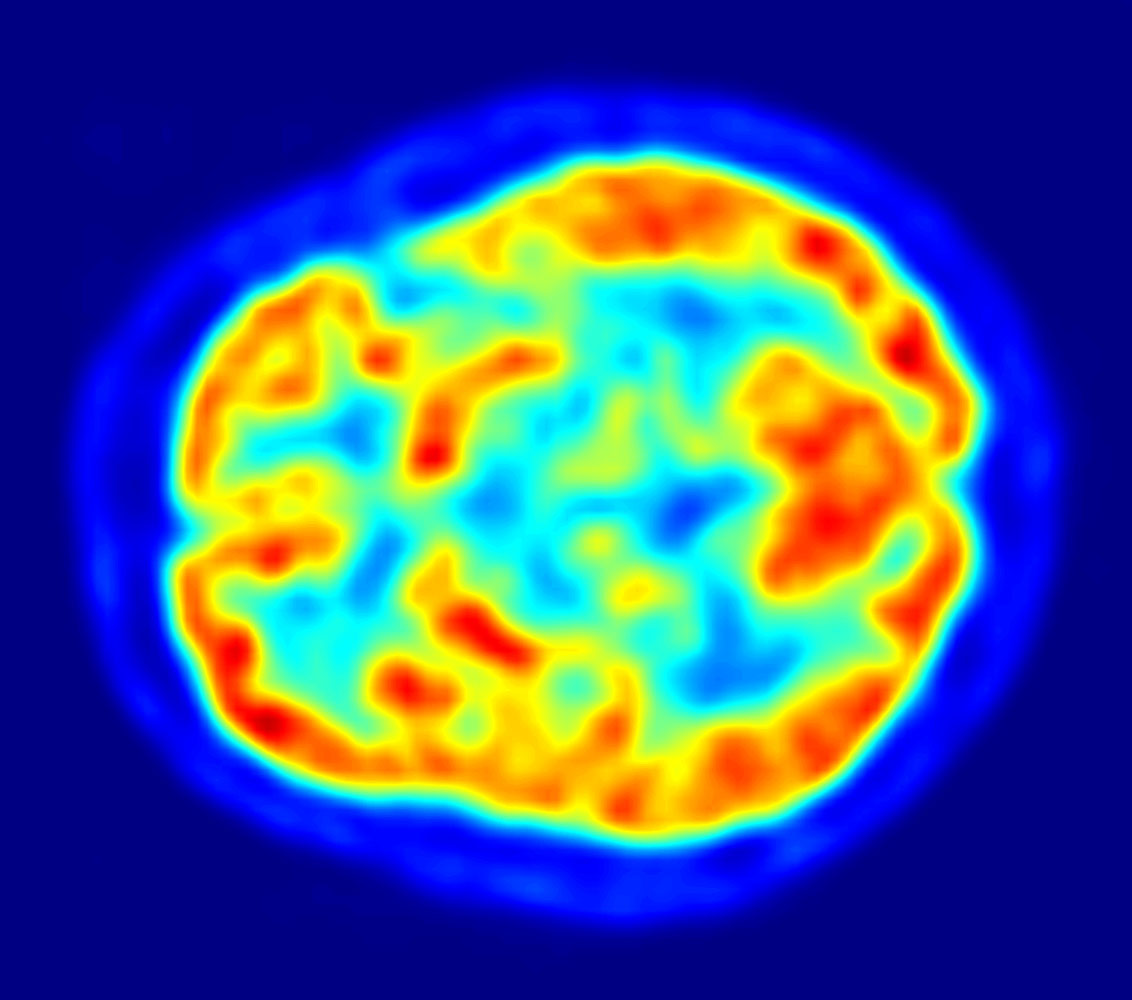
So my doctors want me to have two combined PET/CT scans. PET (Positron Emission Tomography) scans are super colourful and pretty, but that's not the only reason they want me to have one (I hope).

PET scan of the brain

 Basically, PET scans can show those areas of the pituitary that are most metabolically active. Inactive areas are dark. So the idea is that I will have one of these scans while not on any kind of medication, which should show the whole pituitary lit up like a christmas tree, and then have another scan after three months on a higher dose of lanreotide, which should suppress the hormone production in the TSHoma. Any areas that go from being bright blue on the first scan to being dark in the second scan are probably tumour. Then, if the tumour is in an easily-accessible area of my head, I might have surgery again. If it's somewhere tricky to reach, I'll probably just continue to have regular injections of lanreotide indefinitely.

So I'm not having any more lanreotide injections for six weeks, so that it's definitely completely out of my system. And in the meantime they want to have me come in overnight one for some research tests on my metabolism and things. Essentially the hospital are collecting patients with pituitary tumours that produce TSH and studying us, so I am now officially a guinea pig.

_______________________________________________
*How could you ever think such a thing?

**I'm joking, they were very nice.

***Or just the pituitary stalk, but you don't get to use a word like "infundibular" every day.

Monday, 7 May 2012

IMFW: Signed In Blood

Exciting news recently about a new test to identify people's blood groups, which was allegedly inspired by Voldemort's evil self-writing diary in the Harry Potter books. When a blood sample is applied to the paper, it actually spells out the person's ABO and Rhesus blood groups, the idea being that this is far more user-friendly and should reduce misinterpretations of blood group compared to the existing tests.


Warning: side effects may include possession by the Dark Lord.


Monday, 30 April 2012

Characteristics of Thyrotropinoma

I found an article on a website which lists the characteristics of thyrotropinoma (a.k.a TSH-oma, a.k.a the kind of pituitary tumour I have, which secretes thyroid-stimulating hormone) as follows:

"Thyrotropin secretion by thyrotropinomas is characterized by increased pulse frequency, delayed diurnal rhythm, enhanced basal secretion, spikiness, and disorderliness."

I deeply resent this. In fact, I am a very orderly person.