Aloha! It's been another age since I've written in here! My apologies. I thought I'd pop by to give you a quick update.
Way back on the 15th April I had an MRI scan at the hospital (so long ago that I had to look up the dates in my diary at work...). I didn't get the results until the 20th May, when I had an appointment with a very nice nurse in Neurosurgery. My lovely boyfriend came with me to the hospital and saw the scan images, so I guess now he is in the enviable position of having seen exactly what's going on inside his girlfriend's head!
The scans look pretty good - it's always hard to tell just from an MRI, but the surgeons were optimistic that they managed to remove the whole tumour, and there's nothing obviously wrong in the images. The trouble is that the pituitary gland is so tiny - about the size of your little fingernail - so even with the contrast injections, at best an MRI is only an indication of what's going on in there - blood tests are very important as well. But the surgeons are very happy with me, and as far as they're concerned, I don't have to have another MRI for a year. Hurrah!
On the 27th June I went to see the endocrine nurses for a synacthen test. This test evaluates how well the pituitary is producing adrenocorticotropic hormone (ACTH). This hormone is really crucial for your body, and because there's always a risk that surgery can damage the pituitary gland, patients who have transsphenoidal surgery are put on replacement steroid medication as a matter of course. The doctors will only let you come off the medication if a synacthen test shows your pituitary gland is now able to produce ACTH on demand.
I already had one of these tests back in March and my pituitary had a fairly good response, but not quite good enough to come off the medication totally. The endocrinologists halved my dose of hydrocortisone, but I'm still taking 5mg in the morning and 5mg at midday. I'm hoping that the results of my test last week will be good enough for me to come off the steroids totally. It would be in line with what happened after my last operation, when it took about six months before I was able to come off medication. Certainly immediately after the operation I was in need of the steroids - about a month after surgery, I forgot my 4 o'clock 5mg dose, and was a complete emotional wreck all evening until I remembered I hadn't taken it at about 7pm. I took it - and half an hour later I was already feeling immensely better. More recently I have forgotten to take my hydrocortisone on time once or twice and not had any ill effects at all, which hopefully is a good sign.
I don't know yet what date I'm due back at the hospital for my next proper follow-up with endocrinology. I had thought it would be the end of June, but apparently it's actually going to be the end of July, four months after my last clinic appointment. Then I should get the results of the synacthen test, and the other blood tests they did at the same time to check my thyroid levels.
Showing posts with label adenoma. Show all posts
Showing posts with label adenoma. Show all posts
Monday, 1 July 2013

Wednesday, 6 February 2013
Sad News about Tanya Angus, Acromegaly Sufferer
I've been out of the world for a little while thanks to my surgery, so I was saddened to find out only today that Tanya Angus, an acromegaly sufferer, passed away on the 14th January. She was aged just 34, and died from heart failure and transient ischaemic attack (a "mini-stroke").
Tanya Angus had one of the most severe cases of acromegaly (a.k.a. gigantism) ever seen; it was not until her pituitary adenoma (tumour) grew to the size of a grapefruit that she was finally diagnosed. By this time, the tumour wrapped around her pituitary gland proved extremely resistant to surgical and radiotherapy treatment. Her condition caused her to grow from 5'8" at the age of 21 to 7ft tall by the time of her death, and to go from 130 to 400lbs. Just last August it seemed that injections to inhibit her growth hormone production had been successful, but by October sadly her levels of growth hormone were rising once again.
She was a well-known figure in the acromegaly community for her efforts to raise awareness of the condition, and to encourage education about and early detection of gigantism among the medical profession. Anyone reading her website, or the comments sections of the various news websites which reported her death, can't fail to notice how many of her fellow acromegaly sufferers viewed her as an inspiration.

Tanya Angus had one of the most severe cases of acromegaly (a.k.a. gigantism) ever seen; it was not until her pituitary adenoma (tumour) grew to the size of a grapefruit that she was finally diagnosed. By this time, the tumour wrapped around her pituitary gland proved extremely resistant to surgical and radiotherapy treatment. Her condition caused her to grow from 5'8" at the age of 21 to 7ft tall by the time of her death, and to go from 130 to 400lbs. Just last August it seemed that injections to inhibit her growth hormone production had been successful, but by October sadly her levels of growth hormone were rising once again.
She was a well-known figure in the acromegaly community for her efforts to raise awareness of the condition, and to encourage education about and early detection of gigantism among the medical profession. Anyone reading her website, or the comments sections of the various news websites which reported her death, can't fail to notice how many of her fellow acromegaly sufferers viewed her as an inspiration.
Tuesday, 8 January 2013
Round 2 With Neurosurgery
So, back to the story of my various experiences way back in November! A
mere two months late...
On the 5th November, I had an appointment at the Neurosurgery clinic - as I discovered less than a week beforehand. I had been very nervous about it, but I turned up at the hospital on time, and went through the strange procedure in Neurosurgery where they seat you in one waiting room for five minutes, then lead you through to a second waiting room further along the corridor shortly afterwards. The last time I had apre-surgery appointment with Neuro, I was kept waiting for about three hours, so I had come prepared with su-dokus and a lengthy novel - but amazingly this time I was only there for around twenty minutes.
My second surprise when I was shown in to see the surgeon was that he was actually the surgeon named on my paperwork; previously when I went to meet the surgeon, I just met a member of the surgical team, not the leading surgeon dude himself. But there he was, complete with a trainee doctor who was shadowing him for the week. It's a teaching hospital, so I'm quite used to having an assortment of medical students sitting in on my appointments; the highlight was probably a charming exchange student from Japan who was assigned to the endocrinology department. When an endocrinological emergency meant that we were sat alone together in my endocrinologist's office for twenty minutes, he admitted that he had no desire to become an endocrinologist himself, but we did have a very nice chat about Japanese medical schools.
So, I sat down and the neurosurgeon mentioned the results of my recentMRI pituitary scan, and seemed surprised to hear that no-one had told me about them. Back when I first became a patient, when I had an MRI someone was guaranteed to phone me and let me know the results, but alas in recent times this seems to have completely fallen by the wayside, and it's so much hassle trying to call up and find out myself that I tend to just wait until my next appointment to find out.
It was good news; the pituitary tumour hadn't grown since the previous scan in July, and in fact if anything they thought it might have reduced in size slightly, although it's difficult to tell with these things unless it's a substantial change. I had the scan at the end of October, by which time I'd been on my lanreotide injections for two months continuously, and before that I had an injection in August which lasted for a month, followed by a month without medication before the injections started again. So it looks like they were effective at controlling the pituitary tumour growth, which is excellent news! Although I've had the injections before, they've never really looked at whether they had an effect on the size of the tumour by scanning a "before and after" shot, which is something I've found a bit strange, to be honest.
Despite that, the neurosurgeon was (perhaps unsurprisingly) keen to press on with endoscopic transsphenoidal surgery. The risks are largely the same as last time, although slightly increased as it's a second surgery. There's about a 15% chance that surgery will leave me with hypopituitarism - i.e. unable to produce one or more pituitary hormones. The most likely one to go would be thyroid stimulating hormone, as that's what the tumour produces, but it could be anything. Any hormone that I can't make would need replacing with medication (except possibly growth hormone, which they don't tend to replace unless strictly necessary), which I'd probably have to take permanently (although it depends; some people develop hormone deficiencies right after surgery and then recover). I'll be back on the steroids after the surgery until it's clear that my pituitary is producing ACTH (adrenocorticotropic hormone) again. Last time I was given a pill slicer when I left hospital, which I managed to lose, to my great regret - I'm secretly hoping I'll get another one.
There's also a slight risk of waking up with permanent double vision. The surgeon told me that he "can't remember" the last time this happened, but until I see a certificate assuring me that he doesn't have any kind of early-onset dementia, I refuse to be entirely reassured. It's because the tumour is now over to one side of the pituitary and surgery will thus be taking place closer to various important eye nervy things. I hope I'm not confusing you with all this technobabble.
It's a slightly different type of surgery I'll be having this time, endoscopic transsphenoidal surgery, which takes a bit longer but should have better results. I'll be under anaesthetic for longer, so probably will have more side effects from that and take longer to get over the anaesthetic. On the plus side though, they might not need to put packing in my nose afterwards, which would be awesome, because having the packing taken out last time was So Not Fun. However, I bled oozily from the nose for like three days last time and had to wear a hilarious moustache made out of bandages to catch all the blood (sorry for the TMI) for several days, so I guess I might be one of the unlucky cases who still needs packing. But oh my goodness, it would be nice not to have it.
Anyway, the whole consultation didn't take very long at all really, I couldn't think of any good questions, so I went home. The very next day, I was off to see the Ear Nose and Throat people... and have a tiny camera pushed up my nose. But more on that next time...
On the 5th November, I had an appointment at the Neurosurgery clinic - as I discovered less than a week beforehand. I had been very nervous about it, but I turned up at the hospital on time, and went through the strange procedure in Neurosurgery where they seat you in one waiting room for five minutes, then lead you through to a second waiting room further along the corridor shortly afterwards. The last time I had apre-surgery appointment with Neuro, I was kept waiting for about three hours, so I had come prepared with su-dokus and a lengthy novel - but amazingly this time I was only there for around twenty minutes.
My second surprise when I was shown in to see the surgeon was that he was actually the surgeon named on my paperwork; previously when I went to meet the surgeon, I just met a member of the surgical team, not the leading surgeon dude himself. But there he was, complete with a trainee doctor who was shadowing him for the week. It's a teaching hospital, so I'm quite used to having an assortment of medical students sitting in on my appointments; the highlight was probably a charming exchange student from Japan who was assigned to the endocrinology department. When an endocrinological emergency meant that we were sat alone together in my endocrinologist's office for twenty minutes, he admitted that he had no desire to become an endocrinologist himself, but we did have a very nice chat about Japanese medical schools.
So, I sat down and the neurosurgeon mentioned the results of my recentMRI pituitary scan, and seemed surprised to hear that no-one had told me about them. Back when I first became a patient, when I had an MRI someone was guaranteed to phone me and let me know the results, but alas in recent times this seems to have completely fallen by the wayside, and it's so much hassle trying to call up and find out myself that I tend to just wait until my next appointment to find out.
It was good news; the pituitary tumour hadn't grown since the previous scan in July, and in fact if anything they thought it might have reduced in size slightly, although it's difficult to tell with these things unless it's a substantial change. I had the scan at the end of October, by which time I'd been on my lanreotide injections for two months continuously, and before that I had an injection in August which lasted for a month, followed by a month without medication before the injections started again. So it looks like they were effective at controlling the pituitary tumour growth, which is excellent news! Although I've had the injections before, they've never really looked at whether they had an effect on the size of the tumour by scanning a "before and after" shot, which is something I've found a bit strange, to be honest.
Despite that, the neurosurgeon was (perhaps unsurprisingly) keen to press on with endoscopic transsphenoidal surgery. The risks are largely the same as last time, although slightly increased as it's a second surgery. There's about a 15% chance that surgery will leave me with hypopituitarism - i.e. unable to produce one or more pituitary hormones. The most likely one to go would be thyroid stimulating hormone, as that's what the tumour produces, but it could be anything. Any hormone that I can't make would need replacing with medication (except possibly growth hormone, which they don't tend to replace unless strictly necessary), which I'd probably have to take permanently (although it depends; some people develop hormone deficiencies right after surgery and then recover). I'll be back on the steroids after the surgery until it's clear that my pituitary is producing ACTH (adrenocorticotropic hormone) again. Last time I was given a pill slicer when I left hospital, which I managed to lose, to my great regret - I'm secretly hoping I'll get another one.
There's also a slight risk of waking up with permanent double vision. The surgeon told me that he "can't remember" the last time this happened, but until I see a certificate assuring me that he doesn't have any kind of early-onset dementia, I refuse to be entirely reassured. It's because the tumour is now over to one side of the pituitary and surgery will thus be taking place closer to various important eye nervy things. I hope I'm not confusing you with all this technobabble.
It's a slightly different type of surgery I'll be having this time, endoscopic transsphenoidal surgery, which takes a bit longer but should have better results. I'll be under anaesthetic for longer, so probably will have more side effects from that and take longer to get over the anaesthetic. On the plus side though, they might not need to put packing in my nose afterwards, which would be awesome, because having the packing taken out last time was So Not Fun. However, I bled oozily from the nose for like three days last time and had to wear a hilarious moustache made out of bandages to catch all the blood (sorry for the TMI) for several days, so I guess I might be one of the unlucky cases who still needs packing. But oh my goodness, it would be nice not to have it.
Anyway, the whole consultation didn't take very long at all really, I couldn't think of any good questions, so I went home. The very next day, I was off to see the Ear Nose and Throat people... and have a tiny camera pushed up my nose. But more on that next time...
Friday, 21 December 2012
Pituitary Awareness Quiz: The Answers
Hola! Well, I'm just back from a spot of festive carol singing at the local pub with my whole family in tow, and I thought: what better time to finally put up the answers to October's National Pituitary Month quiz?
Q.1: Acromegaly is a rare disease caused by a growth-hormone-secreting pituitary tumour, which can lead to gigantism and excessive growth of the body's tissues. But what language is the word "acromegaly" derived from, and what does it literally mean?
Correct answer: c) from the Greek akros "highest; extremity" and megalos "large".
***
Q.2: Approximately how many (normal-sized) human pituitary glands could you fit in an Olympic-sized swimming pool?
Correct answer: Wildly debateable! Although I did have a correct answer, calculated by my lovely boyfriend on the basis of the human pituitary gland being roughly the size of a pea and assuming that the glands on the bottom retained their shape instead of being pulverized by the weight of the ones on top, I decided to award a point to anyone who showed their working; because it's the effort that counts!
***
Q.3: Which of these is an alternative name for the pituitary stalk?
Correct answer: c) The infundibular stem
***
Q.4: The human pituitary gland will vary in size over a person's life. What physiological event (other than untoward tumourousness) causes the pituitary gland to reach its largest natural size... and why?
Correct answer: Pregnancy, although the gland tends to be at its largest shortly after giving birth. This is due to lactotroph hyperplasia; basically that means an increase in the number of cells which secrete the hormone prolactin, which stimulates milk production for breastfeeding.
***
Q.5: Beta-endorphin is used by the body to numb pain, and is found in the anterior pituitary gland, as well as the hypothalamus. From the extracts of which species' pituitary gland was beta-endorphin first discovered?
Correct answer: d) Camel (apparently!)
***
***
Q.8: I'm currently receiving monthly lanreotide injections. These are somatostatin analogues - hormone injections - which counteract the effect of my pituitary adenoma producing too much thyroid hormone. Assuming this is the only medication I'm taking, and assuming I live in England... am I allowed to donate blood?
Correct answer: a) Yes
***
Q.9: Which of the below is the correct spelling of the full name of the pituitary hormone ACTH? (no cheating!)
Correct answer: d) adrenocorticotropic hormone
***
Q.10: What hormone does my pituitary tumour overproduce?
Correct answer: a) Thyroid stimulating hormone
***
Q.11: Who is this man, and what does he have to do with the pituitary gland?
Correct answer: Harvey Cushing, pioneering neurosurgeon and the man who discovered Cushing's Syndrome.
***
So now you know!
The results will be out tomorrow...
THE ANSWERS:
Q.1: Acromegaly is a rare disease caused by a growth-hormone-secreting pituitary tumour, which can lead to gigantism and excessive growth of the body's tissues. But what language is the word "acromegaly" derived from, and what does it literally mean?
Correct answer: c) from the Greek akros "highest; extremity" and megalos "large".
***
Q.2: Approximately how many (normal-sized) human pituitary glands could you fit in an Olympic-sized swimming pool?
Correct answer: Wildly debateable! Although I did have a correct answer, calculated by my lovely boyfriend on the basis of the human pituitary gland being roughly the size of a pea and assuming that the glands on the bottom retained their shape instead of being pulverized by the weight of the ones on top, I decided to award a point to anyone who showed their working; because it's the effort that counts!
***
Q.3: Which of these is an alternative name for the pituitary stalk?
Correct answer: c) The infundibular stem
***
Q.4: The human pituitary gland will vary in size over a person's life. What physiological event (other than untoward tumourousness) causes the pituitary gland to reach its largest natural size... and why?
Correct answer: Pregnancy, although the gland tends to be at its largest shortly after giving birth. This is due to lactotroph hyperplasia; basically that means an increase in the number of cells which secrete the hormone prolactin, which stimulates milk production for breastfeeding.
***
Q.5: Beta-endorphin is used by the body to numb pain, and is found in the anterior pituitary gland, as well as the hypothalamus. From the extracts of which species' pituitary gland was beta-endorphin first discovered?
Correct answer: d) Camel (apparently!)
***
Q.6: Only one of the following pituitary-related
conditions was first identified by a woman named Cindy. But which one was
it?
Correct answer: a) Sheehan Syndrome
***
Q.7: A five point bonus was awarded for writing a poem about the pituitary: there are no wrong answers!
Correct answer: a) Sheehan Syndrome
***
Q.7: A five point bonus was awarded for writing a poem about the pituitary: there are no wrong answers!
***
Q.8: I'm currently receiving monthly lanreotide injections. These are somatostatin analogues - hormone injections - which counteract the effect of my pituitary adenoma producing too much thyroid hormone. Assuming this is the only medication I'm taking, and assuming I live in England... am I allowed to donate blood?
Correct answer: a) Yes
***
Q.9: Which of the below is the correct spelling of the full name of the pituitary hormone ACTH? (no cheating!)
Correct answer: d) adrenocorticotropic hormone
***
Q.10: What hormone does my pituitary tumour overproduce?
Correct answer: a) Thyroid stimulating hormone
***
Q.11: Who is this man, and what does he have to do with the pituitary gland?
Correct answer: Harvey Cushing, pioneering neurosurgeon and the man who discovered Cushing's Syndrome.
***
So now you know!
The results will be out tomorrow...
Saturday, 11 August 2012
Getting Aggressive
Last Thursday was my latest trip to hospital. My mum came with me, which was nice - she often tries to make it over for the more "important" hospital visits (and the ones where I would be bored out of my skull if I went alone, thankfully!). We got there in ok time, I registered at the reception and we grabbed a seat in the endocrine waiting room. Mum went and got me a coffee (she is a hero) and just as I was raising it to my lips I was called in for the weighing and blood pressure tests.
Weight: 57kg fully clothed and shoe-ed, so I've lost 2kg since the beginning of May and possibly even lost a little since the beginning of July, when I weighed 57kg with no shoes on. That's probably down to the hyperthyroidism. When I first started losing weight, it was because I was on treatment that made me not hyperthyroid anymore, and my appetite dropped massively. Then after my pituitary surgery I lost a bit more weight initially and then was fairly stable for a while. So the fact that it's going down again is now probably a bad thing and due to my crazy thyroid levels. It's strange - I never expected to be one of those people whose doctors want them to stop losing weight, haha!
Resting blood pressure: good; standing blood pressure: a bit low, but fairly standard for me whilst on beta blockers. Then I was finally allowed to return to my delicious coffee.
I actually saw four endocrinologists in total, which was a personal best for me. Although I don't know whether to count one as she didn't speak. I would refer to her as the Silent Endocrinologist, but as she didn't say anything I really have no reason to mention her again.
So first we sat down with Dr Nightcap (shh, I'm stuck for ideas on what to call him) and the Silent Endocrinologist (damnit!) and he went through the basics of symptoms etc. and asked how much I'd been told about what to expect from further treatment. Then Dr Olive and The Main Endocrinologist joined the party. I am so popular!
The short of it is, the tumour has grown and they are going to do more surgery. I had previously been told it had grown "slightly" and this word was repeated. I took this to mean "It has grown a tiny bit, such that a non-medical person like yourself would likely be unable to perceive it at first glance". Then I was shown the latest MRI of my head. It has grown what I would describe as "a slightly alarming amount". You can no longer see the separate pituitary stalk. It's still a fair bit smaller than it was before my original surgery, but at that point the tumour was cystic (ie. had a lot of liquid gunk in the middle, yum) and now it looks probably solid. The good news is that it is not yet encroaching on my optic nerve and it looks like it has remained fairly central so far. You really don't want it growing off to the sides because it becomes impossible to target with surgery if it starts growing around major blood vessels. However, because it has grown a fair bit, they started to bandy around the word "aggressive". I now have an aggressive benign tumour in my head, and if that's not an oxymoron then I don't know what is.*
The Main Endocrinologist described it as "a beautiful surgical target", which I am adding to my list of Weird Compliments I Have Received From The Medical Profession (one day I will publish a book).
The sad news is that it's looking much more likely I might have to have radiotherapy. Previously radiotherapy was mentioned as an option that they would try to avoid if possible. Now it is an option edging its way onto the table. I am super not keen. Obviously I am infinitely more keen on having radiotherapy than on having my head slowly fill up with tumour, but pituitary radiotherapy is really not fun. It basically usually ends up killing off quite a bit of healthy pituitary as well as the tumour, and in the years after treatment you will almost certainly end up needing a selection of fun hormone replacements, which you're then on for life. Plus, with girls (not sure about the boys?) there's a fairly high risk of infertility. I may do a more in-depth post on pituitary radiotherapy later.
So that was a bit sad. Essentially I am back on the lanreotide injections for three months, then surgery. Surgery is a little bit complicated by the fact that I have a persistant sinus/nose infection ever since my last operation, so I will need to be checked out and possibly treated by the Ear Nose Throat team before they let me have surgery. This may apparently involve sticking a camera up my nose. Obviously if that happens you will be the first to get the disgusting details, dear reader! At the moment, surgery may be in November-time, but obviously that depends on appointments getting booked and ENT giving me the all clear and things.
The good news is they're doing fancy endoscopic surgery on me this time which does have higher success rates. The surgery is still a possibility of cure, but success rates are quite a bit lower for a second surgery. And the fact that the tumour has clearly grown in quite a short time (it was stable at my previous scan in March) is not a good sign. Consequently they're already planning how to treat me if/when it does turn out that they don't manage to get the whole bloody thing out.
___________________________________________
*Pituitary tumours are only considered cancerous if they metastasize, which is extremely rare. The majority of pituitary tumours are very slow growing, however mine has grown back quickly so they are treating it as "aggressive". These tumours are also treated as aggressive if they invade the areas surrounding the pituitary fossa.
Weight: 57kg fully clothed and shoe-ed, so I've lost 2kg since the beginning of May and possibly even lost a little since the beginning of July, when I weighed 57kg with no shoes on. That's probably down to the hyperthyroidism. When I first started losing weight, it was because I was on treatment that made me not hyperthyroid anymore, and my appetite dropped massively. Then after my pituitary surgery I lost a bit more weight initially and then was fairly stable for a while. So the fact that it's going down again is now probably a bad thing and due to my crazy thyroid levels. It's strange - I never expected to be one of those people whose doctors want them to stop losing weight, haha!
Resting blood pressure: good; standing blood pressure: a bit low, but fairly standard for me whilst on beta blockers. Then I was finally allowed to return to my delicious coffee.
I actually saw four endocrinologists in total, which was a personal best for me. Although I don't know whether to count one as she didn't speak. I would refer to her as the Silent Endocrinologist, but as she didn't say anything I really have no reason to mention her again.
So first we sat down with Dr Nightcap (shh, I'm stuck for ideas on what to call him) and the Silent Endocrinologist (damnit!) and he went through the basics of symptoms etc. and asked how much I'd been told about what to expect from further treatment. Then Dr Olive and The Main Endocrinologist joined the party. I am so popular!
The short of it is, the tumour has grown and they are going to do more surgery. I had previously been told it had grown "slightly" and this word was repeated. I took this to mean "It has grown a tiny bit, such that a non-medical person like yourself would likely be unable to perceive it at first glance". Then I was shown the latest MRI of my head. It has grown what I would describe as "a slightly alarming amount". You can no longer see the separate pituitary stalk. It's still a fair bit smaller than it was before my original surgery, but at that point the tumour was cystic (ie. had a lot of liquid gunk in the middle, yum) and now it looks probably solid. The good news is that it is not yet encroaching on my optic nerve and it looks like it has remained fairly central so far. You really don't want it growing off to the sides because it becomes impossible to target with surgery if it starts growing around major blood vessels. However, because it has grown a fair bit, they started to bandy around the word "aggressive". I now have an aggressive benign tumour in my head, and if that's not an oxymoron then I don't know what is.*
The Main Endocrinologist described it as "a beautiful surgical target", which I am adding to my list of Weird Compliments I Have Received From The Medical Profession (one day I will publish a book).
The sad news is that it's looking much more likely I might have to have radiotherapy. Previously radiotherapy was mentioned as an option that they would try to avoid if possible. Now it is an option edging its way onto the table. I am super not keen. Obviously I am infinitely more keen on having radiotherapy than on having my head slowly fill up with tumour, but pituitary radiotherapy is really not fun. It basically usually ends up killing off quite a bit of healthy pituitary as well as the tumour, and in the years after treatment you will almost certainly end up needing a selection of fun hormone replacements, which you're then on for life. Plus, with girls (not sure about the boys?) there's a fairly high risk of infertility. I may do a more in-depth post on pituitary radiotherapy later.
So that was a bit sad. Essentially I am back on the lanreotide injections for three months, then surgery. Surgery is a little bit complicated by the fact that I have a persistant sinus/nose infection ever since my last operation, so I will need to be checked out and possibly treated by the Ear Nose Throat team before they let me have surgery. This may apparently involve sticking a camera up my nose. Obviously if that happens you will be the first to get the disgusting details, dear reader! At the moment, surgery may be in November-time, but obviously that depends on appointments getting booked and ENT giving me the all clear and things.
The good news is they're doing fancy endoscopic surgery on me this time which does have higher success rates. The surgery is still a possibility of cure, but success rates are quite a bit lower for a second surgery. And the fact that the tumour has clearly grown in quite a short time (it was stable at my previous scan in March) is not a good sign. Consequently they're already planning how to treat me if/when it does turn out that they don't manage to get the whole bloody thing out.
___________________________________________
*Pituitary tumours are only considered cancerous if they metastasize, which is extremely rare. The majority of pituitary tumours are very slow growing, however mine has grown back quickly so they are treating it as "aggressive". These tumours are also treated as aggressive if they invade the areas surrounding the pituitary fossa.
Wednesday, 11 July 2012
The Very Scary Case of Kane Gorny
Before going into hospital last Tuesday, I stopped off at one of my favourite cafes for a hot chocolate, as a pre-hospital treat. I wasn't allowed caffeine in the three days before going in, so I had been suffering from a woeful lack of hot drinks. I got my hot chocolate (which was delicious) and sat down by the pile of daily papers they keep at the café. Alas, all the more upmarket titles had been taken, so I had to settle for that peculiar bastion of journalistic achievement: the Daily Mail.
You can imagine my feeling of ill-omen when, immediately before going into hospital overnight for further investigations into my pituitary tumour, I saw that the Mail's headline story was about Kane Gorny, a 22-year-old with a pituitary tumour who died of dehydration in hospital after nurses denied him his medication.
You can read the Mail's story online here. According to the Mail, it seems that after his entirely routine hip replacement surgery, nurses did not give Mr Gorny medication necessary for fluid retention; he became so agitated from dehydration that he called 999 in an attempt to get some water, but was sedated and left unattended overnight, despite his mother raising concerns. Even after his death, the attitude of some members of the nursing staff appears to have been appalling.
I thought I would tackle a couple of questions raised by the reporting on this terrible story, before moving on to look at it as a whole:

You can imagine my feeling of ill-omen when, immediately before going into hospital overnight for further investigations into my pituitary tumour, I saw that the Mail's headline story was about Kane Gorny, a 22-year-old with a pituitary tumour who died of dehydration in hospital after nurses denied him his medication.
You can read the Mail's story online here. According to the Mail, it seems that after his entirely routine hip replacement surgery, nurses did not give Mr Gorny medication necessary for fluid retention; he became so agitated from dehydration that he called 999 in an attempt to get some water, but was sedated and left unattended overnight, despite his mother raising concerns. Even after his death, the attitude of some members of the nursing staff appears to have been appalling.
I thought I would tackle a couple of questions raised by the reporting on this terrible story, before moving on to look at it as a whole:
What was wrong with him?
Kane Gorny suffered from a pituitary tumour; that much is certain. The exact details of Mr Gorny's condition are still somewhat sketchy and vary depending on which paper you read, but I'm going to guess that he possibly had acromegaly or Cushing's Disease, from the statement of his endocrinologist that he had a "rare tumour", and the fact that he had joint problems.
Most papers have reported that he had a "malignant" brain tumour or "brain cancer". The tumour may well have been cancerous, but it should perhaps be noted that this extremely rare for pituitary tumours; they are sometimes misreported as malignant due to journalists misunderstanding the condition and the fact that a tumour labelled "benign" may still be very harmful. In any case, I'll be looking at the definition of malignancy/cancer with regard to pituitary tumours in a future post, hopefully within the next couple of weeks, because it's an interesting question.
Why did he need a hip replacement aged just 22?
After pituitary surgery, sometimes the healthy pituitary gland is damaged, leaving it unable to produce certain hormones, including ACTH (adrenocorticotrophic hormone), which stimulates the adrenal glands to produce the steroid hormone cortisol. Without cortisol in the body, you can die quite quickly - consequently, it is standard to give patients steroid pills after surgery until doctors are certain their pituitary gland is able to produce ACTH. If the pituitary gland has been damaged, patients will need to take these pills for life.
Most reports have stated that Mr Gorny's steroid treatment left him requiring a hip replacement; high levels of steroids in the body can lead to avascular necrosis (although not in "a couple of weeks" as one paper initially reported). Additionally, if he did indeed have Cushing's or acromegaly, both of these conditions can adversely affect joints.
How did he die of dehydration so quickly?
A healthy human can live for a couple of days without water, depending on exertion and environmental conditions. Kane Gorny could not. After his pituitary surgery, Mr Gorny was left with diabetes insipidus. This is a very different condition from what we refer to as "diabetes" (diabetes mellitus) and is caused by a deficiency in anti-diuretic hormone (ADH, or vasopressin). Anti-diuretic hormone is secreted by the pituitary gland and helps to control the body's fluid balance. In diabetes insipidus, the lack of this hormone means that the body cannot conserve much of the water which it takes in, and consequently the sufferer becomes extremely thirsty and needs to urinate frequently. Unfortunately, developing this condition is a fairly common side-effect of pituitary surgery and pituitary radiotherapy.
In order to treat his diabetes insipidus, Kane Gorny would have needed to take a drug called Desmopressin (DDAVP), which is a synthetic substitute for vasopressin. As long as he was taking this drug, his body would be able to retain a normal amount of the water he drank, and he would not become dehydrated. When the drug was witheld, his body could not remain hydrated, and he died.
How could the hospital get this so wrong?
Unfortunately this is the question that can't be answered. Kane Gorny's death appears to have been preceeded by a number of absolutely catastrophic blunders at the hospital. His endocrinologists were not informed that he was in the hospital for surgery; his surgeon was entirely unaware of his condition; nurses did not read his notes; no-one listened to his mother's concerns; the list goes on.
Diabetes insipidus is a common problem among pituitary patients, but far more rare in the general population. Endocrine and neurosurgery nurses would likely be familiar with the condition, the importance of the medication Mr Gorny was taking, and the crucial need to monitor his fluid balance. The nurses actually looking after him knew almost nothing about it.
It's a sad fact that there are a hell of a lot of medical conditions in the world. Patients with diabetes insipidus or the inability to produce steroid hormones are encouraged to wear MedicAlert jewellery to alert paramedics and medical staff to their conditions in case of emergency, yet it seems even when medical staff have access to full notes on a patient they can go unheeded.
Sometimes it gets frustrating when you're in hospital or go to the doctors and are asked for the thousandth time to explain what's wrong with you. In the future I'll try to be more grateful that someone is checking...
_____________________________________________________________________
Kane Gorny's brother is fundraising for CLIC Sargent. You can donate here.

Tuesday, 10 July 2012
Human Guinea Pig: Part 4 - Pituitary MRI Scan
This is the fourth part of the story about my overnight stay in the hospital's research department, having lots of tests to look at the effect my pituitary tumour is having on my body and metabolism. You can read the first part here, the second part here and the third part here.
Pituitary MRI Scan
After my Actiheart was fitted, they had to take it right off again as I went straight down to have my pituitary MRI, another scan where no metal is allowed. I was strangely comforted by the fact that the MRI receptionist was fairly rude to Dr Olive when she asked to speak to the technicians - not because I dislike Dr Olive, who is lovely, but just because it's nice to know it's not only patients that bear the brunt of receptionists' bad days. I have a theory that in every hospital the receptionist recruitment protocol calls for exactly 50% completely lovely, can't-do-enough-to-help-you staff, and 50% short-tempered and angry people. That or they slip some kind of Jekyll-and-Hyde potion into their coffees.
"Have you come from Norway today?" the technician asked me.
I think she was quite disappointed that I had not, though I've no idea why.
I was still dressed in the giant scrubs and they keep scanning rooms pretty cool, as the equipment needs low temperatures. Fortunately the technician was both lovely and observant, and she gave me a blanket to keep me warm in the scanner. The usual ritual of ear plugs and glasses removal was observed, and packing was duly stuffed into the strange helmet thing you have to put your head in. Then I was drawn backwards into the machine.
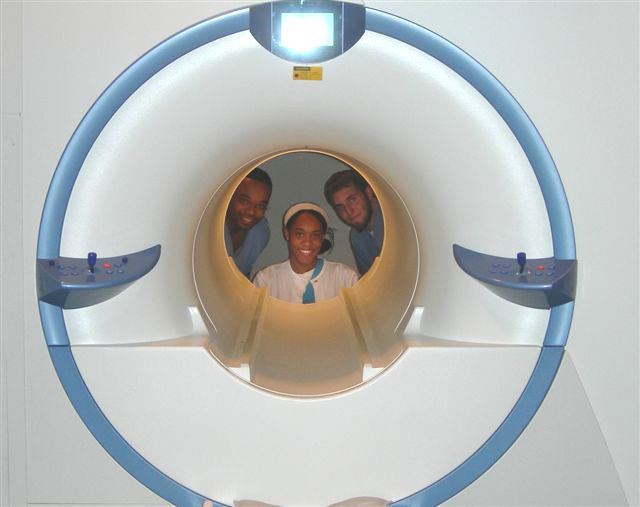 |
| I didn't get a photo, so here's a cheesy stock image of some people smiling through an MRI scanner |
Then came the contrast injection, at which point I was given my panic button - usually they give you one at the start of the scan, but I was so happy under my blanket I hadn't even noticed I didn't have it - in case you have a reaction to the contrast dye (unlikely unless you have undiagnosed kidney failure, but still). Then another set of scans - each set took about ten minutes, I would guess - and then freedom! Easy as pre-packaged pie.
The strangest part of the scan actually happened after it was all over. There was another patient with the same condition as me who was having the tests at the same time - this meant we could both have our PET scans on the same day, as the hospital prefers doing two of the same type at once to save money. We'll call him Bob. I hadn't met him at that point, but he was having his pituitary MRI immediately after me, and so I stayed in the waiting room with a very sweet Filipino nurse waiting for his scan to be finished so we could all go back to the research department together.
I was, as I have mentioned before, still wearing scrubs. I was however wearing a pair of exclusive "I'M A PATIENT" bracelets detailing my name, age, hospital no. etc. and my allergies (trimethoprim = brings me out in an attractive full-body rash). The waiting room was pretty full, so I was sitting off to one side, flipping through an elderly magazine,* when a woman came up to me and asked me how much longer the current scan would take.
Well initially, I admit, I gave her a "woman, you crazy!" look, until I suddenly realised that in my current garb I probably looked like a member of staff.
"Sorry, I'm not a doctor, I'm a patient," I said.
"So how long will it take?" she asked.
I got out my "woman, you crazy!" face again. "Er, I don't know…"
"Well, I think it's really bad that we're not being given any information," she told me. "How long do you think it will take?"
"It probably depends on the type of scan?" I suggested.
And with that, she stamped off, muttering angrily to herself.
On the way back to the research department, I got to meet Bob! He is the first ever person I have met who also has a TSHoma, which is not surprising as there's only about 20 of us across the whole of the UK, Ireland and, apparently, Norway (this may explain the MRI technician's cryptic question). Bob was a bit of a legend and had sensibly rejected the scrubs they had suggested he wear, in favour of pyjamas with Animal from the Muppets on; obviously the preferable sartorial choice.
.png)
You might think that, on finally meeting someone else with the same incredibly rare pituitary tumour, we would discuss symptoms, or treatment. But no! People with TSH secreting pituitary adenomas are nothing if not polite, and of course we would not want the lovely Filipino nurse feeling left out of the conversation. So, as she most likely had no brain tumours of any sort, we instead discussed the best way to travel to Cardiff by public transport.
And a very educational conversation it was too.
My pituitary MRI scan experience:
Hassle: 2/5
Fun: 2/5 (extra point for meeting Bob!)
Weirdness: 3/5
Results: 2/5
Total Score: 9/20
I fear I've just had too many MRIs to find them exciting any more!
________________________________________________
*The magazine was old... it wasn't a magazine for old people.
Friday, 6 July 2012
Human Guinea Pig: Part 1 - The Research Facility
I turned up at the hospital at 2pm on Tuesday and met up with the endocrinologist who's been in charge of arranging the series of tests which I was due to undergo (she needs a top secret blogging name; we'll call her Dr Olive). We went to the research department where the tests would be carried out, and I was delighted to be introduced to my private room - complete with en-suite bathroom and free TV (and sharps bin, and cardiac arrest instructions).
I think I've mentioned this before, but just in case - the tests which I had done over the past few days were done partly as general research into my condition and partly as a guide on what kind of treatment I should be given next. Firstly, a nurse was called in to do my initial tests; height (5'7"), weight (57.9 kgs), blood pressure (105 over 77), blood oxygen (97%) and resting heartrate (116 beats per minute - normal rate is 70-100 bpm). She had obviously not been informed about my tachycardia, because when she saw how fast my heart was going she looked at me askance and said "Did you come here running?" I assured her I had not, and that 116 bpm was perfectly normal for me. Later when Dr Olive looked at the results I think she was quite surprised; I had explained to her that I had tachycardia but she was surprised that my resting heartrate could be so high; of course, at that point when she took my pulse it was a perfectly standard 79 bpm.
I also had my breathing rate observed which was deeply disconcerting, as it essentially involves a nurse staring at your boobs for a solid minute while you attempt to "breathe normally". It is strangely difficult to breathe normally when you know someone is counting every inhalation.
Next came my ECG (electrocardiogram, a.k.a. EKG), where they put a bunch of incredibly sticky pads on your wrists, ankles, and across your chest around the heart. Then they attach a bunch of wires to the pads, which feed into a machine, which then prints out a trace of your heartbeat. It doesn't take very long but it is a bit of a hassle - the worst part is peeling the sticky pads off afterwards, although as the very nice nurse - let's call her Carla - pointed out afterwards, it's definitely a lot worse for blokes with hairy chests!
After that, I had to give my consent to the various tests that they wanted to do, and answer a few questions about my medication, my pituitary adenoma and any other medical conditions. It wasn't particularly exciting, although when Carla asked me if I ever suffered from any kind of recurrent pain, I said no. It was only after she'd asked me two further questions about pain that I finally remembered the fact that I have hypermobility syndrome and consequently have fairly regular bouts of joint pain, and have done since I was a child. I apologised for apparently being a massive idiot and she laughed and said people often forget these things when it becomes normal for them.
Some people with hypermobility/Ehlers Dahnlos Syndrome are incredibly flexible - later, Dr Olive came to ask me another set of questions, and when I mentioned the hypermobility again I think she was faintly disappointed at my lack of hilariously bendy joints. My little fingers do bend backwards alarmingly, but the joints that are most affected are in my legs and feet so they're not very impressive - and at the moment I can't even get vaguely close to touching my toes thanks to damaging a muscle in my left leg dancing.
Once I had been thoroughly questioned, I was left alone to contemplate my crimes - or at least, someone else's crimes, thanks to Arthur Conan Doyle, Sherlock Holmes and my Kobo e-reader, a birthday present from my parents and an excellent device for anyone planning to spend time in hospital.
You can read the next post about my time in the hospital, and my DEXA body density scan, by clicking here.
 |
| My charming room |
I also had my breathing rate observed which was deeply disconcerting, as it essentially involves a nurse staring at your boobs for a solid minute while you attempt to "breathe normally". It is strangely difficult to breathe normally when you know someone is counting every inhalation.
Next came my ECG (electrocardiogram, a.k.a. EKG), where they put a bunch of incredibly sticky pads on your wrists, ankles, and across your chest around the heart. Then they attach a bunch of wires to the pads, which feed into a machine, which then prints out a trace of your heartbeat. It doesn't take very long but it is a bit of a hassle - the worst part is peeling the sticky pads off afterwards, although as the very nice nurse - let's call her Carla - pointed out afterwards, it's definitely a lot worse for blokes with hairy chests!
After that, I had to give my consent to the various tests that they wanted to do, and answer a few questions about my medication, my pituitary adenoma and any other medical conditions. It wasn't particularly exciting, although when Carla asked me if I ever suffered from any kind of recurrent pain, I said no. It was only after she'd asked me two further questions about pain that I finally remembered the fact that I have hypermobility syndrome and consequently have fairly regular bouts of joint pain, and have done since I was a child. I apologised for apparently being a massive idiot and she laughed and said people often forget these things when it becomes normal for them.
Some people with hypermobility/Ehlers Dahnlos Syndrome are incredibly flexible - later, Dr Olive came to ask me another set of questions, and when I mentioned the hypermobility again I think she was faintly disappointed at my lack of hilariously bendy joints. My little fingers do bend backwards alarmingly, but the joints that are most affected are in my legs and feet so they're not very impressive - and at the moment I can't even get vaguely close to touching my toes thanks to damaging a muscle in my left leg dancing.
Once I had been thoroughly questioned, I was left alone to contemplate my crimes - or at least, someone else's crimes, thanks to Arthur Conan Doyle, Sherlock Holmes and my Kobo e-reader, a birthday present from my parents and an excellent device for anyone planning to spend time in hospital.
 |
| Not quite an ocean view... |
You can read the next post about my time in the hospital, and my DEXA body density scan, by clicking here.
Thursday, 5 July 2012
Medical Test Top Trumps
In relation to last night's post: Panic over! Turns out the darn thing is completely waterproof after all and I should have just left it on. Another example of my excellent sievebrain: good at draining pasta, not so good at retaining pertinent information about medical devices.
I am back from l'hôpital and I did indeed have an interesting time of it. While I did not appreciate waking up to an array of 23 blood tests yesterday morning, I can't deny that they hospital have been pretty darn thorough in their endeavours to understand what my pituitary tumour is doing to my metabolism! They also thoughtfully froze some spare blood - in case they later think of other blood tests they wish they'd done at the time. The tests were partly for research purposes into TSHoma and other rare thyroid conditions, and partly to decide how they want to move forward with my own treatment.
Here is a list of the tests and scans they did:
MRI Scan
CT Scan
PET Scan
DEXA Scans:
- body composition
- bone density (spine and hip/femur)
ECG heart trace
Step test
Actiheart 5-day heart rate and activity monitor
12 hour urine collection
Glucose tolerance test
GEM resting metabolic rate testing
TFT bloods
Blood pressure, blood oxygen, etc.
Symptoms/Quality of life questionnaire
Don't know what half of those acronyms stand for? Never fear, neither did I. All will become clear shortly. I had so many tests that there's no way on earth I could describe them all in one post, unless it was the longest and most terrifying blog post in the world, so I figure I'll go through what happened chronologically. In order to introduce an element of competition to the proceedings, I have decided to rate each medical test against a set of four criteria: Hassle (how much hassle the test was to undergo), Fun (how fun the test was. I may have to introduce minus scores), Weirdness (self explanatory) and Results (does the test produce a pretty picture/interesting information once completed).
Each type of test will be scored on a range of 0-5, and by the time I have finished it should be possible to play Emer's Medical Test Top Trumps. Just what you've always wanted!
_____________________________________________
p.s. - forgot to mention, I took my camera with me as promised so I actually finally have a few photos to show you!
ANYWAY.
I am back from l'hôpital and I did indeed have an interesting time of it. While I did not appreciate waking up to an array of 23 blood tests yesterday morning, I can't deny that they hospital have been pretty darn thorough in their endeavours to understand what my pituitary tumour is doing to my metabolism! They also thoughtfully froze some spare blood - in case they later think of other blood tests they wish they'd done at the time. The tests were partly for research purposes into TSHoma and other rare thyroid conditions, and partly to decide how they want to move forward with my own treatment.
Here is a list of the tests and scans they did:
MRI Scan
CT Scan
PET Scan
DEXA Scans:
- body composition
- bone density (spine and hip/femur)
ECG heart trace
Step test
Actiheart 5-day heart rate and activity monitor
12 hour urine collection
Glucose tolerance test
GEM resting metabolic rate testing
TFT bloods
Blood pressure, blood oxygen, etc.
Symptoms/Quality of life questionnaire
Don't know what half of those acronyms stand for? Never fear, neither did I. All will become clear shortly. I had so many tests that there's no way on earth I could describe them all in one post, unless it was the longest and most terrifying blog post in the world, so I figure I'll go through what happened chronologically. In order to introduce an element of competition to the proceedings, I have decided to rate each medical test against a set of four criteria: Hassle (how much hassle the test was to undergo), Fun (how fun the test was. I may have to introduce minus scores), Weirdness (self explanatory) and Results (does the test produce a pretty picture/interesting information once completed).
Each type of test will be scored on a range of 0-5, and by the time I have finished it should be possible to play Emer's Medical Test Top Trumps. Just what you've always wanted!
_____________________________________________
p.s. - forgot to mention, I took my camera with me as promised so I actually finally have a few photos to show you!
Wednesday, 27 June 2012
Last Minute Pituitary Surgery
This continues the story from my previous post about the pre-operative assessment I had before going into hospital for transsphenoidal pituitary surgery last year.
The few days before my pituitary surgery were a curious affair. I had been scheduled to go into hospital on the evening of Monday the 11th April, to have surgery on the 12th. On the 8th, I had a missed call from the hospital on my mobile; they left a message informing me that my surgery had been cancelled due to unforeseen circumstances and to await further instructions.
I completely freaked out. I called the hospital and tried to get some explanation or an indication of when I would be able to have the surgery instead; they explained that someone else whose operation had previously been postponed had been bumped up into my spot and they didn't know when the surgery would be. I hadn't realised until then that surgeons queue up a whole day's worth of patients needing the same operation; hopefully unlike judges they don't suffer from decision fatigue or feel the need to spice things up after the third transsphenoidal surgery of the day.
I was really upset. On a practical level, I had arranged my leave from work, wound up everything I needed to do and planned around my absence. My parents had both arranged leave from work and booked into a bed & breakfast nearby so they could come to see me in the hospital. On an emotional level, I was really nervous about the surgery and desperate to get it over and done with.
My boyfriend came over that weekend and we got hilariously lost attempting to go for a walk to a teashop, which obviously made me feel a lot better - especially when we eventually found it and had tea and scones. My parents said they would come up and stay on Monday night anyway, seeing as they had already arranged to do so, and we could all go out to dinner. So, I got over it and started to get used to the idea that I would have to wait longer for the surgery.
Half the office was pretty confused when I turned up at work on Monday, and I spent the day emailing people saying "lol jokes I'm actually still here". Then, at four o'clock in the afternoon, the hospital called. They said they'd had someone "drop out"* of their surgery the next day, so would I like to have mine tomorrow after all?
Of course my immediate reaction was to shout "STOP TOYING WITH ME" down the phone, but somehow I restrained myself and agreed. Then I just about had time to tell my manager and run out of the office to my house,** call my parents and tell them the news, pack, call my boyfriend and tell him the news, text various people, eat some dinner (at Nandos! highly recommended for pre- brain surgery snacks) and go to sleep.
Six weeks later, I discovered I hadn't even remembered to put my Out Of Office autoreply on. There were a lot of emails to go through.
One of the first things they gave me in the hospital was a pair of compression stockings, which I had to wear the whole time I was in there in order to avoid blood clots. They were extremely attractive - I actually still have them in a drawer somewhere. Next time I take a long-distance plane journey, I'll be sorted!
Anyway, the tale of the day of my surgery is a story for another day...
_____________________________
*Still not sure if that's a euphemism for "died"…
**Ok… a bus was involved at some point.
The few days before my pituitary surgery were a curious affair. I had been scheduled to go into hospital on the evening of Monday the 11th April, to have surgery on the 12th. On the 8th, I had a missed call from the hospital on my mobile; they left a message informing me that my surgery had been cancelled due to unforeseen circumstances and to await further instructions.
I completely freaked out. I called the hospital and tried to get some explanation or an indication of when I would be able to have the surgery instead; they explained that someone else whose operation had previously been postponed had been bumped up into my spot and they didn't know when the surgery would be. I hadn't realised until then that surgeons queue up a whole day's worth of patients needing the same operation; hopefully unlike judges they don't suffer from decision fatigue or feel the need to spice things up after the third transsphenoidal surgery of the day.

I was really upset. On a practical level, I had arranged my leave from work, wound up everything I needed to do and planned around my absence. My parents had both arranged leave from work and booked into a bed & breakfast nearby so they could come to see me in the hospital. On an emotional level, I was really nervous about the surgery and desperate to get it over and done with.
My boyfriend came over that weekend and we got hilariously lost attempting to go for a walk to a teashop, which obviously made me feel a lot better - especially when we eventually found it and had tea and scones. My parents said they would come up and stay on Monday night anyway, seeing as they had already arranged to do so, and we could all go out to dinner. So, I got over it and started to get used to the idea that I would have to wait longer for the surgery.
Half the office was pretty confused when I turned up at work on Monday, and I spent the day emailing people saying "lol jokes I'm actually still here". Then, at four o'clock in the afternoon, the hospital called. They said they'd had someone "drop out"* of their surgery the next day, so would I like to have mine tomorrow after all?
Of course my immediate reaction was to shout "STOP TOYING WITH ME" down the phone, but somehow I restrained myself and agreed. Then I just about had time to tell my manager and run out of the office to my house,** call my parents and tell them the news, pack, call my boyfriend and tell him the news, text various people, eat some dinner (at Nandos! highly recommended for pre- brain surgery snacks) and go to sleep.
Six weeks later, I discovered I hadn't even remembered to put my Out Of Office autoreply on. There were a lot of emails to go through.
One of the first things they gave me in the hospital was a pair of compression stockings, which I had to wear the whole time I was in there in order to avoid blood clots. They were extremely attractive - I actually still have them in a drawer somewhere. Next time I take a long-distance plane journey, I'll be sorted!
Anyway, the tale of the day of my surgery is a story for another day...
_____________________________
*Still not sure if that's a euphemism for "died"…
**Ok… a bus was involved at some point.
Saturday, 23 June 2012
Hyperthyroid Patients, Unite!
Subtitle: You have nothing to lose but your goitres!
So here's the strange thing: I have a TSHoma - a pituitary tumour which secretes TSH (thyroid stimulating hormone). It's super rare. According to my endocrinologist there are maybe thirteen or so other people in the UK with this condition which, in a population of 63 million, is Not Very Many, although it probably does go largely underdiagnosed; I had my first symptoms when I was around 16 or 17 and didn't get a diagnosis until I was 22.
But anyway, the point is that it can sometimes almost feel like two separate conditions; I have the pituitary adenoma, and the hyperthyroidism it causes. My symptoms, apart from the odd nasty headache, are pretty much exclusively those of hyperthyroidism; my treatment is for the adenoma. Consequently, although I am in all seriousness a paid-up member of the Pituitary Foundation and can chat about transsphenoidal surgery and lanreotide injections with the best of them, I'm missing out on the chance to bitch and moan about sinus tachycardia and getting the shakes with other people whose blood has turned to delicious thyroid hormone stew. More fool me!
People with excess thyroid hormone usually get that way from either a) taking too high a dose of thyroxine medication (exogenous thyrotoxicosis), or b) something else. The former can be dealt with simply by reducing the dose. The latter is more complicated. Possible causes include:
Graves Disease - the most common cause of hyperthyroidism, Graves is an autoimmune disease which can be treated with anithyroid drugs, surgery to remove part or all of the thyroid, or a dose of radiactive iodine. After such treatment there's a substantial and ironic risk of hypothyroidism - i.e. not having enough thyroid hormone.
Tumours of the thyroid gland - thyroid adenoma is a benign tumour of the thyroid gland which may secrete large amounts of thyroid hormone, while thyroid nodules may be benign or malignant and again may or may not release thyroid hormone - in some cases they may actually inhibit its production, causing hypothyroidism.
Thyroiditis - inflammation of the thyroid gland. Although this often initially leads to high levels of thyroid hormone being released, it usually progresses to thyroid disfunction with the gland unable to produce sufficient hormones, and ultimately causes hypothyroidism. Around 7% of women experience temporary thyroiditis after giving birth (postpartum thyroiditis) which may lead to hyper- or hypothyroidism, or both; this usually resolves itself.
TSH hypersecretion - super rare, but usually caused by a pituitary adenoma (hurrah!). However, I believe there is also the possibility of a tumour in the hypothalamus causing excess Thyrotropin Releasing Hormone and hyperstimulating the pituitary gland to overproduce TSH, which in turn would hyperstimulate the thyroid gland to overproduce thyroid hormone. Again, it's very rare.
I guess really I should be grateful for this, as effectively I have two health conditions for the price of one. This blog is usually focussed mainly around the dramatic "there's a tumour in my head!" aspects of my pituitary adenoma, and poor little hyperthyroidism barely gets a look in, except for when I complain about my tachycardia/hair falling out/absurd appetite issues. But no longer! From now on I vow to go on about hyperthyroidism more. So you guys will get two lots of whingeing for the price of one!
So here's the strange thing: I have a TSHoma - a pituitary tumour which secretes TSH (thyroid stimulating hormone). It's super rare. According to my endocrinologist there are maybe thirteen or so other people in the UK with this condition which, in a population of 63 million, is Not Very Many, although it probably does go largely underdiagnosed; I had my first symptoms when I was around 16 or 17 and didn't get a diagnosis until I was 22.
But anyway, the point is that it can sometimes almost feel like two separate conditions; I have the pituitary adenoma, and the hyperthyroidism it causes. My symptoms, apart from the odd nasty headache, are pretty much exclusively those of hyperthyroidism; my treatment is for the adenoma. Consequently, although I am in all seriousness a paid-up member of the Pituitary Foundation and can chat about transsphenoidal surgery and lanreotide injections with the best of them, I'm missing out on the chance to bitch and moan about sinus tachycardia and getting the shakes with other people whose blood has turned to delicious thyroid hormone stew. More fool me!
People with excess thyroid hormone usually get that way from either a) taking too high a dose of thyroxine medication (exogenous thyrotoxicosis), or b) something else. The former can be dealt with simply by reducing the dose. The latter is more complicated. Possible causes include:
Graves Disease - the most common cause of hyperthyroidism, Graves is an autoimmune disease which can be treated with anithyroid drugs, surgery to remove part or all of the thyroid, or a dose of radiactive iodine. After such treatment there's a substantial and ironic risk of hypothyroidism - i.e. not having enough thyroid hormone.
Tumours of the thyroid gland - thyroid adenoma is a benign tumour of the thyroid gland which may secrete large amounts of thyroid hormone, while thyroid nodules may be benign or malignant and again may or may not release thyroid hormone - in some cases they may actually inhibit its production, causing hypothyroidism.
Thyroiditis - inflammation of the thyroid gland. Although this often initially leads to high levels of thyroid hormone being released, it usually progresses to thyroid disfunction with the gland unable to produce sufficient hormones, and ultimately causes hypothyroidism. Around 7% of women experience temporary thyroiditis after giving birth (postpartum thyroiditis) which may lead to hyper- or hypothyroidism, or both; this usually resolves itself.
TSH hypersecretion - super rare, but usually caused by a pituitary adenoma (hurrah!). However, I believe there is also the possibility of a tumour in the hypothalamus causing excess Thyrotropin Releasing Hormone and hyperstimulating the pituitary gland to overproduce TSH, which in turn would hyperstimulate the thyroid gland to overproduce thyroid hormone. Again, it's very rare.
I guess really I should be grateful for this, as effectively I have two health conditions for the price of one. This blog is usually focussed mainly around the dramatic "there's a tumour in my head!" aspects of my pituitary adenoma, and poor little hyperthyroidism barely gets a look in, except for when I complain about my tachycardia/hair falling out/absurd appetite issues. But no longer! From now on I vow to go on about hyperthyroidism more. So you guys will get two lots of whingeing for the price of one!
Friday, 11 May 2012
Ding Ding: Round Two
I had been holding off posting for a few days, not out of laziness,* but because I was waiting to find out the outcome of my hospital appointment last Thursday. And then it took me absolutely ages to type this up because, let's face it, it's dull and complex. For the last couple of months I have been largely in the dark as to the results of my blood tests and recent MRi scan, so I really had no idea what to expect.
What I did not expect was to find the television in the endocrine waiting room playing Cash In The Attic. This television has, to my knowledge, never previously displayed anything other than The Jeremy Kyle Show. I always assumed that the hospital trust had performed some kind of patient survey and determined that diabetics and people with pituitary tumours prefer their televisual experiences to involve shouting, paternity testing, and the phrase "Madam, you disgust me".
I digress.
First up, as per usual, I was weighed (lost: one kilogram since February, almost certainly due to forswearing chocolate over Lent rather than the TSH-oma) and had my blood pressure taken (standing blood pressure: 118/76 - score! It would appear that switching my heart medication back to propranolol has made a difference). Then I had a quick review with one of the endocrinologists about how my symptoms have changed since being on lanreotide injections (not much).
Then the doctor ran away and eventually returned with two other endocrinologists in tow, who all stood at the other end of the room and surveyed me like something interesting they'd found in a jar at the Hunterian Museum.**
They have been somewhat confused by the fact that my levels of various thyroid hormones have remained roughly the same since being on the lanreotide injections, despite the fact that you would expect them to drop.
Additionally, the MRI scan of my pituitary was a little tricky to interpret. Essentially, the pituitary gland is like a tiny upside-down lollipop just below your brain. The stick of the lollipop is called the infundibular stalk*** and it connects the pituitary gland to the hypothalamus. My original MRI pituitary scan showed a great big gobstopper lollipop with a dark patch of necrosis in the middle, where the tissue inside the tumour had died off a bit. To picture this, first imagine a lollipop with a liquid centre, and then imagine something a lot more disgusting. But my latest scan shows a rather more normal-sized lollipop which hasn't grown since my surgery (hurrah!). However, the stick of the lollipop is slightly bending to one side.
Given that there's limited space inside your head for these things to grow, a wonky pituitary stalk can indicate that the bulk of a tumour is pushing the rest of the pituitary gland to one side. So the area of pituitary gland on the left-hand side is now under suspicion. I have to say, looking at the scans was kind of awesome, because it's not like when people show you the ultrasound of their baby and you have to pretend you totally see what they're talking about. I actually could see what they were talking about.
But the problem with MRIs is that they can show you what's there, but not what it's doing. So although it looks like there's probably a bit of tumour left on one side of my pituitary gland and that may well be what's still causing my symptoms, it's still possible that it's not that bit at all. And it would be rubbish to have surgery, take that bit out and then discover it was actually healthy pituitary tissue.
So my doctors want me to have two combined PET/CT scans. PET (Positron Emission Tomography) scans are super colourful and pretty, but that's not the only reason they want me to have one (I hope).
Basically, PET scans can show those areas of the pituitary that are most metabolically active. Inactive areas are dark. So the idea is that I will have one of these scans while not on any kind of medication, which should show the whole pituitary lit up like a christmas tree, and then have another scan after three months on a higher dose of lanreotide, which should suppress the hormone production in the TSHoma. Any areas that go from being bright blue on the first scan to being dark in the second scan are probably tumour. Then, if the tumour is in an easily-accessible area of my head, I might have surgery again. If it's somewhere tricky to reach, I'll probably just continue to have regular injections of lanreotide indefinitely.
So I'm not having any more lanreotide injections for six weeks, so that it's definitely completely out of my system. And in the meantime they want to have me come in overnight one for some research tests on my metabolism and things. Essentially the hospital are collecting patients with pituitary tumours that produce TSH and studying us, so I am now officially a guinea pig.
_______________________________________________
*How could you ever think such a thing?
**I'm joking, they were very nice.
***Or just the pituitary stalk, but you don't get to use a word like "infundibular" every day.
What I did not expect was to find the television in the endocrine waiting room playing Cash In The Attic. This television has, to my knowledge, never previously displayed anything other than The Jeremy Kyle Show. I always assumed that the hospital trust had performed some kind of patient survey and determined that diabetics and people with pituitary tumours prefer their televisual experiences to involve shouting, paternity testing, and the phrase "Madam, you disgust me".

I digress.
First up, as per usual, I was weighed (lost: one kilogram since February, almost certainly due to forswearing chocolate over Lent rather than the TSH-oma) and had my blood pressure taken (standing blood pressure: 118/76 - score! It would appear that switching my heart medication back to propranolol has made a difference). Then I had a quick review with one of the endocrinologists about how my symptoms have changed since being on lanreotide injections (not much).
Then the doctor ran away and eventually returned with two other endocrinologists in tow, who all stood at the other end of the room and surveyed me like something interesting they'd found in a jar at the Hunterian Museum.**
They have been somewhat confused by the fact that my levels of various thyroid hormones have remained roughly the same since being on the lanreotide injections, despite the fact that you would expect them to drop.
Additionally, the MRI scan of my pituitary was a little tricky to interpret. Essentially, the pituitary gland is like a tiny upside-down lollipop just below your brain. The stick of the lollipop is called the infundibular stalk*** and it connects the pituitary gland to the hypothalamus. My original MRI pituitary scan showed a great big gobstopper lollipop with a dark patch of necrosis in the middle, where the tissue inside the tumour had died off a bit. To picture this, first imagine a lollipop with a liquid centre, and then imagine something a lot more disgusting. But my latest scan shows a rather more normal-sized lollipop which hasn't grown since my surgery (hurrah!). However, the stick of the lollipop is slightly bending to one side.
Given that there's limited space inside your head for these things to grow, a wonky pituitary stalk can indicate that the bulk of a tumour is pushing the rest of the pituitary gland to one side. So the area of pituitary gland on the left-hand side is now under suspicion. I have to say, looking at the scans was kind of awesome, because it's not like when people show you the ultrasound of their baby and you have to pretend you totally see what they're talking about. I actually could see what they were talking about.

But the problem with MRIs is that they can show you what's there, but not what it's doing. So although it looks like there's probably a bit of tumour left on one side of my pituitary gland and that may well be what's still causing my symptoms, it's still possible that it's not that bit at all. And it would be rubbish to have surgery, take that bit out and then discover it was actually healthy pituitary tissue.
So my doctors want me to have two combined PET/CT scans. PET (Positron Emission Tomography) scans are super colourful and pretty, but that's not the only reason they want me to have one (I hope).

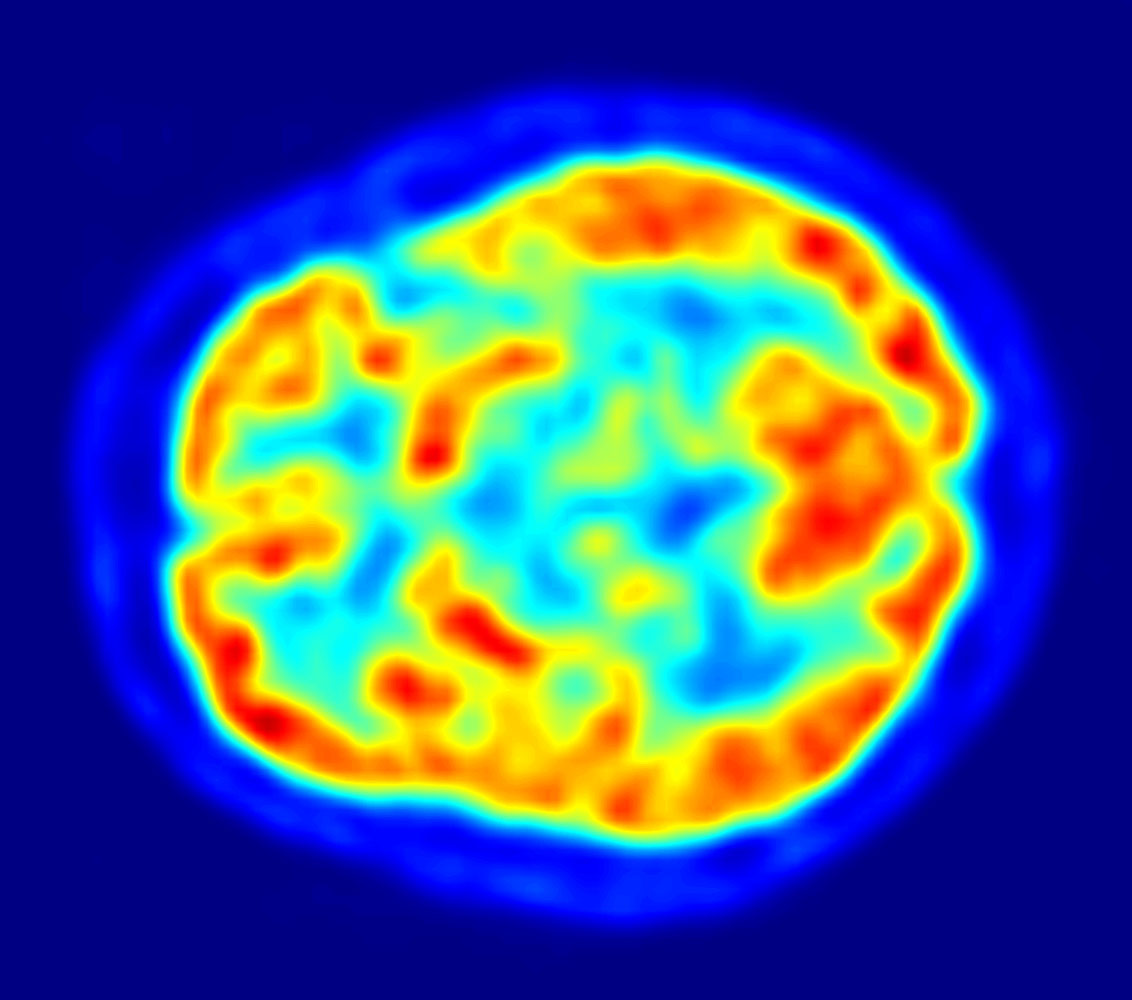 |
| PET scan of the brain |
Basically, PET scans can show those areas of the pituitary that are most metabolically active. Inactive areas are dark. So the idea is that I will have one of these scans while not on any kind of medication, which should show the whole pituitary lit up like a christmas tree, and then have another scan after three months on a higher dose of lanreotide, which should suppress the hormone production in the TSHoma. Any areas that go from being bright blue on the first scan to being dark in the second scan are probably tumour. Then, if the tumour is in an easily-accessible area of my head, I might have surgery again. If it's somewhere tricky to reach, I'll probably just continue to have regular injections of lanreotide indefinitely.
So I'm not having any more lanreotide injections for six weeks, so that it's definitely completely out of my system. And in the meantime they want to have me come in overnight one for some research tests on my metabolism and things. Essentially the hospital are collecting patients with pituitary tumours that produce TSH and studying us, so I am now officially a guinea pig.

_______________________________________________
*How could you ever think such a thing?
**I'm joking, they were very nice.
***Or just the pituitary stalk, but you don't get to use a word like "infundibular" every day.
Thursday, 22 March 2012
My Last Injection... For Now
On Tuesday morning at 10.15 I had my latest lanreotide injection, and as the initial decision was that I would have them for three months and then review, I'm now waiting to hear back from my endocrinologist as to whether he wants me to continue with the injections. The answer to that will almost certainly be yes, unless the next MRI scan shows that my pituitary tumour has fallen out of my nose at some point in the last two months;* the real question is whether the dosage needs to be increased, and if they're thinking about sending me in for more surgery.
Actually getting the injection was fun, because it was administered by my favourite nurse. I know it's wrong to have favourites, but I was almost heartbroken last month when both she and her lovely Australian colleague were away at injection time and I had to book in with The Rubbish Nurse. She's not a bad nurse, I should clarify, she's very competent, but she hasn't got the hang of Making Injections Fun yet. This is a valuable skill and, in case there are any nurses out there, it goes like this:
1. Recognise the patient. If you don't recognise the patient, you can just pretend. This is an acceptable fiction and they will almost certainly pretend back.
Pro tip: Once you are practised at this deception, or if you are interested in a career in acting, consider taking this a step further and invent a complete backstory to your relationship with each patient. Imagining that you are administering an injection to the wife of the man with whom you had a torrid affair in pre-independence Kiribati will add spice to an otherwise dull day.
2. Greet the patient. Do not disappear down the corridor so quickly that they can't work out which dread medical portal you emerged from.
Pro tip: Alternatively, if you really can't bear to wait for your patients to pick up their coats before exiting the waiting room, why not turn this into a game of Hide and Seek (Nurse Edition)? There's nothing like the sight of confused patients blundering into the wrong consulting room to raise a belly laugh in the morning.
3. Put The Patient At Ease. When unwrapping the syringe of lanreotide, remember to refrain from comments such as "Bloody hell, that's a big needle!"
Pro tip: Consider tapping in to your patients' latent competitive natures by introducing a leaderboard of Bravest Patient of the Week. That way, they'll be practically queuing up to be spiked by giant needles, instead of fleeing you in terror.
4. Be Awesome. This guideline may be difficult for new practitioners to grasp immediately. Examples of Being Awesome include (but are not limited to): telling patients interesting medical facts (this week I learned about the sciatic nerve), having an awesome accent, telling amusing family anecdotes, laughing frequently, and adopting unusual pet names for each patient.
Pro tip: Like the finest cuisine, the best pet names are based around animals and vegetables. Everyone's been called "duck" or "pumpkin" - why not mix it up? Try referring to patients as "prarie dog" or "aubergine".
In other news, I had a bit of minor drama trying to get hold of my beloved Somatuline Autogel injection this month; when I got the prescription, I headed straight to Boots Pharmacy as usual, who always have to order it in directly from their supplier because it's a pretty unusual item. I happily skipped to the counter, only to be informed that their supplier didn't have any in stock, and they couldn't say when they might have it, so I should go elsewhere.
Somewhat surprised, I decided to transfer my business to the Superdrug pharmacy. "I'll have to check with our supplier," said the young man behind the counter. He immediately phoned them, while standing in front of me. Apparently everything was fine and they'd have it in the next day. Impressed by this speedy service, I skipped off on my merry way.** Of course, next day I got a phone call from them saying that their supplier didn't have any and they couldn't say when it would next be in stock. Heaven only knows who the bloke behind the counter had actually phoned while I was watching; perhaps he's the chap keeping the Speakng Clock in business.
So I picked up my prescription and, feeling a little panicked, decided to try Boots again before walking miles to another pharmacy. And lo! the bloke behind the counter looked at my script and quoth: "Oh yes, we've got that for you." I assumed he was confused - perhaps a relation of the guy in Superdrug. But no! Boots had lovingly ordered in my medication even though they had encouraged me to look elsewhere, just on the offchance I would return for it. So that was nice.
____________________________________________________
*Just to clarify for any non-medically-qualified readers: this is unlikely.
**I was doing a lot of skipping that day.
Actually getting the injection was fun, because it was administered by my favourite nurse. I know it's wrong to have favourites, but I was almost heartbroken last month when both she and her lovely Australian colleague were away at injection time and I had to book in with The Rubbish Nurse. She's not a bad nurse, I should clarify, she's very competent, but she hasn't got the hang of Making Injections Fun yet. This is a valuable skill and, in case there are any nurses out there, it goes like this:
The Idiot's Guide To Making Injections Fun:
1. Recognise the patient. If you don't recognise the patient, you can just pretend. This is an acceptable fiction and they will almost certainly pretend back.
Pro tip: Once you are practised at this deception, or if you are interested in a career in acting, consider taking this a step further and invent a complete backstory to your relationship with each patient. Imagining that you are administering an injection to the wife of the man with whom you had a torrid affair in pre-independence Kiribati will add spice to an otherwise dull day.
2. Greet the patient. Do not disappear down the corridor so quickly that they can't work out which dread medical portal you emerged from.
Pro tip: Alternatively, if you really can't bear to wait for your patients to pick up their coats before exiting the waiting room, why not turn this into a game of Hide and Seek (Nurse Edition)? There's nothing like the sight of confused patients blundering into the wrong consulting room to raise a belly laugh in the morning.
3. Put The Patient At Ease. When unwrapping the syringe of lanreotide, remember to refrain from comments such as "Bloody hell, that's a big needle!"
Pro tip: Consider tapping in to your patients' latent competitive natures by introducing a leaderboard of Bravest Patient of the Week. That way, they'll be practically queuing up to be spiked by giant needles, instead of fleeing you in terror.
4. Be Awesome. This guideline may be difficult for new practitioners to grasp immediately. Examples of Being Awesome include (but are not limited to): telling patients interesting medical facts (this week I learned about the sciatic nerve), having an awesome accent, telling amusing family anecdotes, laughing frequently, and adopting unusual pet names for each patient.
Pro tip: Like the finest cuisine, the best pet names are based around animals and vegetables. Everyone's been called "duck" or "pumpkin" - why not mix it up? Try referring to patients as "prarie dog" or "aubergine".
***
In other news, I had a bit of minor drama trying to get hold of my beloved Somatuline Autogel injection this month; when I got the prescription, I headed straight to Boots Pharmacy as usual, who always have to order it in directly from their supplier because it's a pretty unusual item. I happily skipped to the counter, only to be informed that their supplier didn't have any in stock, and they couldn't say when they might have it, so I should go elsewhere.
Somewhat surprised, I decided to transfer my business to the Superdrug pharmacy. "I'll have to check with our supplier," said the young man behind the counter. He immediately phoned them, while standing in front of me. Apparently everything was fine and they'd have it in the next day. Impressed by this speedy service, I skipped off on my merry way.** Of course, next day I got a phone call from them saying that their supplier didn't have any and they couldn't say when it would next be in stock. Heaven only knows who the bloke behind the counter had actually phoned while I was watching; perhaps he's the chap keeping the Speakng Clock in business.
So I picked up my prescription and, feeling a little panicked, decided to try Boots again before walking miles to another pharmacy. And lo! the bloke behind the counter looked at my script and quoth: "Oh yes, we've got that for you." I assumed he was confused - perhaps a relation of the guy in Superdrug. But no! Boots had lovingly ordered in my medication even though they had encouraged me to look elsewhere, just on the offchance I would return for it. So that was nice.
____________________________________________________
*Just to clarify for any non-medically-qualified readers: this is unlikely.
**I was doing a lot of skipping that day.
Sunday, 11 March 2012
Pituitary Surgery: Pre-operative Assessment
After meeting my pituitary surgeon Mr Pout, I was trundled off to have my pre-operative assessment. The NHS wesbite describes pre-operative assessments as:
"...carried out prior to treatment, [to ensure] that the patient is fully informed about the procedure and the post operative recovery, is in optimum health and has made arrangements for admission, discharge and post operative care at home. "
I met a very nice nurse and her very nice (and extremely lengthy) questionnaire, which we got to fill in together. What a treat! I got to answer questions about my health, fitness, medications, allergies, medical history and more. It was like being on Mastermind, except the nurse was a lot more judgemental than John Humphrys when I couldn't remember an answer.* Possibly it was more like University Challenge, in the rounds where you're not supposed to confer.
After hearing about the more technical (and terrifying) side of transsphenoidal pituitary surgery from Mr Pout, the pre-operative assessment was a chance to find out more about the practical side of things, like visiting hours for my ward in the hospital, what would happen in the lead-up to my surgery, and exactly how nice my parents had to be to me for how many weeks afterwards.
With the benefit of hindsight, I would have taken my cue from John Humphrys and done some slightly more thorough interrogation of both the nurse and surgeon. The problem is, you don't know what you're not being told until some time after they've not told you it.
I would have appreciated being told, for example, that after my surgery, I had to have blood tests done every hour for six hours, then every two hours for twelve hours, then every four hours, etc etc. Admittedly, I have complained about this in a previous post. But the thing was, although I understand that the blood tests were necessary to keep track of my pituitary hormones, it wasn't until after they'd already done a couple of rounds of blood tests that I was even told exactly how long it was going to go on for. And my arm was really sore because they kept putting surgical tape on it (it appears there's no plasters on the NHS) and then ripping it off every five minutes to stick another needle in. If only I had shaved my inner elbows.
Plus, it would have been helpful to know precisely what scan they were intending to send me in for on the day of the surgery. This got super confused on the day, and I'll talk more about it in a future post, but I was never told that they wanted me to have a CT scan of my pituitary before surgery, so I was completely confused when a couple of hospital porteers turned up to wheel me away to the scanning department.
Also at the pre-operative assessment, you get weighed and measured and have your blood pressure taken. If it's a little low like mine usually is, and if they suddenly realise that (thanks to their insane waiting times) you haven't eaten anything since before you turned up to the hospital six hours ago, they may give you free cake and biscuits. These are of a surprisingly high quality for hospital-supplied nibbles.
Oh, and they swab you to check whether or not you have MRSA bacteria present on your skin. If you do, you might be put last in the day's queue for surgery.
______________________________________________________
*Incidentally, did you know that the format of Mastermind was allegedly inspired by creator Bill Wright's experience of being interrogated by Nazis?
"...carried out prior to treatment, [to ensure] that the patient is fully informed about the procedure and the post operative recovery, is in optimum health and has made arrangements for admission, discharge and post operative care at home. "
I met a very nice nurse and her very nice (and extremely lengthy) questionnaire, which we got to fill in together. What a treat! I got to answer questions about my health, fitness, medications, allergies, medical history and more. It was like being on Mastermind, except the nurse was a lot more judgemental than John Humphrys when I couldn't remember an answer.* Possibly it was more like University Challenge, in the rounds where you're not supposed to confer.
 |
| Wait... who actually is my GP? |
After hearing about the more technical (and terrifying) side of transsphenoidal pituitary surgery from Mr Pout, the pre-operative assessment was a chance to find out more about the practical side of things, like visiting hours for my ward in the hospital, what would happen in the lead-up to my surgery, and exactly how nice my parents had to be to me for how many weeks afterwards.
With the benefit of hindsight, I would have taken my cue from John Humphrys and done some slightly more thorough interrogation of both the nurse and surgeon. The problem is, you don't know what you're not being told until some time after they've not told you it.
I would have appreciated being told, for example, that after my surgery, I had to have blood tests done every hour for six hours, then every two hours for twelve hours, then every four hours, etc etc. Admittedly, I have complained about this in a previous post. But the thing was, although I understand that the blood tests were necessary to keep track of my pituitary hormones, it wasn't until after they'd already done a couple of rounds of blood tests that I was even told exactly how long it was going to go on for. And my arm was really sore because they kept putting surgical tape on it (it appears there's no plasters on the NHS) and then ripping it off every five minutes to stick another needle in. If only I had shaved my inner elbows.
Plus, it would have been helpful to know precisely what scan they were intending to send me in for on the day of the surgery. This got super confused on the day, and I'll talk more about it in a future post, but I was never told that they wanted me to have a CT scan of my pituitary before surgery, so I was completely confused when a couple of hospital porteers turned up to wheel me away to the scanning department.
Also at the pre-operative assessment, you get weighed and measured and have your blood pressure taken. If it's a little low like mine usually is, and if they suddenly realise that (thanks to their insane waiting times) you haven't eaten anything since before you turned up to the hospital six hours ago, they may give you free cake and biscuits. These are of a surprisingly high quality for hospital-supplied nibbles.
Oh, and they swab you to check whether or not you have MRSA bacteria present on your skin. If you do, you might be put last in the day's queue for surgery.
______________________________________________________
*Incidentally, did you know that the format of Mastermind was allegedly inspired by creator Bill Wright's experience of being interrogated by Nazis?
Friday, 9 March 2012
Pituitary Surgery: Question Time with Mr Surgeon
My first piece of advice for patients about to undergo transsphenoidal pituitary surgery: when they invite you to the hospital to "meet your surgeon" before the surgery, don't expect to, you know, actually meet your surgeon. Obviously, that would be mad.
You get to meet a member of the the surgical team. When I was booked in for pituitary surgery, I was told that "my surgeon" would be Mr Hamstercheeks,* a man noted for his skill at rummaging around inside skulls. However, there were at least two other neurosurgeons involved in the operation, presumably for when Hamstercheeks got bored or hungry or felt like helping the anaesthetist with his sudoku.
One of these was Mr. Pout, who I met for my surgical assessment. He was a nice guy, and my main contact with the surgical team; he saw me before the operation, checked up on me every day while I was in hospital, signed me off to go home and then met me again three months later, just to confirm that my head hadn't accidentally fallen off in the intervening period.**
When one of the nurses at the hospital saw that Mr Pout was my surgeon, she almost turned green - with envy, not with sulfhemoglobinaemia. "Ooh," she giggled, "he's very dishy isn't he? He's got beautiful eyes."
Up until that point, it hadn't occurred to me that Mr Pout was good looking.*** As a general rule of thumb, announcing that you intend to drill through their skull is not the best way to generate ardour in a member of the opposite sex. Which may explain why trepanning died out.
In any case, I suddenly realised that, given the number of clean and shiny objects in an operating theatre, an excessively attractive surgeon could be a liability. What if he became distracted by his own reflection? What if the other male surgeons became envious of his hold over the female staff members, deliberately sabotaged my brain and then blamed it on him? What if he discovered his first grey hair, truly realised the transience of beauty in this mortal world, and was left to conduct my surgery through a fog of fatalistic despair?
All in all, I felt much happier about Mr. Hamstercheeks.
Anyway.
My second piece of advice to patients about to undergo pituitary surgery is this: bring a book to your surgical assessment. Better yet, bring two books and a small camping set. Having spent a lot of time at the hospital in recent years, I have become used to lengthy waiting times. I can happily sit for an hour at a stretch examining other patients' facial features and trying to work out who's got acromegaly. I can read trashy magazines and become fully immersed in Jordan's Latest Love Rat Shocker (With Exclusive Pictures Inside!). But I think Neurosurgery holds the record for my longest wait yet. And unlike the Endocrine Unit, the neuro department is miles from a coffee shop.
When I actually got in to see Mr Pout, it was a fairly brief chat. We had a butchers at my MRI and discussed the possible complications of surgery, as follows:
1. death.
2. death
3. DEATH
I'm pretty sure he mentioned some other stuff too, but I have to admit that's what I focused in on. In fairness, the risk of death associated with transsphenoidal pituitary surgery in an otherwise-healthy patient is pretty low, and it's only fair for surgeons to mention in advance that there's a slight risk of death, as with any operation involving general anaesthetic or sharp knives near major blood vessels. If they didn't mention it, I'm sure people would complain when they woke up dead. Plus I guess then if you're merely blinded or lose all pituitary function, you feel like at least it could have been worse. Other possible complications of transspenoidal pituitary surgery include cerebro-spinal fluid leak, meningitis, stroke and coma leading to…you guessed it, death.
My favourite part about meeting with the surgeon was the letter I got afterwards. It was sent from Mr Pout to my endocrinologist, basically confirming that I was a suitable candidate for surgery, and I was copied in on the correspondance.
Here's the bit I liked the best:
"...I note Miss Grey is of petite build and has small nasal passages."
Thanks, Mr. Pout! I never thought of myself as having a "petite build" before. And small nasal passages! You know how to flatter a girl.
In fact, this is neurosurgical shorthand for "book an Ear Nose & Throat team for the surgery, we're not sure her nose is big enough for all the scalpels and cameras and things to fit up there".
I don't know what they write when the ENT people aren't required. Possibly: "I note Miss --- is a bit of a heifer, with a big old conk to match. Tell ENT to take the day off".
__________________________________________________________________
*Personal details may have been subtly altered to protect the individuals concerned.
**A common complication of neurosurgery.
You get to meet a member of the the surgical team. When I was booked in for pituitary surgery, I was told that "my surgeon" would be Mr Hamstercheeks,* a man noted for his skill at rummaging around inside skulls. However, there were at least two other neurosurgeons involved in the operation, presumably for when Hamstercheeks got bored or hungry or felt like helping the anaesthetist with his sudoku.
One of these was Mr. Pout, who I met for my surgical assessment. He was a nice guy, and my main contact with the surgical team; he saw me before the operation, checked up on me every day while I was in hospital, signed me off to go home and then met me again three months later, just to confirm that my head hadn't accidentally fallen off in the intervening period.**
When one of the nurses at the hospital saw that Mr Pout was my surgeon, she almost turned green - with envy, not with sulfhemoglobinaemia. "Ooh," she giggled, "he's very dishy isn't he? He's got beautiful eyes."
Up until that point, it hadn't occurred to me that Mr Pout was good looking.*** As a general rule of thumb, announcing that you intend to drill through their skull is not the best way to generate ardour in a member of the opposite sex. Which may explain why trepanning died out.
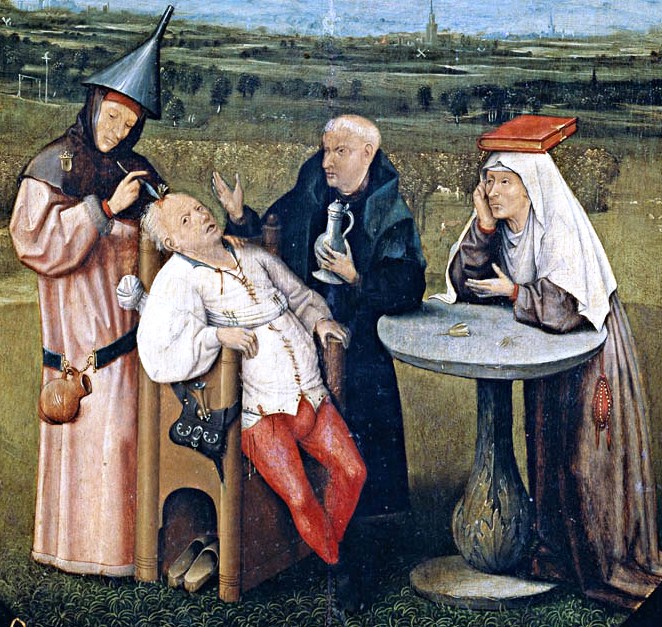 |
| Practically an orgy. |
All in all, I felt much happier about Mr. Hamstercheeks.
Anyway.
My second piece of advice to patients about to undergo pituitary surgery is this: bring a book to your surgical assessment. Better yet, bring two books and a small camping set. Having spent a lot of time at the hospital in recent years, I have become used to lengthy waiting times. I can happily sit for an hour at a stretch examining other patients' facial features and trying to work out who's got acromegaly. I can read trashy magazines and become fully immersed in Jordan's Latest Love Rat Shocker (With Exclusive Pictures Inside!). But I think Neurosurgery holds the record for my longest wait yet. And unlike the Endocrine Unit, the neuro department is miles from a coffee shop.
When I actually got in to see Mr Pout, it was a fairly brief chat. We had a butchers at my MRI and discussed the possible complications of surgery, as follows:
1. death.
2. death
3. DEATH
I'm pretty sure he mentioned some other stuff too, but I have to admit that's what I focused in on. In fairness, the risk of death associated with transsphenoidal pituitary surgery in an otherwise-healthy patient is pretty low, and it's only fair for surgeons to mention in advance that there's a slight risk of death, as with any operation involving general anaesthetic or sharp knives near major blood vessels. If they didn't mention it, I'm sure people would complain when they woke up dead. Plus I guess then if you're merely blinded or lose all pituitary function, you feel like at least it could have been worse. Other possible complications of transspenoidal pituitary surgery include cerebro-spinal fluid leak, meningitis, stroke and coma leading to…you guessed it, death.
My favourite part about meeting with the surgeon was the letter I got afterwards. It was sent from Mr Pout to my endocrinologist, basically confirming that I was a suitable candidate for surgery, and I was copied in on the correspondance.
Here's the bit I liked the best:
"...I note Miss Grey is of petite build and has small nasal passages."
Thanks, Mr. Pout! I never thought of myself as having a "petite build" before. And small nasal passages! You know how to flatter a girl.
In fact, this is neurosurgical shorthand for "book an Ear Nose & Throat team for the surgery, we're not sure her nose is big enough for all the scalpels and cameras and things to fit up there".
I don't know what they write when the ENT people aren't required. Possibly: "I note Miss --- is a bit of a heifer, with a big old conk to match. Tell ENT to take the day off".
__________________________________________________________________
*Personal details may have been subtly altered to protect the individuals concerned.
**A common complication of neurosurgery.
Wednesday, 7 March 2012
Pituitary Tumour Surgery: Hypophysectomy or Adenectomy?
I can't believe that it's March already! This time last year, I was in a flurry of nervousness, waiting to find out the date of my pituitary surgery. Before setting a definite date, you get the chance to meet your surgeon and you're called in for a pre-operative assessment.
At the time, I was informed that the full name for standard pituitary surgery is transsphenoidal hypophysectomy. On reflection, this seems strange because "hypophys-ectomy" implies that they're aiming to cut out ("-ectomy") the whole pituitary gland ("hypophys-") when, in fact, the aim is to cut out the pituitary tumour while leaving the healthy gland intact. I've also seen the phrase "transsphenoidal adenectomy" used for the same procedure, but in fact that's even less specific as the "aden-" part just means "gland", so an adenectomy is simply the surgical removal of any gland. An adenoma-ectomy would indicate surgery to cut out a glandular tumour, and a quick scan of Google indicates that this phrase is also in use amongst the medical profession. How confusing.
Excuse the unexciting etymological rambling, but this has literally only just occurred to me.
ANYWAY.
A word of advice to anyone about to undergo pituitary surgery: don't tell your friends and family that you're going to a pre-op assessment for a transsphenoidal hypophysectomy. They will either gaze at you blankly and without comprehension, or they will hone in on the words "pre-op" (as in TRANSSEXUAL) and "blah-blah-physectomy" (sounds a bit like VASECTOMY) and ask if you're secretly a man.*
This may be upsetting.
In any case, I think that the pre-operative assessment and Question Time with Mr Surgeon probably deserve posts to themselves, so on that bombshell... adieu.
_____________________________________________________________
* Or presumably, if you are male, whether you're about to become a woman.
At the time, I was informed that the full name for standard pituitary surgery is transsphenoidal hypophysectomy. On reflection, this seems strange because "hypophys-ectomy" implies that they're aiming to cut out ("-ectomy") the whole pituitary gland ("hypophys-") when, in fact, the aim is to cut out the pituitary tumour while leaving the healthy gland intact. I've also seen the phrase "transsphenoidal adenectomy" used for the same procedure, but in fact that's even less specific as the "aden-" part just means "gland", so an adenectomy is simply the surgical removal of any gland. An adenoma-ectomy would indicate surgery to cut out a glandular tumour, and a quick scan of Google indicates that this phrase is also in use amongst the medical profession. How confusing.
Excuse the unexciting etymological rambling, but this has literally only just occurred to me.
ANYWAY.
A word of advice to anyone about to undergo pituitary surgery: don't tell your friends and family that you're going to a pre-op assessment for a transsphenoidal hypophysectomy. They will either gaze at you blankly and without comprehension, or they will hone in on the words "pre-op" (as in TRANSSEXUAL) and "blah-blah-physectomy" (sounds a bit like VASECTOMY) and ask if you're secretly a man.*
This may be upsetting.
In any case, I think that the pre-operative assessment and Question Time with Mr Surgeon probably deserve posts to themselves, so on that bombshell... adieu.
_____________________________________________________________
* Or presumably, if you are male, whether you're about to become a woman.
Friday, 24 February 2012
Health Update
My poor little blog is really looking quite neglected! Fortunately I had a trip to the hospital yesterday. To see a doctor, I mean, not just for fun.
After being weighed and having my blood pressure done, I was called in to see.... a doctor who is not my endocrinologist. My endocrinologist seems to be displaying classic signs of pathological demand avoidance syndrome, in that every time someone arranges an appointment for him to see me, he disappears. He's been my endocrinologist for seven months now and I've only met him once, in passing, while I was having some blood tests. Perhaps he's put off by the possessive way in which I refer to him as "my" endocrinologist, but if so then he really needs to address the problem, or how can our relationship progress to the next level?*
Anyhow, we went through my latest blood test results and, being the marvel of medical science that I undoubtedly am,** my body appears to have pulled off the neat trick of producing higher levels of thyroid hormone during treatment with a thyroid-stimulating-hormone suppressing drug than before treatment. Apparently they're not concerned, because the tumour does produce quite low levels of TSH anyway and all my thyroid hormone results are within the upper normal range, so the only way they can tell what's going on is to look at the alpha subunit, a particular protein which tends to be over-produced by TSH-producing pituitary adenomas. The test result takes 4 weeks to come through, so we have to wait to find out where I am at the moment. Over the last year or so, though, they were:
Before surgery last April: 13.00
After surgery: 8.40
This January: 5.90
What it's meant to be: 1.00 or less.
So it could be worse, could be better! Fingers crossed that the lanreotide injections are doing the trick. I get to have another MRI sometime soon (they forgot to book it in for me, apparently I was supposed to have one in February) and to go back in 2 months. Oh, and they recommended I be referred to the Ear Nose and Throat team for my stupid malingering post-surgery sinusitis. You know. The sinusistis my GP told me couldn't be related at all to the surgery... oh well. I get to explore another hospital department. Whoop whoop!
____________________________________________
*i.e. the level at which he is actually in the room when I am supposed to be meeting him.
**Shut up, I so am.
After being weighed and having my blood pressure done, I was called in to see.... a doctor who is not my endocrinologist. My endocrinologist seems to be displaying classic signs of pathological demand avoidance syndrome, in that every time someone arranges an appointment for him to see me, he disappears. He's been my endocrinologist for seven months now and I've only met him once, in passing, while I was having some blood tests. Perhaps he's put off by the possessive way in which I refer to him as "my" endocrinologist, but if so then he really needs to address the problem, or how can our relationship progress to the next level?*

Anyhow, we went through my latest blood test results and, being the marvel of medical science that I undoubtedly am,** my body appears to have pulled off the neat trick of producing higher levels of thyroid hormone during treatment with a thyroid-stimulating-hormone suppressing drug than before treatment. Apparently they're not concerned, because the tumour does produce quite low levels of TSH anyway and all my thyroid hormone results are within the upper normal range, so the only way they can tell what's going on is to look at the alpha subunit, a particular protein which tends to be over-produced by TSH-producing pituitary adenomas. The test result takes 4 weeks to come through, so we have to wait to find out where I am at the moment. Over the last year or so, though, they were:
Before surgery last April: 13.00
After surgery: 8.40
This January: 5.90
What it's meant to be: 1.00 or less.
So it could be worse, could be better! Fingers crossed that the lanreotide injections are doing the trick. I get to have another MRI sometime soon (they forgot to book it in for me, apparently I was supposed to have one in February) and to go back in 2 months. Oh, and they recommended I be referred to the Ear Nose and Throat team for my stupid malingering post-surgery sinusitis. You know. The sinusistis my GP told me couldn't be related at all to the surgery... oh well. I get to explore another hospital department. Whoop whoop!
____________________________________________
*i.e. the level at which he is actually in the room when I am supposed to be meeting him.
**Shut up, I so am.
Wednesday, 15 February 2012
Acromegaly: A Monstrous Illness?
Last week I wrote about the first of two websites which got me thinking about acromegaly, and I've been thinking away all weekend. The second thought-provoker was this post, on a blog about horror films, which mentions the little-known 1944 film The Monster Maker. Why is this film of interest? Because the plot centres around acromegaly. Kind of. Let's just say that The Monster Maker is to acromegaly as The Core is to science.
Brief disclaimer: I haven't watched this film, just read about it. But here's a rough synopsis; I can't imagine anyone's too worried about spoilers for a film that came out almost seventy years ago.
We start with one mad scientist, Dr. Igor Markoff.* Years previously, he injected his wife with the "acromegaly virus" for the rather melodramatic reason that he wants to disfigure her so that no other men would want her. Consequently, she committed suicide. In the present, he comes across Patricia, the daughter of a famous pianist, who just happens to look exactly like his dead wife. Before she developed acromegaly, presumably.
But Patricia isn't interested in Markoff's subtle advances.** So obviously, the logical course of action is for Markoff to infect her father with the "acromegaly virus" as well, and then use the prospect of a possible cure to blackmail him into getting her to marry Markoff. The ending of the film seems somewhat confused, but by all accounts it appears to involve a man in a gorilla suit. Because... well, why the hell not?
Leaving aside the dodgy science, and indeed the gorilla, this film sounds interesting. Patricia's father, Anthony Lawrence, becomes sick and deformed, taking on the appearance of a monster thanks to some serious effort on behalf of the makeup department; Igor Markoff looks entirely normal, except for his trademark I'm-an-evil-genius goatee. Lawrence's appearance inspires fear in the viewer; Markoff is the real monster. The moral of the story is so crushingly obvious that a child could pick up on it, although these days most children would probably be complaining that the film isn't scary enough - and besides, it's in black and white! What's that about? And why didn't they just CGI the gorilla? Seriously, WTF.
But people who suffer from disfiguring diseases like acromegaly and Cushing's Disease in real life don't have the advantage of B-movie actors and low budget sets to ram this point home to every stranger they run across in their daily life.
Acromegaly sufferers often experience discrimination because of their appearance. In advanced cases, as well as facial deformity and increased height, massive growth of soft tissues may give the impression of being overweight. The resultant discrimination can be particularly bad for women; activist Tanya Angus has spoken about how she's treated differently since developing the condition.
Similarly, in Cushing's Disease, a pituitary tumour causes sufferers to put on weight, often to the point of obesity. Not for nothing has it been called "the Ugly Disease". But strangers don't know that; most people are likely to think that a person is overweight due to greed. To quote a Ricky Gervais joke "We all eat too much in the West. But it's people who say it's glandular, isn't it? It's not glandular, it's greed". Well, sometimes... it is glandular. It's pituitary glandular, it's adrenal glandular, it's thyroid glandular. Glands can seriously screw you over, as I have learned. It's difficult enough being diagnosed with a serious, hard-to-treat illness which causes physical pain and makes you fat and destroys your self-esteem. But to also have to put up with abuse from complete strangers who refuse to believe you're even ill must be horrific. And because Cushing's usually takes a long time to diagnose, sufferers often go years believing that it's their fault that they're putting on so much weight, even though they're eating healthily and exercising well.
These are problems that need to be addressed. It's bizarre that while it's now (happily) seen as unacceptable to discriminate against people on the grounds of race, gender or sexuality, discriminating against people who are overweight, and making assumptions about their medical conditions, seems to be ok.
_film_poster.jpg) ________________________________________________________
________________________________________________________
*N.B. that it's very important for mad scientists to have vaguely foreign-sounding names.
**He sends her flowers every single day, filled with creepy notes and messages. Oh, and he watches her continually. No matter what Twilight's told you, boys, stalking is not a romantic way to woo a lady.
Brief disclaimer: I haven't watched this film, just read about it. But here's a rough synopsis; I can't imagine anyone's too worried about spoilers for a film that came out almost seventy years ago.
We start with one mad scientist, Dr. Igor Markoff.* Years previously, he injected his wife with the "acromegaly virus" for the rather melodramatic reason that he wants to disfigure her so that no other men would want her. Consequently, she committed suicide. In the present, he comes across Patricia, the daughter of a famous pianist, who just happens to look exactly like his dead wife. Before she developed acromegaly, presumably.
But Patricia isn't interested in Markoff's subtle advances.** So obviously, the logical course of action is for Markoff to infect her father with the "acromegaly virus" as well, and then use the prospect of a possible cure to blackmail him into getting her to marry Markoff. The ending of the film seems somewhat confused, but by all accounts it appears to involve a man in a gorilla suit. Because... well, why the hell not?
Leaving aside the dodgy science, and indeed the gorilla, this film sounds interesting. Patricia's father, Anthony Lawrence, becomes sick and deformed, taking on the appearance of a monster thanks to some serious effort on behalf of the makeup department; Igor Markoff looks entirely normal, except for his trademark I'm-an-evil-genius goatee. Lawrence's appearance inspires fear in the viewer; Markoff is the real monster. The moral of the story is so crushingly obvious that a child could pick up on it, although these days most children would probably be complaining that the film isn't scary enough - and besides, it's in black and white! What's that about? And why didn't they just CGI the gorilla? Seriously, WTF.


But people who suffer from disfiguring diseases like acromegaly and Cushing's Disease in real life don't have the advantage of B-movie actors and low budget sets to ram this point home to every stranger they run across in their daily life.
Acromegaly sufferers often experience discrimination because of their appearance. In advanced cases, as well as facial deformity and increased height, massive growth of soft tissues may give the impression of being overweight. The resultant discrimination can be particularly bad for women; activist Tanya Angus has spoken about how she's treated differently since developing the condition.
Similarly, in Cushing's Disease, a pituitary tumour causes sufferers to put on weight, often to the point of obesity. Not for nothing has it been called "the Ugly Disease". But strangers don't know that; most people are likely to think that a person is overweight due to greed. To quote a Ricky Gervais joke "We all eat too much in the West. But it's people who say it's glandular, isn't it? It's not glandular, it's greed". Well, sometimes... it is glandular. It's pituitary glandular, it's adrenal glandular, it's thyroid glandular. Glands can seriously screw you over, as I have learned. It's difficult enough being diagnosed with a serious, hard-to-treat illness which causes physical pain and makes you fat and destroys your self-esteem. But to also have to put up with abuse from complete strangers who refuse to believe you're even ill must be horrific. And because Cushing's usually takes a long time to diagnose, sufferers often go years believing that it's their fault that they're putting on so much weight, even though they're eating healthily and exercising well.
These are problems that need to be addressed. It's bizarre that while it's now (happily) seen as unacceptable to discriminate against people on the grounds of race, gender or sexuality, discriminating against people who are overweight, and making assumptions about their medical conditions, seems to be ok.
*N.B. that it's very important for mad scientists to have vaguely foreign-sounding names.
**He sends her flowers every single day, filled with creepy notes and messages. Oh, and he watches her continually. No matter what Twilight's told you, boys, stalking is not a romantic way to woo a lady.
Friday, 3 February 2012
The Silence of the Gland: Diagnosed
It's been a while since I wrote the last post about my previous attempts at diagnosis, so I decided to man up and get the heck on with it. Yeah! USA! USA!*
Obviously my tales of pituitary surgery will be the most enthralling/gross, but who knows, maybe the events leading up to surgery will also be of interest to someone. If worst comes to the worst and I develop dementia in my old age, I guess I can read all about my exciting earlier life!
It had been determined that there was nothing wrong with my heart. My cardiologist ordered several blood tests and referred me to endocrinology.
This is where it gets dull and technical.
What I didn't know was that, up until that point, although I showed symptoms of hyperthyroidism, my doctors had only ordered blood tests which looked at my levels of thyroid-stimulating hormone, rather than the thyroid hormones themselves. TSH is produced by the pituitary, then it travels through the blood and spurs the thyroid gland to produce thyroid hormones. Usually, when hyperthyroidism is caused by a problem with the thyroid gland, you would expect the pituitary gland to produce only very low level of thyroid-stimulating hormone (TSH), as the body is trying to suppress the overproduction of thyroid hormones. However, my TSH tests had always come back within the "normal range", so it was assumed that hyperthyroidism was not the problem.
Then a letter dropped through my door from one of the consultant endocrinologists at the hospital. It informed me that my blood test results were "very unusual", and that they suspected I may have a rare condition called resistance to thyroid hormone (RTH). I was called into the hospital for further tests.
At the hospital, I met the consultant who had written the letter. To this day, he possesses one of the finest moustaches I have ever seen. Whilst I sat wondering what kind of scissors he used to trim it so neatly across his upper lip, he informed me that resistance to thyroid hormone is a rare genetic condition, in which most or all of the body's tissues do not respond normally to thyroid hormone. In some people, there are few symptoms as the whole body is equally resistant to the hormone, resulting in high levels of thyroid hormone in the blood but few issues associated with this; in others, the pituitary is more resistant than other tissues to thyroid hormone, leading to some symptoms of hyperthyroidism.
My blood tests showed that I had normal levels of thyroid stimulating hormone, but high levels of thyroid hormones T3 and T4 in my blood - indicating that my pituitary was not responding normally to the high thyroid levels. I was told that the only other possibility was that I might have a tumour on my pituitary which was producing TSH, a.k.a. a TSH-oma, but that this was even more absurdly rare than resistance to thyroid hormone and it was much more likely to be RTH.
I had more complex blood tests at the hospital, and they even took DNA samples to look for the particular mutation. Everything came back negative. The moustachioed doctor's main area of interest was resistance to thyroid hormone, so he passed my case to a colleague specialising in pituitary issues; it was pretty much certain by then that I had a pituitary adenoma, they just needed an MRI to show the tumour. Which they did - and I've already written a post about the MRI, which you can read here.
I don't really remember the phone call from my endocrinologist informing me that I did indeed have a pituitary macroadenoma, measuring 23mm by 19mm by some other measurement which I've forgotten. By that point I had had a chance to get used to the idea that I had a pituitary tumour, so the phone call was really just official confirmation with additional details. But I do remember calling my mum to tell her the news; I walked home from work the long way, through one of the big parks nearby.
After that it was a bit of a whirl of activity. I got the news just before Christmas 2010 and as soon as I arrived back in town after New Year's, I had to arrange to start lanreotide injections to reduce the amount of TSH the tumour was producing. They wanted me to have injections for three months, then a transsphenoidal hypophysectomy (that's pituitary surgery to you and me) immediately afterwards. I had to spend a day in hospital so that they could check that my pituitary was still producing other hormones at a normal level and wasn't about to collapse due to a lack of adrenocorticotropic hormone or something. It all passed in a bit of a blur; the idea of surgery was definitely what most occupied my mind in the intervening months...
UPDATE: You can click here to read about my experience having an MRI scan, or click here to go back and read about my earlier experiences trying to get a diagnosis.
____________________________________________________________
*Or something...

Obviously my tales of pituitary surgery will be the most enthralling/gross, but who knows, maybe the events leading up to surgery will also be of interest to someone. If worst comes to the worst and I develop dementia in my old age, I guess I can read all about my exciting earlier life!
LAST TIME ON PITUITARY ADEMOANER:
This is where it gets dull and technical.
What I didn't know was that, up until that point, although I showed symptoms of hyperthyroidism, my doctors had only ordered blood tests which looked at my levels of thyroid-stimulating hormone, rather than the thyroid hormones themselves. TSH is produced by the pituitary, then it travels through the blood and spurs the thyroid gland to produce thyroid hormones. Usually, when hyperthyroidism is caused by a problem with the thyroid gland, you would expect the pituitary gland to produce only very low level of thyroid-stimulating hormone (TSH), as the body is trying to suppress the overproduction of thyroid hormones. However, my TSH tests had always come back within the "normal range", so it was assumed that hyperthyroidism was not the problem.
Then a letter dropped through my door from one of the consultant endocrinologists at the hospital. It informed me that my blood test results were "very unusual", and that they suspected I may have a rare condition called resistance to thyroid hormone (RTH). I was called into the hospital for further tests.
At the hospital, I met the consultant who had written the letter. To this day, he possesses one of the finest moustaches I have ever seen. Whilst I sat wondering what kind of scissors he used to trim it so neatly across his upper lip, he informed me that resistance to thyroid hormone is a rare genetic condition, in which most or all of the body's tissues do not respond normally to thyroid hormone. In some people, there are few symptoms as the whole body is equally resistant to the hormone, resulting in high levels of thyroid hormone in the blood but few issues associated with this; in others, the pituitary is more resistant than other tissues to thyroid hormone, leading to some symptoms of hyperthyroidism.

My blood tests showed that I had normal levels of thyroid stimulating hormone, but high levels of thyroid hormones T3 and T4 in my blood - indicating that my pituitary was not responding normally to the high thyroid levels. I was told that the only other possibility was that I might have a tumour on my pituitary which was producing TSH, a.k.a. a TSH-oma, but that this was even more absurdly rare than resistance to thyroid hormone and it was much more likely to be RTH.
I had more complex blood tests at the hospital, and they even took DNA samples to look for the particular mutation. Everything came back negative. The moustachioed doctor's main area of interest was resistance to thyroid hormone, so he passed my case to a colleague specialising in pituitary issues; it was pretty much certain by then that I had a pituitary adenoma, they just needed an MRI to show the tumour. Which they did - and I've already written a post about the MRI, which you can read here.
I don't really remember the phone call from my endocrinologist informing me that I did indeed have a pituitary macroadenoma, measuring 23mm by 19mm by some other measurement which I've forgotten. By that point I had had a chance to get used to the idea that I had a pituitary tumour, so the phone call was really just official confirmation with additional details. But I do remember calling my mum to tell her the news; I walked home from work the long way, through one of the big parks nearby.
After that it was a bit of a whirl of activity. I got the news just before Christmas 2010 and as soon as I arrived back in town after New Year's, I had to arrange to start lanreotide injections to reduce the amount of TSH the tumour was producing. They wanted me to have injections for three months, then a transsphenoidal hypophysectomy (that's pituitary surgery to you and me) immediately afterwards. I had to spend a day in hospital so that they could check that my pituitary was still producing other hormones at a normal level and wasn't about to collapse due to a lack of adrenocorticotropic hormone or something. It all passed in a bit of a blur; the idea of surgery was definitely what most occupied my mind in the intervening months...
UPDATE: You can click here to read about my experience having an MRI scan, or click here to go back and read about my earlier experiences trying to get a diagnosis.
____________________________________________________________
*Or something...
Subscribe to:
Posts (Atom)