It's been over six months now since my last bout of brain surgery. Time has certainly flown! The first two months after surgery are pretty weird really - on the one hand, at the time everything seems to go very slowly because a) doing minor things like making a cup of tea are a huge effort, and b) you get pretty bored sitting around but don't have the energy to actually do anything. But in retrospect, time seems to have sped by, because the days of recovery just turn into a vague blur of teacups and low-quality daytime TV.
So how am I doing? I haven't actually really taken the time to sit down and address that question in a blog post for quite a while. This is, happily, probably because the answer is: pretty good! Everyone who knows me is now bored of me going on and on about how much muscle I have put on in the last six months - not least because, as far as outward appearances are concerned, I have not visibly morphed into Arnold(ina) Schwartzenegger. For which I am rightly grateful.
But for years, the high levels of thyroid hormone rushing around my system have been subtly damaging my muscles and impairing my body's ability to produce new muscle. When I had a body density scan last July, the results freaked me out a little - I had a high percentage of body fat - but my endocrinologist explained this was probably due to unusually low muscle rather than high levels of fat. Since recovering from surgery, though, I have gone back to doing the same level of exercise I had been doing previously - several hours of dancing, lots of walking, and I've now started swimming and the odd cycle ride - but the difference is remarkable, because I'm finally actually seeing results from it. Things are becoming noticeably easier than they were even before I was diagnosed. I bought a new bicycle a few weeks ago and then went on a bike ride with my boyfriend, and actually got a bit teary-eyed by the end, because we'd cycled for around an hour and finished with an uphill stretch and I felt.... Totally fine. Even back in my first year of university, three years before I was actually diagnosed, I would have found that quite a push. I always blamed myself and assumed I was just really unfit but it did seem unfair that even when I played badminton regularly, walked lots and cycled, I always seemed to find exercise much harder than everyone else. Now, looking back, I finally know why.
Other positive things include an improvement with my hair - if you've read my blog before, you might remember that my hair has been falling out on and off since I was about 17 - the first symptom of my pituitary tumour. It has definitely improved since surgery. It's quite normal for your hair to fall out a bit for a couple of weeks about three months after surgery, which did happen, but overall I have noticed an improvement. It's falling out less when I wash my hair, and I have lots of short new hairs growing around my hairline (which actually just looks like a hilarious fluffy mess, but I do not care). It's not entirely linear progress - about a week ago I had quite a lot of hair come out in the shower - but it is progress. Of course, the trouble with hair is that it grows slowly, so even if the good progress continues it would still be quite a long time before I see my hair back to normal - and I guess it's probably unlikely it will ever get back to how it was before. I haven't been to a hairdressers in years because I just hate having the focus on my hair, and I've worn a hairband every day since midway through my third year at university (now three years ago - wow!) to hide just how thin and patchy it is. It would be really nice if I could feel confident to go out with my hair down again.
In other news, my heart still goes a little fast now and then but an ECG scan I had a month or two back didn't show anything strange. I'm supposed to have been referred for a 24 hour heart tape, but nothing seems to have come of it - I need to contact my GP's again I guess.
I'm resigned to the fact that my nose and sinuses are never going to be the same after two pituitary surgeries via the nasal cavities, but there you go! I take a fluticasone steroid nose spray every day which helps to minimise the irritation. Having started swimming, I've noticed that my nose and sinuses become hugely irritated by the chlorine and if I don't use my sinus rinse after swimming, I wake up the next morning sounding incredibly nasal. I love singing and occasionally if my nose is really irritated it does affect my voice, but for the most part the fluticasone spray seems to work.
So there you go! Six months down the line, overall I'm probably feeling the best I have in a very long time, albeit with some minor niggles. Fingers crossed the good progress continues.
Showing posts with label thyroid. Show all posts
Showing posts with label thyroid. Show all posts
Thursday, 4 July 2013

Tuesday, 12 February 2013
Phone Calls Galore
Yesterday I went into the hospital to have some blood tests done - sodium levels and thyroid-stimulating hormone levels. I got the results this morning in a phone call from my endocrinologist - speedy service! - and the good news is that they're both normal and, indeed middle-of-the-normal-range. Hurrah!
My endocrinologist suggested that one of the reasons I might still be getting so tired is that my body could be effectively "crashing"; having been used to fairly high levels of thyroid hormone coursing through its veins, suddenly having lower (if more normal levels) might come as a bit of a shock. Having too much thyroid hormone (hyperthyroidism) gives symptoms similar to an excess of adrenaline, all the body's systems speed up - heartbeat, metabolism etc - while having too little thyroid hormone (hypothyroidism) is characterised by more of a "slowing down", with symptoms like fatigue being common. Happily it seems that I'm not hypothyroid, but after having been hyperthyroid for a fair while, my body may still be struggling slightly to adjust to the lower thyroid hormone levels.
I also have been back to my old tricks of chasing the bloody hospital up for appointments. I was expecting an appointment with ENT four weeks post surgery - as today is my four-week anniversary and I'd not heard anything, I called them. Apparently they were "never notified of my discharge" and consequently no appointment was booked. So I won't be seeing them until the 7th March. Endocrinology have booked me in for a clinic appointment to see the doctors, but appear to have neglected to book me in for the various blood tests I'm supposed to have before then; unfortunately they don't like having humans answer their phone, so I've finally had to leave them a message asking what's going on.
Opthalmology have gotten involved now and want to check my eyesight is ok, as pituitary surgery is carried out very close to the optic nerve and there is a risk of damage to the vision, but I've yet to arrange a date with them because, having made all these other phone calls, I am tired. And it's almost lunchtime.
My endocrinologist suggested that one of the reasons I might still be getting so tired is that my body could be effectively "crashing"; having been used to fairly high levels of thyroid hormone coursing through its veins, suddenly having lower (if more normal levels) might come as a bit of a shock. Having too much thyroid hormone (hyperthyroidism) gives symptoms similar to an excess of adrenaline, all the body's systems speed up - heartbeat, metabolism etc - while having too little thyroid hormone (hypothyroidism) is characterised by more of a "slowing down", with symptoms like fatigue being common. Happily it seems that I'm not hypothyroid, but after having been hyperthyroid for a fair while, my body may still be struggling slightly to adjust to the lower thyroid hormone levels.
I also have been back to my old tricks of chasing the bloody hospital up for appointments. I was expecting an appointment with ENT four weeks post surgery - as today is my four-week anniversary and I'd not heard anything, I called them. Apparently they were "never notified of my discharge" and consequently no appointment was booked. So I won't be seeing them until the 7th March. Endocrinology have booked me in for a clinic appointment to see the doctors, but appear to have neglected to book me in for the various blood tests I'm supposed to have before then; unfortunately they don't like having humans answer their phone, so I've finally had to leave them a message asking what's going on.
Opthalmology have gotten involved now and want to check my eyesight is ok, as pituitary surgery is carried out very close to the optic nerve and there is a risk of damage to the vision, but I've yet to arrange a date with them because, having made all these other phone calls, I am tired. And it's almost lunchtime.
Thursday, 7 February 2013
More Blood Tests
Had a phone call from my endocrinologist today. On the 22nd January, I had blood tests done to check out my serum osmolality, which basically looked at the sodium levels in my blood. Getting the results was not so simple; I was registered as a temporary resident at my old GP's where my parents live, and the GP was not confident about interpreting the results of the test, as he does so few of them, so he faxed the results for my endocrinologist to interpret.
I never heard back from my endocrinologist, and although I thought about calling frankly I couldn't be bothered because trying to get a hold of them is always such a ridiculous faff. So I assumed no news was good news. Then they called today, to say that when the blood tests were taken, my sodium levels were a bit low. So I need to get that checked out with another blood test. It's fairly common for sodium levels to drop a bit right after this kind of surgery and then self-correct, and I don't really have any symptoms of low sodium levels, so I guess we'll have to wait and see.
The endocrinologist asked how I was feeling and whether I was "back to normal", which kind of surprised me as it's only been three weeks and two days since the surgery. I said no, which seemed to surprise her - she asked in what way, so I explained that I get tired, I'm still kind of slow and I get worn out quite easily (I occassionally get a little headache and my nose is definitely not back to normal but the tiredness is definitely the key point!). All of which seemed perfectly normal to me shortly after a major operation, and in fact I'm considerably less tired and slow than I was after my last surgery (although that is mainly because I was super pathetic last time). But she wants to check out my thyroid levels as well, in case my tiredness is a symptom of hypothyroidism; there's always a risk that, having removed the pituitary tumour producing thyroid-stimulating hormone, they've removed some of the healthy pituitary tissue as well and that therefore I've gone in the other direction and now have low, rather than high, thyroid levels.
I was a bit worried about that immediately after the phonecall, but then my boyfriend pointed out that she could well have been mixed up as to how long ago my surgery was, or that they could just be being very cautious. Because I had an injection of lanreotide (which lowers your TSH levels) just a week and a bit before the surgery, there's also the possibility that the drug is still in my system and is now lowering them too much.
So the long and short of it is: more blood tests, wait and see!
I never heard back from my endocrinologist, and although I thought about calling frankly I couldn't be bothered because trying to get a hold of them is always such a ridiculous faff. So I assumed no news was good news. Then they called today, to say that when the blood tests were taken, my sodium levels were a bit low. So I need to get that checked out with another blood test. It's fairly common for sodium levels to drop a bit right after this kind of surgery and then self-correct, and I don't really have any symptoms of low sodium levels, so I guess we'll have to wait and see.
The endocrinologist asked how I was feeling and whether I was "back to normal", which kind of surprised me as it's only been three weeks and two days since the surgery. I said no, which seemed to surprise her - she asked in what way, so I explained that I get tired, I'm still kind of slow and I get worn out quite easily (I occassionally get a little headache and my nose is definitely not back to normal but the tiredness is definitely the key point!). All of which seemed perfectly normal to me shortly after a major operation, and in fact I'm considerably less tired and slow than I was after my last surgery (although that is mainly because I was super pathetic last time). But she wants to check out my thyroid levels as well, in case my tiredness is a symptom of hypothyroidism; there's always a risk that, having removed the pituitary tumour producing thyroid-stimulating hormone, they've removed some of the healthy pituitary tissue as well and that therefore I've gone in the other direction and now have low, rather than high, thyroid levels.
I was a bit worried about that immediately after the phonecall, but then my boyfriend pointed out that she could well have been mixed up as to how long ago my surgery was, or that they could just be being very cautious. Because I had an injection of lanreotide (which lowers your TSH levels) just a week and a bit before the surgery, there's also the possibility that the drug is still in my system and is now lowering them too much.
So the long and short of it is: more blood tests, wait and see!
Monday, 27 August 2012
IMFW: Thyrotoxic Period Paralysis
Today's Interesting Medical Fact of the Week is about thyrotoxic periodic paralysis, a curious malady occurring mainly in men of Japanese, Vietnamese, Chinese, Korean Thai and Filipino descent - and Native Americans are also at greater risk, as they share a genetic background with East Asian people. The condition causes attacks of muscle weakness and paralysis and usually occurs in the presence of high thyroid hormone levels (hyperthyroidism) and low potassium levels (hypokalemia).
The attacks of paralysis can be brought on by exercise, drinking alcohol and eating food high in carbohydrates or salt, and they can be dangerous if they lead to respiratory failure or irregular heartbeat. This condition can be treated by first correcting the hypokalemia, then the hyperthyroidism; once treatment has achieved normal thyroid levels, this usually leads to a complete resolution of the problem.
Thyrotoxic period paralysis is commonly associated with Graves Disease, although other illnesses which lead to high thyroid levels (including TSH-producing pituitary adenoma... yay!) can also cause the condition. It's not fully understood and there is still confusion over why males are predominantly affected despite the fact that overactive thyroid problems are more common in women.
The attacks of paralysis can be brought on by exercise, drinking alcohol and eating food high in carbohydrates or salt, and they can be dangerous if they lead to respiratory failure or irregular heartbeat. This condition can be treated by first correcting the hypokalemia, then the hyperthyroidism; once treatment has achieved normal thyroid levels, this usually leads to a complete resolution of the problem.
Thyrotoxic period paralysis is commonly associated with Graves Disease, although other illnesses which lead to high thyroid levels (including TSH-producing pituitary adenoma... yay!) can also cause the condition. It's not fully understood and there is still confusion over why males are predominantly affected despite the fact that overactive thyroid problems are more common in women.
Tuesday, 7 August 2012
Please Sir, Can I Have My Medication?
Regular readers will remember that earlier in the year I was lamenting the fact that my stupid GP's forced me to change GP surgery after I moved a few minutes down the road, due to their weird practice boundaries. At first I thought this was just Massively Inconvenient And Stupid, but in fact it's gone on to have far more serious ramifications.
At present I am thyrotoxic; I have way too much thyroid hormone sloshing around my body, because my pituitary tumour is producing a hormone which is overstimulating my thyroid gland. It has been getting noticeably worse recently; over the past few weeks I have had to up my dose of the beta blockers I take to control my excessively fast heartbeat from 1 - 2 per day to 2 or more frequently 3 per day. I'm noticeably more jittery, I get shaky hands sometimes, I'm getting much more tired more easily. I feel pretty rubbish right now.
The medical universe strongly agree that I need to go on lanreotide injections to stop the tumour producing thyroid stimulating hormone immediately. Like right now. Like actually we should probably have put you back on them at the start of July.
They do not agree on who should pay for it.
My injections are expensive; they cost about £750 a pop (one injection lasts for four weeks, so they cost about £27 a day). My old GP noted that they were more expensive than uranium, but he went on and prescribed them anyway.
My new GP noted that they were more expensive than uranium, and that they are now on our PCT Red List.
The Red List is a list of drugs that should only be prescribed by a specialist, not a general practitioner. It has been suggested that more PCTs are red-listing more drugs to make savings cuts. I could not possibly comment on that. What I do know is that despite the fact that my specialist endocrinologist requested my new GP prescribe them, this is apparently not enough, and after consulting with the PCT (primary care trust) she was unable to do so. The problem is complicated by the fact that the long-acting form of the drug I need (Somatuline Autogel) is not technically licensed for my condition (TSHoma). The older, short-acting form is licensed, but it only lasts ten days, and who wants injections every ten days? Essentially this is just wrangling, but my GP doesn't want to be held responsible for prescribing an unlicensed drug for me, should anything go wrong. She is playing by the book, which is a stance I can sympathise with.
Fortunately the day after I first found out about this issue, I went into the hospital for an appointment and informed my various endocrinologists of the problem. They immediately requested that the specialist nurses order in the first dose of the drug for me so that I could have it administered as soon as possible.
The nurses already have the syringe full of delicious lanreotide. It came in yesterday.
I could have had the injection yesterday. I could have had it today. I could even have it tomorrow, but I don't know if I will - because even though the first dose has been bought and paid for and is SITTING IN A FRIDGE WAITING FOR ME, they are wrangling about who should pay for the next dose.
The next dose.
WHICH I DON'T NEED TO HAVE FOR FOUR WEEKS.
The nurse was super apologetic when I called up to find out what the heck was going on (as I had been told I would probably have it yesterday or today but hadn't heard anything) and she's basically spent the whole afternoon trying to find out if she can just give me the damn injection already and work out where the next one is coming from afterwards.
There is no question that the NHS wants me to have this drug. It's the drug I need, I've had it before, plenty of other patients with my condition have had it before, it works, the licensing issue is really just a wrangle and they reckon the drug company is hoping to get it licensed for TSHoma soon anyway. All the people actually involved in my care want me to have this drug as soon as possible because being this thyrotoxic is Not A Good Thing. But no-one wants to pay for it. Which is ridiculous because it's public damn money. If the hospital pays for it, if my GP's pay for it, it doesn't matter - the net effect on the public purse is exactly the same.*
So please can I just have the damn injection already?
________________________________________________
*Although in fact, it would probably be cheaper to the NHS overall for me to have it administered by a nurse at my GP's practice rather than an expensive and specialist endocrine nurse at the hospital whose time is probably more valuable.**
** And more expensive if my thyroid gland goes into overdrive while I'm hanging around waiting and sends me into a coma.***
***Very unlikely but actually not entirely impossible.
At present I am thyrotoxic; I have way too much thyroid hormone sloshing around my body, because my pituitary tumour is producing a hormone which is overstimulating my thyroid gland. It has been getting noticeably worse recently; over the past few weeks I have had to up my dose of the beta blockers I take to control my excessively fast heartbeat from 1 - 2 per day to 2 or more frequently 3 per day. I'm noticeably more jittery, I get shaky hands sometimes, I'm getting much more tired more easily. I feel pretty rubbish right now.
The medical universe strongly agree that I need to go on lanreotide injections to stop the tumour producing thyroid stimulating hormone immediately. Like right now. Like actually we should probably have put you back on them at the start of July.
They do not agree on who should pay for it.
My injections are expensive; they cost about £750 a pop (one injection lasts for four weeks, so they cost about £27 a day). My old GP noted that they were more expensive than uranium, but he went on and prescribed them anyway.
My new GP noted that they were more expensive than uranium, and that they are now on our PCT Red List.
The Red List is a list of drugs that should only be prescribed by a specialist, not a general practitioner. It has been suggested that more PCTs are red-listing more drugs to make savings cuts. I could not possibly comment on that. What I do know is that despite the fact that my specialist endocrinologist requested my new GP prescribe them, this is apparently not enough, and after consulting with the PCT (primary care trust) she was unable to do so. The problem is complicated by the fact that the long-acting form of the drug I need (Somatuline Autogel) is not technically licensed for my condition (TSHoma). The older, short-acting form is licensed, but it only lasts ten days, and who wants injections every ten days? Essentially this is just wrangling, but my GP doesn't want to be held responsible for prescribing an unlicensed drug for me, should anything go wrong. She is playing by the book, which is a stance I can sympathise with.
Fortunately the day after I first found out about this issue, I went into the hospital for an appointment and informed my various endocrinologists of the problem. They immediately requested that the specialist nurses order in the first dose of the drug for me so that I could have it administered as soon as possible.
The nurses already have the syringe full of delicious lanreotide. It came in yesterday.
I could have had the injection yesterday. I could have had it today. I could even have it tomorrow, but I don't know if I will - because even though the first dose has been bought and paid for and is SITTING IN A FRIDGE WAITING FOR ME, they are wrangling about who should pay for the next dose.
The next dose.
WHICH I DON'T NEED TO HAVE FOR FOUR WEEKS.
The nurse was super apologetic when I called up to find out what the heck was going on (as I had been told I would probably have it yesterday or today but hadn't heard anything) and she's basically spent the whole afternoon trying to find out if she can just give me the damn injection already and work out where the next one is coming from afterwards.
There is no question that the NHS wants me to have this drug. It's the drug I need, I've had it before, plenty of other patients with my condition have had it before, it works, the licensing issue is really just a wrangle and they reckon the drug company is hoping to get it licensed for TSHoma soon anyway. All the people actually involved in my care want me to have this drug as soon as possible because being this thyrotoxic is Not A Good Thing. But no-one wants to pay for it. Which is ridiculous because it's public damn money. If the hospital pays for it, if my GP's pay for it, it doesn't matter - the net effect on the public purse is exactly the same.*
So please can I just have the damn injection already?
________________________________________________
*Although in fact, it would probably be cheaper to the NHS overall for me to have it administered by a nurse at my GP's practice rather than an expensive and specialist endocrine nurse at the hospital whose time is probably more valuable.**
** And more expensive if my thyroid gland goes into overdrive while I'm hanging around waiting and sends me into a coma.***
***Very unlikely but actually not entirely impossible.
Saturday, 23 June 2012
Hyperthyroid Patients, Unite!
Subtitle: You have nothing to lose but your goitres!
So here's the strange thing: I have a TSHoma - a pituitary tumour which secretes TSH (thyroid stimulating hormone). It's super rare. According to my endocrinologist there are maybe thirteen or so other people in the UK with this condition which, in a population of 63 million, is Not Very Many, although it probably does go largely underdiagnosed; I had my first symptoms when I was around 16 or 17 and didn't get a diagnosis until I was 22.
But anyway, the point is that it can sometimes almost feel like two separate conditions; I have the pituitary adenoma, and the hyperthyroidism it causes. My symptoms, apart from the odd nasty headache, are pretty much exclusively those of hyperthyroidism; my treatment is for the adenoma. Consequently, although I am in all seriousness a paid-up member of the Pituitary Foundation and can chat about transsphenoidal surgery and lanreotide injections with the best of them, I'm missing out on the chance to bitch and moan about sinus tachycardia and getting the shakes with other people whose blood has turned to delicious thyroid hormone stew. More fool me!
People with excess thyroid hormone usually get that way from either a) taking too high a dose of thyroxine medication (exogenous thyrotoxicosis), or b) something else. The former can be dealt with simply by reducing the dose. The latter is more complicated. Possible causes include:
Graves Disease - the most common cause of hyperthyroidism, Graves is an autoimmune disease which can be treated with anithyroid drugs, surgery to remove part or all of the thyroid, or a dose of radiactive iodine. After such treatment there's a substantial and ironic risk of hypothyroidism - i.e. not having enough thyroid hormone.
Tumours of the thyroid gland - thyroid adenoma is a benign tumour of the thyroid gland which may secrete large amounts of thyroid hormone, while thyroid nodules may be benign or malignant and again may or may not release thyroid hormone - in some cases they may actually inhibit its production, causing hypothyroidism.
Thyroiditis - inflammation of the thyroid gland. Although this often initially leads to high levels of thyroid hormone being released, it usually progresses to thyroid disfunction with the gland unable to produce sufficient hormones, and ultimately causes hypothyroidism. Around 7% of women experience temporary thyroiditis after giving birth (postpartum thyroiditis) which may lead to hyper- or hypothyroidism, or both; this usually resolves itself.
TSH hypersecretion - super rare, but usually caused by a pituitary adenoma (hurrah!). However, I believe there is also the possibility of a tumour in the hypothalamus causing excess Thyrotropin Releasing Hormone and hyperstimulating the pituitary gland to overproduce TSH, which in turn would hyperstimulate the thyroid gland to overproduce thyroid hormone. Again, it's very rare.
I guess really I should be grateful for this, as effectively I have two health conditions for the price of one. This blog is usually focussed mainly around the dramatic "there's a tumour in my head!" aspects of my pituitary adenoma, and poor little hyperthyroidism barely gets a look in, except for when I complain about my tachycardia/hair falling out/absurd appetite issues. But no longer! From now on I vow to go on about hyperthyroidism more. So you guys will get two lots of whingeing for the price of one!
So here's the strange thing: I have a TSHoma - a pituitary tumour which secretes TSH (thyroid stimulating hormone). It's super rare. According to my endocrinologist there are maybe thirteen or so other people in the UK with this condition which, in a population of 63 million, is Not Very Many, although it probably does go largely underdiagnosed; I had my first symptoms when I was around 16 or 17 and didn't get a diagnosis until I was 22.
But anyway, the point is that it can sometimes almost feel like two separate conditions; I have the pituitary adenoma, and the hyperthyroidism it causes. My symptoms, apart from the odd nasty headache, are pretty much exclusively those of hyperthyroidism; my treatment is for the adenoma. Consequently, although I am in all seriousness a paid-up member of the Pituitary Foundation and can chat about transsphenoidal surgery and lanreotide injections with the best of them, I'm missing out on the chance to bitch and moan about sinus tachycardia and getting the shakes with other people whose blood has turned to delicious thyroid hormone stew. More fool me!
People with excess thyroid hormone usually get that way from either a) taking too high a dose of thyroxine medication (exogenous thyrotoxicosis), or b) something else. The former can be dealt with simply by reducing the dose. The latter is more complicated. Possible causes include:
Graves Disease - the most common cause of hyperthyroidism, Graves is an autoimmune disease which can be treated with anithyroid drugs, surgery to remove part or all of the thyroid, or a dose of radiactive iodine. After such treatment there's a substantial and ironic risk of hypothyroidism - i.e. not having enough thyroid hormone.
Tumours of the thyroid gland - thyroid adenoma is a benign tumour of the thyroid gland which may secrete large amounts of thyroid hormone, while thyroid nodules may be benign or malignant and again may or may not release thyroid hormone - in some cases they may actually inhibit its production, causing hypothyroidism.
Thyroiditis - inflammation of the thyroid gland. Although this often initially leads to high levels of thyroid hormone being released, it usually progresses to thyroid disfunction with the gland unable to produce sufficient hormones, and ultimately causes hypothyroidism. Around 7% of women experience temporary thyroiditis after giving birth (postpartum thyroiditis) which may lead to hyper- or hypothyroidism, or both; this usually resolves itself.
TSH hypersecretion - super rare, but usually caused by a pituitary adenoma (hurrah!). However, I believe there is also the possibility of a tumour in the hypothalamus causing excess Thyrotropin Releasing Hormone and hyperstimulating the pituitary gland to overproduce TSH, which in turn would hyperstimulate the thyroid gland to overproduce thyroid hormone. Again, it's very rare.
I guess really I should be grateful for this, as effectively I have two health conditions for the price of one. This blog is usually focussed mainly around the dramatic "there's a tumour in my head!" aspects of my pituitary adenoma, and poor little hyperthyroidism barely gets a look in, except for when I complain about my tachycardia/hair falling out/absurd appetite issues. But no longer! From now on I vow to go on about hyperthyroidism more. So you guys will get two lots of whingeing for the price of one!
Monday, 30 April 2012
Characteristics of Thyrotropinoma
I found an article on a website which lists the characteristics of thyrotropinoma (a.k.a TSH-oma, a.k.a the kind of pituitary tumour I have, which secretes thyroid-stimulating hormone) as follows:
"Thyrotropin secretion by thyrotropinomas is characterized by increased pulse frequency, delayed diurnal rhythm, enhanced basal secretion, spikiness, and disorderliness."
I deeply resent this. In fact, I am a very orderly person.
"Thyrotropin secretion by thyrotropinomas is characterized by increased pulse frequency, delayed diurnal rhythm, enhanced basal secretion, spikiness, and disorderliness."
I deeply resent this. In fact, I am a very orderly person.
Friday, 3 February 2012
The Silence of the Gland: Diagnosed
It's been a while since I wrote the last post about my previous attempts at diagnosis, so I decided to man up and get the heck on with it. Yeah! USA! USA!*
Obviously my tales of pituitary surgery will be the most enthralling/gross, but who knows, maybe the events leading up to surgery will also be of interest to someone. If worst comes to the worst and I develop dementia in my old age, I guess I can read all about my exciting earlier life!
It had been determined that there was nothing wrong with my heart. My cardiologist ordered several blood tests and referred me to endocrinology.
This is where it gets dull and technical.
What I didn't know was that, up until that point, although I showed symptoms of hyperthyroidism, my doctors had only ordered blood tests which looked at my levels of thyroid-stimulating hormone, rather than the thyroid hormones themselves. TSH is produced by the pituitary, then it travels through the blood and spurs the thyroid gland to produce thyroid hormones. Usually, when hyperthyroidism is caused by a problem with the thyroid gland, you would expect the pituitary gland to produce only very low level of thyroid-stimulating hormone (TSH), as the body is trying to suppress the overproduction of thyroid hormones. However, my TSH tests had always come back within the "normal range", so it was assumed that hyperthyroidism was not the problem.
Then a letter dropped through my door from one of the consultant endocrinologists at the hospital. It informed me that my blood test results were "very unusual", and that they suspected I may have a rare condition called resistance to thyroid hormone (RTH). I was called into the hospital for further tests.
At the hospital, I met the consultant who had written the letter. To this day, he possesses one of the finest moustaches I have ever seen. Whilst I sat wondering what kind of scissors he used to trim it so neatly across his upper lip, he informed me that resistance to thyroid hormone is a rare genetic condition, in which most or all of the body's tissues do not respond normally to thyroid hormone. In some people, there are few symptoms as the whole body is equally resistant to the hormone, resulting in high levels of thyroid hormone in the blood but few issues associated with this; in others, the pituitary is more resistant than other tissues to thyroid hormone, leading to some symptoms of hyperthyroidism.
My blood tests showed that I had normal levels of thyroid stimulating hormone, but high levels of thyroid hormones T3 and T4 in my blood - indicating that my pituitary was not responding normally to the high thyroid levels. I was told that the only other possibility was that I might have a tumour on my pituitary which was producing TSH, a.k.a. a TSH-oma, but that this was even more absurdly rare than resistance to thyroid hormone and it was much more likely to be RTH.
I had more complex blood tests at the hospital, and they even took DNA samples to look for the particular mutation. Everything came back negative. The moustachioed doctor's main area of interest was resistance to thyroid hormone, so he passed my case to a colleague specialising in pituitary issues; it was pretty much certain by then that I had a pituitary adenoma, they just needed an MRI to show the tumour. Which they did - and I've already written a post about the MRI, which you can read here.
I don't really remember the phone call from my endocrinologist informing me that I did indeed have a pituitary macroadenoma, measuring 23mm by 19mm by some other measurement which I've forgotten. By that point I had had a chance to get used to the idea that I had a pituitary tumour, so the phone call was really just official confirmation with additional details. But I do remember calling my mum to tell her the news; I walked home from work the long way, through one of the big parks nearby.
After that it was a bit of a whirl of activity. I got the news just before Christmas 2010 and as soon as I arrived back in town after New Year's, I had to arrange to start lanreotide injections to reduce the amount of TSH the tumour was producing. They wanted me to have injections for three months, then a transsphenoidal hypophysectomy (that's pituitary surgery to you and me) immediately afterwards. I had to spend a day in hospital so that they could check that my pituitary was still producing other hormones at a normal level and wasn't about to collapse due to a lack of adrenocorticotropic hormone or something. It all passed in a bit of a blur; the idea of surgery was definitely what most occupied my mind in the intervening months...
UPDATE: You can click here to read about my experience having an MRI scan, or click here to go back and read about my earlier experiences trying to get a diagnosis.
____________________________________________________________
*Or something...

Obviously my tales of pituitary surgery will be the most enthralling/gross, but who knows, maybe the events leading up to surgery will also be of interest to someone. If worst comes to the worst and I develop dementia in my old age, I guess I can read all about my exciting earlier life!
LAST TIME ON PITUITARY ADEMOANER:
This is where it gets dull and technical.
What I didn't know was that, up until that point, although I showed symptoms of hyperthyroidism, my doctors had only ordered blood tests which looked at my levels of thyroid-stimulating hormone, rather than the thyroid hormones themselves. TSH is produced by the pituitary, then it travels through the blood and spurs the thyroid gland to produce thyroid hormones. Usually, when hyperthyroidism is caused by a problem with the thyroid gland, you would expect the pituitary gland to produce only very low level of thyroid-stimulating hormone (TSH), as the body is trying to suppress the overproduction of thyroid hormones. However, my TSH tests had always come back within the "normal range", so it was assumed that hyperthyroidism was not the problem.
Then a letter dropped through my door from one of the consultant endocrinologists at the hospital. It informed me that my blood test results were "very unusual", and that they suspected I may have a rare condition called resistance to thyroid hormone (RTH). I was called into the hospital for further tests.
At the hospital, I met the consultant who had written the letter. To this day, he possesses one of the finest moustaches I have ever seen. Whilst I sat wondering what kind of scissors he used to trim it so neatly across his upper lip, he informed me that resistance to thyroid hormone is a rare genetic condition, in which most or all of the body's tissues do not respond normally to thyroid hormone. In some people, there are few symptoms as the whole body is equally resistant to the hormone, resulting in high levels of thyroid hormone in the blood but few issues associated with this; in others, the pituitary is more resistant than other tissues to thyroid hormone, leading to some symptoms of hyperthyroidism.

My blood tests showed that I had normal levels of thyroid stimulating hormone, but high levels of thyroid hormones T3 and T4 in my blood - indicating that my pituitary was not responding normally to the high thyroid levels. I was told that the only other possibility was that I might have a tumour on my pituitary which was producing TSH, a.k.a. a TSH-oma, but that this was even more absurdly rare than resistance to thyroid hormone and it was much more likely to be RTH.
I had more complex blood tests at the hospital, and they even took DNA samples to look for the particular mutation. Everything came back negative. The moustachioed doctor's main area of interest was resistance to thyroid hormone, so he passed my case to a colleague specialising in pituitary issues; it was pretty much certain by then that I had a pituitary adenoma, they just needed an MRI to show the tumour. Which they did - and I've already written a post about the MRI, which you can read here.
I don't really remember the phone call from my endocrinologist informing me that I did indeed have a pituitary macroadenoma, measuring 23mm by 19mm by some other measurement which I've forgotten. By that point I had had a chance to get used to the idea that I had a pituitary tumour, so the phone call was really just official confirmation with additional details. But I do remember calling my mum to tell her the news; I walked home from work the long way, through one of the big parks nearby.
After that it was a bit of a whirl of activity. I got the news just before Christmas 2010 and as soon as I arrived back in town after New Year's, I had to arrange to start lanreotide injections to reduce the amount of TSH the tumour was producing. They wanted me to have injections for three months, then a transsphenoidal hypophysectomy (that's pituitary surgery to you and me) immediately afterwards. I had to spend a day in hospital so that they could check that my pituitary was still producing other hormones at a normal level and wasn't about to collapse due to a lack of adrenocorticotropic hormone or something. It all passed in a bit of a blur; the idea of surgery was definitely what most occupied my mind in the intervening months...
UPDATE: You can click here to read about my experience having an MRI scan, or click here to go back and read about my earlier experiences trying to get a diagnosis.
____________________________________________________________
*Or something...
Wednesday, 1 February 2012
The Wonderful Thing About Hormones, Is - SHUT THE HELL UP I HATE YOU
Now, as you may or may not have noticed, I am of the female persuasion. And one of the irritating things about this is that, when you get annoyed, no matter how legitimate your grievance, there are a few gentlemen dotted about the place who will always respond with "LOL IT MUST BE HER TIME OF THE MONTH HAHA WOMEN EH AND THEIR MYSTERIOUS HORMONAL PROBLEMS CAN'T LIVE WITH EM CAN'T KEEP EM ON A CONTINUOUS DIAZEPAM IV TO CORRECT THEIR CRAZY LADY ISSUES".
The trouble with this reaction is not just that it is stupid, but also that there is no way of responding to it that does not justify the accusation in the minds of the accusers. If you remain silent, it implies that you agree. If you punch them in the face, this is taken as further evidence of "hormonal imbalance", when in fact it is self-evidently the correct course of action.
But anyway, my experiences over the last year or so of undergoing treatment for my pituitary macroadenoma have certainly made me appreciate The Power of Hormones. And that's what we're going to learn about today.
So what are hormones? Obviously, as we all kind of slightly know, they're like chemically things that sort of slosh around your body, and if they get imbalanced then you go mental and start shouting at people and probably have a hot flush.
On closer examination, this sounds suspiciously like the theory of the four humours, so I turned to Wikipedia for a delightfully un-technical definition: "A hormone is a chemical released by a cell or gland in one part of the body that send out messages which affect cells in other parts of the organism… In essence, it is a chemical messenger that transports a signal from one cell to another."
The pituitary gland is a little gland at the base of the brain, and it sits around all day secreting nine different types of hormone which help to regulate growth, metabolism, water balance, lactation, aspects of preganancy and childbirth, body temperature, blood pressure and more. Given the complex feedback mechanisms required to keep all these hormones in balance, it's easy to see that when you develop a pituitary adenoma which secretes hormone(s), it throws everything completely out of whack.
Pituitary adenomas may secrete growth hormone (acromegaly), adrenocorticotropic hormone (Cushing's disease), prolactin (prolactinoma), or as in my case thyroid-stimulating hormone (TSH-oma). But then it gets complicated, because each hormone may interact with and affect the levels of other hormones as well. So, for example, in my case my body was producing too much thyroid-stimulating hormone, which caused my body to produce too much thyroid hormone, which had a knock-on effect on other hormones including prolactin and SHBG (technically not a hormone itself but a glycoprotein which affects the levels of other hormones in the body). It's basically like your body has spent ages laying out a complex pattern of dominoes on the floor, in which one starter domino needs to be flicked for them all to neatly fall over, and then some buffon comes tramping in wearing giant boots and stomps right in the middle of them. Lots of the dominoes fall over, some don't, and it's a bloody nightmare trying to set it all up again.
So, this time last year, my hormones were completely messed up and I was experiencing all kinds of crazy symptoms; rapid heartrate, hair falling out, massive appetite etc etc. And then I started treatment with lanreotide injections - the same injections that I'm having at the moment - and started to see an improvement in my TSH levels, which continued for several months and has only just got worse again (damnit!).
I already knew about The Power of Hormones. When your heart's going at 140bpm it's hard to ignore. But I hadn't really been prepared for the fact that when I began treatment, my changing hormone levels would affect me in more ways than simply improving my symptoms. The same thing has happened again in the past week or so since having my first injection. The first thing to arrive, just like last year, was the Crazy Appetite Swings. On Sunday, I had no appetite. I could happily have eaten nothing all day; just having a coffee in the morning made me feel really full. On Monday, I was back to normal; by Tuesday, I was completely ravenous.* There will probably be weeks of me alternately spending days completely uninterested in food, and then making like the Very Hungry Caterpillar and eating my way through anything placed in front of me, up to and including my own desk.
But the Crazy Hunger Swings are not so crazy as the Crazy Cat Lady Mood Swings. I guess I am fortunate in that my mood swings haven't tended too much towards the angry thus far,** but rather to the excessively emotional. For example, yesterday I was walking home from work, listening to my ipod as per usual, when all of a sudden and to my intense embarassment I burst into tears at a Beyonce song. I'm not going to say which song, out of shame, but the fact that I had this sudden surge of emotion struck me as rather hilarious and I then started giggling, so I was walking home laughing and weeping like a complete maniac and generally very glad I didn't see anyone I knew en route. I'm going to try my best not to adopt hundreds of cats and live in a bin liner, but at the rate I'm going the position of local madwoman may well be within my reach very shortly.
After a few more weeks of treatment, hopefully my hormones should be more in balance, but until that happy day every time my eyes well up with tears at the sight of a cute piglet in a teacup, I shall remember The Power Of Hormones.
_______________________________________________________________
*Admittedly not ravenous enough to eat the horrific curried parsnip soup I had for lunch at work, though.
**Although last year I would occasionally find myself becoming suddenly and irrationally furious if someone, say, dared to walk in front of me on the pavement. Happily, as soon as I recognised I was being silly the feeling would go away.***
***And if that didn't work, I used to just push them into the path of oncoming traffic.

The trouble with this reaction is not just that it is stupid, but also that there is no way of responding to it that does not justify the accusation in the minds of the accusers. If you remain silent, it implies that you agree. If you punch them in the face, this is taken as further evidence of "hormonal imbalance", when in fact it is self-evidently the correct course of action.
But anyway, my experiences over the last year or so of undergoing treatment for my pituitary macroadenoma have certainly made me appreciate The Power of Hormones. And that's what we're going to learn about today.
So what are hormones? Obviously, as we all kind of slightly know, they're like chemically things that sort of slosh around your body, and if they get imbalanced then you go mental and start shouting at people and probably have a hot flush.
On closer examination, this sounds suspiciously like the theory of the four humours, so I turned to Wikipedia for a delightfully un-technical definition: "A hormone is a chemical released by a cell or gland in one part of the body that send out messages which affect cells in other parts of the organism… In essence, it is a chemical messenger that transports a signal from one cell to another."
The pituitary gland is a little gland at the base of the brain, and it sits around all day secreting nine different types of hormone which help to regulate growth, metabolism, water balance, lactation, aspects of preganancy and childbirth, body temperature, blood pressure and more. Given the complex feedback mechanisms required to keep all these hormones in balance, it's easy to see that when you develop a pituitary adenoma which secretes hormone(s), it throws everything completely out of whack.
Pituitary adenomas may secrete growth hormone (acromegaly), adrenocorticotropic hormone (Cushing's disease), prolactin (prolactinoma), or as in my case thyroid-stimulating hormone (TSH-oma). But then it gets complicated, because each hormone may interact with and affect the levels of other hormones as well. So, for example, in my case my body was producing too much thyroid-stimulating hormone, which caused my body to produce too much thyroid hormone, which had a knock-on effect on other hormones including prolactin and SHBG (technically not a hormone itself but a glycoprotein which affects the levels of other hormones in the body). It's basically like your body has spent ages laying out a complex pattern of dominoes on the floor, in which one starter domino needs to be flicked for them all to neatly fall over, and then some buffon comes tramping in wearing giant boots and stomps right in the middle of them. Lots of the dominoes fall over, some don't, and it's a bloody nightmare trying to set it all up again.
So, this time last year, my hormones were completely messed up and I was experiencing all kinds of crazy symptoms; rapid heartrate, hair falling out, massive appetite etc etc. And then I started treatment with lanreotide injections - the same injections that I'm having at the moment - and started to see an improvement in my TSH levels, which continued for several months and has only just got worse again (damnit!).
I already knew about The Power of Hormones. When your heart's going at 140bpm it's hard to ignore. But I hadn't really been prepared for the fact that when I began treatment, my changing hormone levels would affect me in more ways than simply improving my symptoms. The same thing has happened again in the past week or so since having my first injection. The first thing to arrive, just like last year, was the Crazy Appetite Swings. On Sunday, I had no appetite. I could happily have eaten nothing all day; just having a coffee in the morning made me feel really full. On Monday, I was back to normal; by Tuesday, I was completely ravenous.* There will probably be weeks of me alternately spending days completely uninterested in food, and then making like the Very Hungry Caterpillar and eating my way through anything placed in front of me, up to and including my own desk.

But the Crazy Hunger Swings are not so crazy as the Crazy Cat Lady Mood Swings. I guess I am fortunate in that my mood swings haven't tended too much towards the angry thus far,** but rather to the excessively emotional. For example, yesterday I was walking home from work, listening to my ipod as per usual, when all of a sudden and to my intense embarassment I burst into tears at a Beyonce song. I'm not going to say which song, out of shame, but the fact that I had this sudden surge of emotion struck me as rather hilarious and I then started giggling, so I was walking home laughing and weeping like a complete maniac and generally very glad I didn't see anyone I knew en route. I'm going to try my best not to adopt hundreds of cats and live in a bin liner, but at the rate I'm going the position of local madwoman may well be within my reach very shortly.
After a few more weeks of treatment, hopefully my hormones should be more in balance, but until that happy day every time my eyes well up with tears at the sight of a cute piglet in a teacup, I shall remember The Power Of Hormones.

_______________________________________________________________
*Admittedly not ravenous enough to eat the horrific curried parsnip soup I had for lunch at work, though.
**Although last year I would occasionally find myself becoming suddenly and irrationally furious if someone, say, dared to walk in front of me on the pavement. Happily, as soon as I recognised I was being silly the feeling would go away.***
***And if that didn't work, I used to just push them into the path of oncoming traffic.
Friday, 18 November 2011
Owner of A Lonely Heart: Attempts at Diagnosis
When I was a very small child, a combination of my bad hearing and an obsession with ponies meant that I thought the classic Yes song Owner of a Lonely Heart was actually called Owner of a Lonely Horse. Ah, the folly of youth.
As the years went by, I became increasingly good at distinguishing between the hollow muscular organ which pumps blood through the circulatory system, and the large solid-hooved herbivorous ungulate mammal. No doubt this helped enormously when it came to talking to the doctors about my heart problems. Anyway. At the end of my previous post on the subject of my lengthy road to diagnosis, I had left my local hospital's A&E department with a heartrate of 140 and no explanation...
The next day, I went to my GP, who prescribed beta-blockers. Going through my symptoms (rapid heartrate, tremors, fatigue, hair loss, etc) it seemed that thyroid problems were an obvious possibility. I'd had my thyroid levels tested at A&E and they came back fine, but my GP checked again. They were still fine.
And that was the problem: in fact, my levels of thyroid hormone (free T3 and T4) were much too high. But when doctors suspect you have too much thyroid hormone - hyperthyroidism - that's not what they look at. Instead, they test your thyroid-stimulating hormone (TSH) levels. Low TSH implies hyperthyroidism (because your body is trying to lower your thyroid levels by producing less TSH) while high TSH implies hypothyroidism (because your body is trying to increase your thyroid levels).
Unfortunately, my TSH level was within normal ranges, even though the whole time I had a tumour sitting on my pituitary gland, giggling frantically to itself and oozing TSH with the enthusiasm and verve of a naughty child left unattended with a box of felt tips and a newly papered wall. It was on the high end of normal, but without measuring the T3 and T4 you'd never realise that it was too high for my body. I should point out at this stage that I don't blame my doctor for not doing the other blood tests. A pituitary adenoma producing TSH (a.k.a. TSHoma) is a one in a million illness.*
It's not my doctor's fault that he didn't recognise how incredibly special I am.**
So the next obvious possibility was that my sinus tachycardia (rapid heartrate) could be due to - gasp - a heart problem! And boy, did they ever check me out. I wore 24-hour heart monitors on several occassions - once I was wearing one when I went to a formal dinner, and had an interesting half-hour beforehand trying to find a way to conceal the bloody great thing using only a lace bolero and my native wit - and I had an ultrasound scan of my heart. Ultrasound heart scans are pretty cool to look at, but I can't help thinking that they must be more fun for men, who (in most cases) don't have boobs. Boobs are not usually a problem, but they aren't half inconvenient when someone's trying to use The Power Of Sound to examine the circulatory organ located somewhere beneath one of them.
After six months I finally got to see a cardiologist. He told me that I didn't have a heart problem, that it was almost certainly hormonal and I should have further blood tests, and that I should stop taking my beta blockers.
Two out of three of those statements were correct.
I'm still not entirely sure why he ordered me to stop taking my pills immediately, when every other doctor I've seen since has emphasized the importance of coming off beta blockers slowly to prevent rebound tachycardia. And equally, I'm not sure why I didn't protest more. Regardless: I came off the beta blockers, spent a week feeling as though walking across a room was a labour worthy of Hercules, then angrily phoned the cardiology department and insisted that I was going back on the bloody medication.
But despite this slight hiccup, progress had been made. The cardiologist had ordered the right blood tests. I was referred to endocrinology...
UPDATE: You can click here to read about how I finally got a diagnosis. Or click here to go back and read about my first trip to hospital.
_________________________________________________
*In fact, a friend of mine who's a medical student told me that one day, when a group of med students were med studenting, a patient's symptoms were described and they were asked for possible diagnoses. One girl suggested a TSHoma. The doctor's response: "Don't be ridiculous, that never happens." I asked my friend if she stepped in to mention that she knew someone with a TSHoma. She did not, apparently because the girl who suggested it as a diagnosis was a bit of a know-it-all and was overdue a put-down. Of such fine things are doctors made.
**Interpret "special" as you will...
As the years went by, I became increasingly good at distinguishing between the hollow muscular organ which pumps blood through the circulatory system, and the large solid-hooved herbivorous ungulate mammal. No doubt this helped enormously when it came to talking to the doctors about my heart problems. Anyway. At the end of my previous post on the subject of my lengthy road to diagnosis, I had left my local hospital's A&E department with a heartrate of 140 and no explanation...

The next day, I went to my GP, who prescribed beta-blockers. Going through my symptoms (rapid heartrate, tremors, fatigue, hair loss, etc) it seemed that thyroid problems were an obvious possibility. I'd had my thyroid levels tested at A&E and they came back fine, but my GP checked again. They were still fine.
And that was the problem: in fact, my levels of thyroid hormone (free T3 and T4) were much too high. But when doctors suspect you have too much thyroid hormone - hyperthyroidism - that's not what they look at. Instead, they test your thyroid-stimulating hormone (TSH) levels. Low TSH implies hyperthyroidism (because your body is trying to lower your thyroid levels by producing less TSH) while high TSH implies hypothyroidism (because your body is trying to increase your thyroid levels).
Unfortunately, my TSH level was within normal ranges, even though the whole time I had a tumour sitting on my pituitary gland, giggling frantically to itself and oozing TSH with the enthusiasm and verve of a naughty child left unattended with a box of felt tips and a newly papered wall. It was on the high end of normal, but without measuring the T3 and T4 you'd never realise that it was too high for my body. I should point out at this stage that I don't blame my doctor for not doing the other blood tests. A pituitary adenoma producing TSH (a.k.a. TSHoma) is a one in a million illness.*

It's not my doctor's fault that he didn't recognise how incredibly special I am.**
So the next obvious possibility was that my sinus tachycardia (rapid heartrate) could be due to - gasp - a heart problem! And boy, did they ever check me out. I wore 24-hour heart monitors on several occassions - once I was wearing one when I went to a formal dinner, and had an interesting half-hour beforehand trying to find a way to conceal the bloody great thing using only a lace bolero and my native wit - and I had an ultrasound scan of my heart. Ultrasound heart scans are pretty cool to look at, but I can't help thinking that they must be more fun for men, who (in most cases) don't have boobs. Boobs are not usually a problem, but they aren't half inconvenient when someone's trying to use The Power Of Sound to examine the circulatory organ located somewhere beneath one of them.
After six months I finally got to see a cardiologist. He told me that I didn't have a heart problem, that it was almost certainly hormonal and I should have further blood tests, and that I should stop taking my beta blockers.
Two out of three of those statements were correct.
I'm still not entirely sure why he ordered me to stop taking my pills immediately, when every other doctor I've seen since has emphasized the importance of coming off beta blockers slowly to prevent rebound tachycardia. And equally, I'm not sure why I didn't protest more. Regardless: I came off the beta blockers, spent a week feeling as though walking across a room was a labour worthy of Hercules, then angrily phoned the cardiology department and insisted that I was going back on the bloody medication.
But despite this slight hiccup, progress had been made. The cardiologist had ordered the right blood tests. I was referred to endocrinology...
UPDATE: You can click here to read about how I finally got a diagnosis. Or click here to go back and read about my first trip to hospital.
_________________________________________________
*In fact, a friend of mine who's a medical student told me that one day, when a group of med students were med studenting, a patient's symptoms were described and they were asked for possible diagnoses. One girl suggested a TSHoma. The doctor's response: "Don't be ridiculous, that never happens." I asked my friend if she stepped in to mention that she knew someone with a TSHoma. She did not, apparently because the girl who suggested it as a diagnosis was a bit of a know-it-all and was overdue a put-down. Of such fine things are doctors made.

**Interpret "special" as you will...
Thursday, 22 September 2011
A Brief History of Whine: Symptoms
So, as this blog is basically a self-contained whinge festival, I thought - what better way to spend my third post than in lengthy enumeration of my various aches and pains? It's important to remember that we're all essentially old people in training, and it's good to get a bit of practice in while you can.
People do ask about my symptoms, perhaps because of the slightly confusing fact that, whilst I technically have a brain tumour, I have thus far (very disobligingly) not gone obviously mental. Hospital drama scriptwriters would be very disappointed in me. I do get headaches - a classic sign! - but for the most part my symptoms have been to do with the hormonal side of the condition.
Contrary to popular opinion, hormone imbalance does not manifest itself solely as PMS/raving menopausal women rushing outside to cool down, despite the many undoubtedly hilarious jokes on the subject. In my case, I had a whole range of pituitary tumor symptoms which built up gradually over a number of years: my hair started falling out when I was in the sixth form at school; I was getting really hungry all the time; I felt the cold particularly badly (that one really baffled the doctors, as people with too much thyroid hormone are supposed to get too hot); I bruised incredibly easily;* my heartrate would go up for no reason; I kept getting ill with various coughs and colds.
That last point really managed to muddy the (already murky) waters of diagnosis. After starting university I was constantly in-and-out of the doctors; in my first year I had bronchitis, and in my second, glandular fever. If they gave out badges for GP visits, I'd have a full display case; in-between actual illnesses, I kept going back and complaining at them. Regular barrages of blood tests - including checking my thyroid - were carried out, and they all came back fine. If they gave out badges for hypochondria, I'd probably have been given one of those, too.
I only really managed to get my GP's attention in January 2010, when I developed tachycardia - i.e. my heartrate suddenly jumped up to about 140 bpm for no apparent reason.** That, for those of you who haven't experienced it, is a rubbish heartrate to have, given that your resting heartrate is supposed to be about 70-100 bpm. It's like constantly feeling that you've just sprinted several hundred metres. To evade a mountain lion. While wearing a dress designed by Lady Gaga Couture.
As well as a high heartrate, I had the shakes, and any loud noises suddenly became surprisingly stressful - plus, I kept twitching worse than Nick Clegg trying to throw off Cameron's Imperius Curse. Fortunately the doctors stuck me on beta blockers, the medication of the aged, and as long as I remembered to take them it wasn't too bad. I couldn't really do any strenuous exercise - but on the plus side, for the first month or two the pills gave me some excitingly vivid dreams.
The high heartrate eventually got a cardiologist involved, who ordered the right kind of thyroid function tests, which flagged up my very high levels of thyroid homornes, eventually led to diagnosis when they realised I was overproducing Thyroid Stimulating Hormone, blah blah. Since my pituitary surgery in April, some of my symptoms have improved; I've halved my dose of beta blockers and found that I can actually go running without collapsing like a pansy,*** which is definitely appreciated. I've had more headaches, though, so I guess it's swings and roundabouts.
So those are my crazy TSH-oma pituitary tumour symptoms! Or at least a quick run-down of the more important ones. I imagine that's more than enough for one post. Hopefully we can all agree that my old-lady bitching skills are being finely honed.
UPDATE: Click here to read my post about my first trip to hospital.
_______________________________________________________________________
* Current record: 22 bruises over three days, with no idea how they got there.
** Interestingly, but not relevantly, that's about the same heartrate as a domestic cat.
*** I tried jogging to catch a train in the summer of 2010 and even though I ran for less than a minute, I was hyperventilating for about half an hour afterwards. Caught the train, though. Slick.


People do ask about my symptoms, perhaps because of the slightly confusing fact that, whilst I technically have a brain tumour, I have thus far (very disobligingly) not gone obviously mental. Hospital drama scriptwriters would be very disappointed in me. I do get headaches - a classic sign! - but for the most part my symptoms have been to do with the hormonal side of the condition.

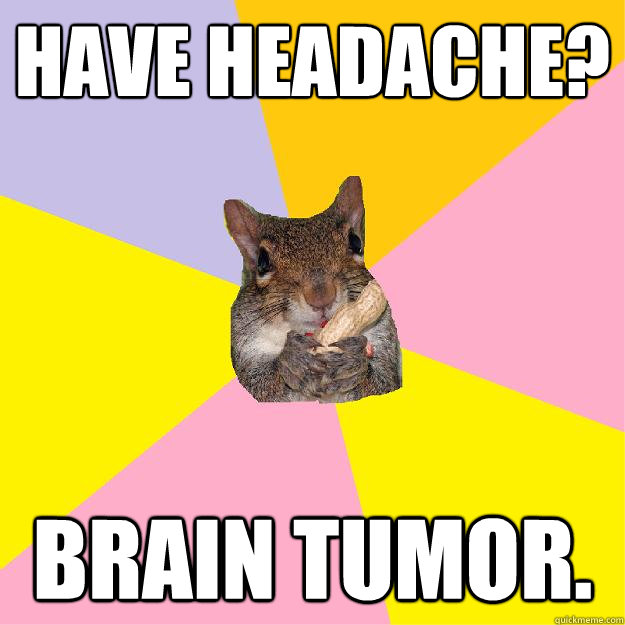
Contrary to popular opinion, hormone imbalance does not manifest itself solely as PMS/raving menopausal women rushing outside to cool down, despite the many undoubtedly hilarious jokes on the subject. In my case, I had a whole range of pituitary tumor symptoms which built up gradually over a number of years: my hair started falling out when I was in the sixth form at school; I was getting really hungry all the time; I felt the cold particularly badly (that one really baffled the doctors, as people with too much thyroid hormone are supposed to get too hot); I bruised incredibly easily;* my heartrate would go up for no reason; I kept getting ill with various coughs and colds.

That last point really managed to muddy the (already murky) waters of diagnosis. After starting university I was constantly in-and-out of the doctors; in my first year I had bronchitis, and in my second, glandular fever. If they gave out badges for GP visits, I'd have a full display case; in-between actual illnesses, I kept going back and complaining at them. Regular barrages of blood tests - including checking my thyroid - were carried out, and they all came back fine. If they gave out badges for hypochondria, I'd probably have been given one of those, too.
I only really managed to get my GP's attention in January 2010, when I developed tachycardia - i.e. my heartrate suddenly jumped up to about 140 bpm for no apparent reason.** That, for those of you who haven't experienced it, is a rubbish heartrate to have, given that your resting heartrate is supposed to be about 70-100 bpm. It's like constantly feeling that you've just sprinted several hundred metres. To evade a mountain lion. While wearing a dress designed by Lady Gaga Couture.

As well as a high heartrate, I had the shakes, and any loud noises suddenly became surprisingly stressful - plus, I kept twitching worse than Nick Clegg trying to throw off Cameron's Imperius Curse. Fortunately the doctors stuck me on beta blockers, the medication of the aged, and as long as I remembered to take them it wasn't too bad. I couldn't really do any strenuous exercise - but on the plus side, for the first month or two the pills gave me some excitingly vivid dreams.
The high heartrate eventually got a cardiologist involved, who ordered the right kind of thyroid function tests, which flagged up my very high levels of thyroid homornes, eventually led to diagnosis when they realised I was overproducing Thyroid Stimulating Hormone, blah blah. Since my pituitary surgery in April, some of my symptoms have improved; I've halved my dose of beta blockers and found that I can actually go running without collapsing like a pansy,*** which is definitely appreciated. I've had more headaches, though, so I guess it's swings and roundabouts.

So those are my crazy TSH-oma pituitary tumour symptoms! Or at least a quick run-down of the more important ones. I imagine that's more than enough for one post. Hopefully we can all agree that my old-lady bitching skills are being finely honed.
UPDATE: Click here to read my post about my first trip to hospital.
_______________________________________________________________________
* Current record: 22 bruises over three days, with no idea how they got there.
** Interestingly, but not relevantly, that's about the same heartrate as a domestic cat.

*** I tried jogging to catch a train in the summer of 2010 and even though I ran for less than a minute, I was hyperventilating for about half an hour afterwards. Caught the train, though. Slick.
Subscribe to:
Posts (Atom)