Now, as you may or may not have noticed, I am of the female persuasion. And one of the irritating things about this is that, when you get annoyed, no matter how legitimate your grievance, there are a few gentlemen dotted about the place who will always respond with "LOL IT MUST BE HER TIME OF THE MONTH HAHA WOMEN EH AND THEIR MYSTERIOUS HORMONAL PROBLEMS CAN'T LIVE WITH EM CAN'T KEEP EM ON A CONTINUOUS DIAZEPAM IV TO CORRECT THEIR CRAZY LADY ISSUES".
The trouble with this reaction is not just that it is stupid, but also that there is no way of responding to it that does not justify the accusation in the minds of the accusers. If you remain silent, it implies that you agree. If you punch them in the face, this is taken as further evidence of "hormonal imbalance", when in fact it is self-evidently the correct course of action.
But anyway, my experiences over the last year or so of undergoing treatment for my pituitary macroadenoma have certainly made me appreciate The Power of Hormones. And that's what we're going to learn about today.
So what are hormones? Obviously, as we all kind of slightly know, they're like chemically things that sort of slosh around your body, and if they get imbalanced then you go mental and start shouting at people and probably have a hot flush.
On closer examination, this sounds suspiciously like the theory of the four humours, so I turned to Wikipedia for a delightfully un-technical definition: "A hormone is a chemical released by a cell or gland in one part of the body that send out messages which affect cells in other parts of the organism… In essence, it is a chemical messenger that transports a signal from one cell to another."
The pituitary gland is a little gland at the base of the brain, and it sits around all day secreting nine different types of hormone which help to regulate growth, metabolism, water balance, lactation, aspects of preganancy and childbirth, body temperature, blood pressure and more. Given the complex feedback mechanisms required to keep all these hormones in balance, it's easy to see that when you develop a pituitary adenoma which secretes hormone(s), it throws everything completely out of whack.
Pituitary adenomas may secrete growth hormone (acromegaly), adrenocorticotropic hormone (Cushing's disease), prolactin (prolactinoma), or as in my case thyroid-stimulating hormone (TSH-oma). But then it gets complicated, because each hormone may interact with and affect the levels of other hormones as well. So, for example, in my case my body was producing too much thyroid-stimulating hormone, which caused my body to produce too much thyroid hormone, which had a knock-on effect on other hormones including prolactin and SHBG (technically not a hormone itself but a glycoprotein which affects the levels of other hormones in the body). It's basically like your body has spent ages laying out a complex pattern of dominoes on the floor, in which one starter domino needs to be flicked for them all to neatly fall over, and then some buffon comes tramping in wearing giant boots and stomps right in the middle of them. Lots of the dominoes fall over, some don't, and it's a bloody nightmare trying to set it all up again.
So, this time last year, my hormones were completely messed up and I was experiencing all kinds of crazy symptoms; rapid heartrate, hair falling out, massive appetite etc etc. And then I started treatment with lanreotide injections - the same injections that I'm having at the moment - and started to see an improvement in my TSH levels, which continued for several months and has only just got worse again (damnit!).
I already knew about The Power of Hormones. When your heart's going at 140bpm it's hard to ignore. But I hadn't really been prepared for the fact that when I began treatment, my changing hormone levels would affect me in more ways than simply improving my symptoms. The same thing has happened again in the past week or so since having my first injection. The first thing to arrive, just like last year, was the Crazy Appetite Swings. On Sunday, I had no appetite. I could happily have eaten nothing all day; just having a coffee in the morning made me feel really full. On Monday, I was back to normal; by Tuesday, I was completely ravenous.* There will probably be weeks of me alternately spending days completely uninterested in food, and then making like the Very Hungry Caterpillar and eating my way through anything placed in front of me, up to and including my own desk.
But the Crazy Hunger Swings are not so crazy as the Crazy Cat Lady Mood Swings. I guess I am fortunate in that my mood swings haven't tended too much towards the angry thus far,** but rather to the excessively emotional. For example, yesterday I was walking home from work, listening to my ipod as per usual, when all of a sudden and to my intense embarassment I burst into tears at a Beyonce song. I'm not going to say which song, out of shame, but the fact that I had this sudden surge of emotion struck me as rather hilarious and I then started giggling, so I was walking home laughing and weeping like a complete maniac and generally very glad I didn't see anyone I knew en route. I'm going to try my best not to adopt hundreds of cats and live in a bin liner, but at the rate I'm going the position of local madwoman may well be within my reach very shortly.
After a few more weeks of treatment, hopefully my hormones should be more in balance, but until that happy day every time my eyes well up with tears at the sight of a cute piglet in a teacup, I shall remember The Power Of Hormones.
_______________________________________________________________
*Admittedly not ravenous enough to eat the horrific curried parsnip soup I had for lunch at work, though.
**Although last year I would occasionally find myself becoming suddenly and irrationally furious if someone, say, dared to walk in front of me on the pavement. Happily, as soon as I recognised I was being silly the feeling would go away.***
***And if that didn't work, I used to just push them into the path of oncoming traffic.
Showing posts with label prolactinoma. Show all posts
Showing posts with label prolactinoma. Show all posts
Wednesday, 1 February 2012




Thursday, 15 December 2011
Famous People with Cushing's Disease?
Being a blogger with a TSHoma (a.k.a. TSH-oma,* a.k.a. thyrotropinoma, a.k.a. a freak) has its pros and cons. On the plus side, as far as I can tell I have definitely found a niche in the market - no mean feat, given the number of enthusiastic and generally excellent blogs written by people with everything from diabetes to acromegaly. On the down side, there's none of that nice cosy caring and chit-chat over tea and lanreotide injections that you get from support groups with other people. People who understand how rubbish it is that your heart's going too fast/your hands have grown enormously/your nose just fell off. So being me, I have been ambling around the internet, happily barging into other people's support groups and demanding to be paid attention because I have a tumour on my pituitary gland too.
A little while ago I found the lovely Acromegaly Bloggers, and more recently bumbled across a blogging group for people with Cushing's disease, called Cushie Bloggers. People with Cushing's disease can at least console themselves with the fact that referring to themselves as "cushies" makes them sound incredibly cute and fluffy and generally charming.
But anyway, finding the blog and reading the experiences of some of the bloggers got me thinking: in an earlier post, I went on a hunt for famous people with pituitary adenomas. Obviously there were no cases of TSHoma/thyrotropinoma - that would be too much to hope for. But there's Russell Watson with his unspecified adenoma, and numerous celebs with acromegaly - even more than I included in my post, in fact: acromegalovelies are all over the shop, from Andre the Giant to Pio Pico.
But where are all the famous Cushing's sufferers?
I've found it difficult to find information specifically on the incidence** of Cushing's Disease, probably due in part to the fact that it's a subtype, as it were, of Cushing's Syndrome, accounting for about 70% of endogenous Cushing's syndrome cases. I have found the incidence of such new cases quoted as about 13 cases per million, so we're talking 9 new cases per million per year, compared to an incidence of 3 - 4 new cases of acromegaly per million, per year. So it is seemingly rather more common than acomegaly, although the massive tendency towards underdiagnosis of both illnesses (and TSH-omas as well) makes these rather shaky figures.
Given that it's relatively easy to find well-known figures suffering from acromegaly (even outside the field of sports, where young sufferers' large frames could be considered to give them an attractive advantage in sports like basketball or wrestling) and given that Cushing's is more common, you'd think it would be easier to find a celebrity with Cushing's. (You'd also expect to find people with prolactinomas, but I suspect that (particularly male) celebrities might prefer to generalise prolactinomas as "tumours" rather than publicly imply that they're leaking milk from their manboobs.) Celebrities diagnosed with Cushing's, on the other hand, are (I would have thought) surely be more likely to publicise their condition, to explain that any excess weight gain was not due to greed or laziness but a medical condition.
So where are they all? I've looked around the place and all I can find is a vague hint that Elvis may have had Cushing's syndrome (as distinct from the disease, Cushing's syndrome does not necessarily imply a pituitary tumour, but could be caused by steroid overdose or adrenal tumours etc). If true it would certainly be something of a PR coup for cushies, but one article in the Daily Mail is not much to go on. The Daily Mail seems to have a little bit of a penchant for Cushing's Disease (is there a sufferer amongst the editorial staff?) and I've also found an article suggesting that King Henry VIII may have had Cushing's Disease. Who knows? When it comes to historical figures, it's fun to speculate, but speculation is all it can remain.
The only - literally the only - modern-day sufferer I've found who comes close to the designation of "celebrity" is J. Jordan Bruns, an artist featured in this article - but he's not exactly a household name, lovely though his art is.
Come on cushies, come out from the woodwork!
UPDATE: If you're interested in reading about famous people who suffer from pituitary tumours, see my other posts looking at famous pituitary ademoaners here and here; my post about Russell Watson, the opera singer who had a pituitary tumour; or check out my post looking at famous women with acromegaly.
___________________________________________________
*Never doubt the power of punctuation. If you search for the wrong one, Google will offer you Tshoki Tshoma's naked photos. Nice.
** I would prefer to write about prevalance but I've found it harder to find figures for that.
A little while ago I found the lovely Acromegaly Bloggers, and more recently bumbled across a blogging group for people with Cushing's disease, called Cushie Bloggers. People with Cushing's disease can at least console themselves with the fact that referring to themselves as "cushies" makes them sound incredibly cute and fluffy and generally charming.

But anyway, finding the blog and reading the experiences of some of the bloggers got me thinking: in an earlier post, I went on a hunt for famous people with pituitary adenomas. Obviously there were no cases of TSHoma/thyrotropinoma - that would be too much to hope for. But there's Russell Watson with his unspecified adenoma, and numerous celebs with acromegaly - even more than I included in my post, in fact: acromegalovelies are all over the shop, from Andre the Giant to Pio Pico.
But where are all the famous Cushing's sufferers?
I've found it difficult to find information specifically on the incidence** of Cushing's Disease, probably due in part to the fact that it's a subtype, as it were, of Cushing's Syndrome, accounting for about 70% of endogenous Cushing's syndrome cases. I have found the incidence of such new cases quoted as about 13 cases per million, so we're talking 9 new cases per million per year, compared to an incidence of 3 - 4 new cases of acromegaly per million, per year. So it is seemingly rather more common than acomegaly, although the massive tendency towards underdiagnosis of both illnesses (and TSH-omas as well) makes these rather shaky figures.
Given that it's relatively easy to find well-known figures suffering from acromegaly (even outside the field of sports, where young sufferers' large frames could be considered to give them an attractive advantage in sports like basketball or wrestling) and given that Cushing's is more common, you'd think it would be easier to find a celebrity with Cushing's. (You'd also expect to find people with prolactinomas, but I suspect that (particularly male) celebrities might prefer to generalise prolactinomas as "tumours" rather than publicly imply that they're leaking milk from their manboobs.) Celebrities diagnosed with Cushing's, on the other hand, are (I would have thought) surely be more likely to publicise their condition, to explain that any excess weight gain was not due to greed or laziness but a medical condition.
So where are they all? I've looked around the place and all I can find is a vague hint that Elvis may have had Cushing's syndrome (as distinct from the disease, Cushing's syndrome does not necessarily imply a pituitary tumour, but could be caused by steroid overdose or adrenal tumours etc). If true it would certainly be something of a PR coup for cushies, but one article in the Daily Mail is not much to go on. The Daily Mail seems to have a little bit of a penchant for Cushing's Disease (is there a sufferer amongst the editorial staff?) and I've also found an article suggesting that King Henry VIII may have had Cushing's Disease. Who knows? When it comes to historical figures, it's fun to speculate, but speculation is all it can remain.
The only - literally the only - modern-day sufferer I've found who comes close to the designation of "celebrity" is J. Jordan Bruns, an artist featured in this article - but he's not exactly a household name, lovely though his art is.
Come on cushies, come out from the woodwork!
UPDATE: If you're interested in reading about famous people who suffer from pituitary tumours, see my other posts looking at famous pituitary ademoaners here and here; my post about Russell Watson, the opera singer who had a pituitary tumour; or check out my post looking at famous women with acromegaly.
___________________________________________________
*Never doubt the power of punctuation. If you search for the wrong one, Google will offer you Tshoki Tshoma's naked photos. Nice.
** I would prefer to write about prevalance but I've found it harder to find figures for that.
Tuesday, 15 November 2011
Russell Watson, It's Not All About You
Following my last post about Russell Watson, I felt inspired to find out about some other famous people who have had pituitary adenomas, using the trusty-yet-woefully-incomplete-and-indeed-quite-inaccurate Wikipedia List of Brain Tumour Patients. And I have learned about:

Governor Pico is my absolute favourite discovery. Not just because I love a guy with a sexy beard, not just because of his awesome name, but also because he is a very intriguing case of retrodiagnosis. Pío Pico lived from 1801 to 1894; acromegaly was first identified in 1886 and he was never diagnosed in his lifetime. In 2010, this paper was published suggesting that he suffered from acromegaly. Looking at pictures of him from 1847 to 1858, he progressively exhibits more of the characteristics associated with acromegaly; this picture from 1858 clearly shows a large forehead, big nose and enlarged lips, a hairless face and hairloss from the eyebrows, which could indicate secondary hypothyroidism, and misaligned eyes which could be due to the tumour pressing on cranial nerves. If you look at the article I linked above, there are more photographs which show his huge hands.
But that's not where the interesting ends. The Governor lived well into his nineties - no mean achievement for a Victorian - while the article suggests that around 80% of patients with untreated acromegaly would be expected to die in the first ten years after diagnosis. It seems instead that his pituitary adenoma spontaneously infarcted sometime after 1858; pictures of him as an old man show that his facial features and hands have become much smaller, he has a full beard and his eyebrows have grown back.*
Another pituitary adenoma and a really sad case. Kevyn Aucoin was a well-known make-up artist and photographer who had worked for Vogue and Revlon, wrote books and appeared on TV. He was diagnosed with acromegaly aged 39, although it's believed he suffered from the condition for some time before it was diagnosed, and the pain of it resulted in an addiction to prescription painkillers. After surgery for his pituitary tumour, his use of painkillers intensified and he died, only a few months later, from liver and kidney failure. You can read about him on his Wikipedia page and this article.
Sun Mingming
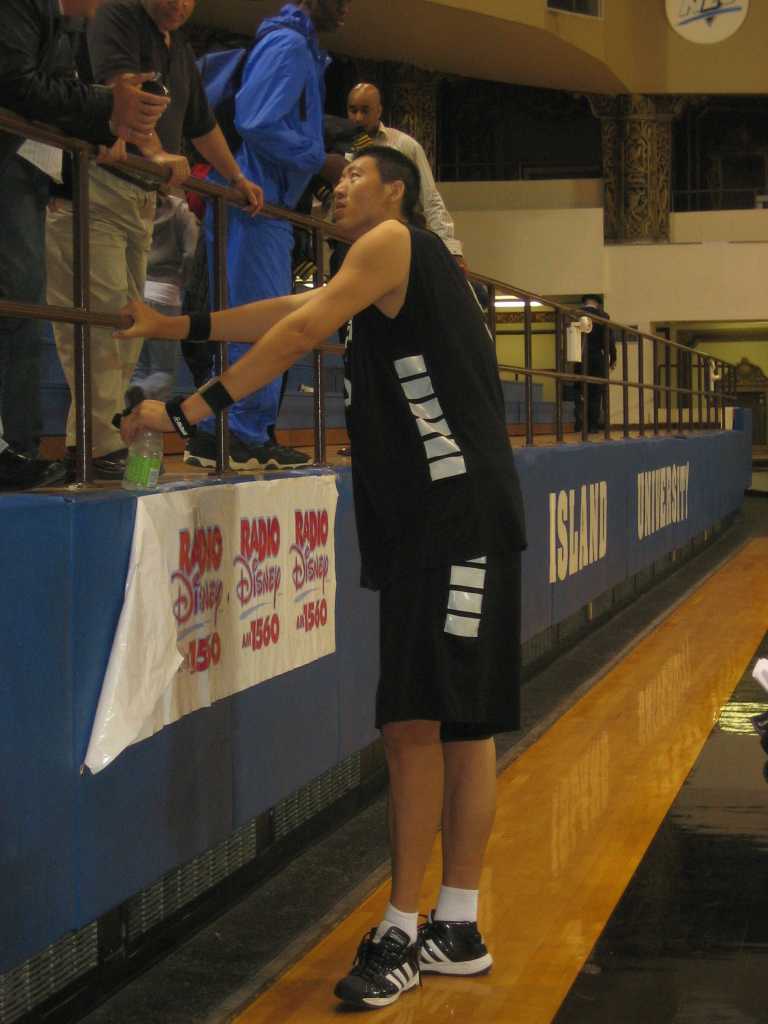
You could probably guess from the subtitle that Sun Mingming also has acromegaly (an overrepresented condition in this sample! I guess because the symptoms are so unusual, lazy journalists don't just write "brain tumour" and move on). Pituitary adenomas which secrete growth hormone and develop before puberty result in sufferers becoming very tall; in adulthood it's all about the growth of soft tissues. Sun underwent gamma knife radiosurgery at the age of 23 and is still playing.
It's been kind of a challenge to discover much about James Murphy and his pituitary macro-adenoma, but in this article he certainly emphasises the fact that it's a benign tumour rather than cancer, and that although it can cause some serious problems and, rarely, death, the prognosis is nowhere near as bad as a cancerous brain tumour. One online forum I bumped across in my researchings was castigating celebrities who fail to make this distinction, so good on him.
From the hints about his ongoing "hormone inhibiting treatment," which on one site is said to be bromocriptine, and the fact that he's not obviously acromegalicious** I'm guessing he has a nasty prolactinoma, but that is just a guess. I'm kind of hoping so, purely because I've found it so hard to get examples of famous pituitary tumourheads who have something other than acromegaly.*** His tumour seems to have been pretty badly located, as they operated basically through his face rather than the nose or mouth, something I hadn't come across before.
So there you have it, a brief run down of some famous folk. There are actually quite a few more cases of acromegaly which I came across - people like Andre the Giant, for instance. But that's enough for now.
UPDATE: True to my word, I have written another post about more famous people with pituitary adenomas. I've also written about famous people with Cushing's Disease and the question of whether there are any famous women with acromegaly.
___________________________________________________________
*Sadly, the article notes that he suffered a lot of abuse and discrimination in his lifetime for his unusual appearance.
**Acromegaly sufferers: you should use this word.
***Acromegalicious folk are obviously awesome, but I'm trying to be balanced here. As for finding anyone famous with a TSHoma like me - it's difficult enough just finding published case studies.
Pío de Jesús Pico
last Governor of California under Mexican rule.
Governor Pico is my absolute favourite discovery. Not just because I love a guy with a sexy beard, not just because of his awesome name, but also because he is a very intriguing case of retrodiagnosis. Pío Pico lived from 1801 to 1894; acromegaly was first identified in 1886 and he was never diagnosed in his lifetime. In 2010, this paper was published suggesting that he suffered from acromegaly. Looking at pictures of him from 1847 to 1858, he progressively exhibits more of the characteristics associated with acromegaly; this picture from 1858 clearly shows a large forehead, big nose and enlarged lips, a hairless face and hairloss from the eyebrows, which could indicate secondary hypothyroidism, and misaligned eyes which could be due to the tumour pressing on cranial nerves. If you look at the article I linked above, there are more photographs which show his huge hands.

But that's not where the interesting ends. The Governor lived well into his nineties - no mean achievement for a Victorian - while the article suggests that around 80% of patients with untreated acromegaly would be expected to die in the first ten years after diagnosis. It seems instead that his pituitary adenoma spontaneously infarcted sometime after 1858; pictures of him as an old man show that his facial features and hands have become much smaller, he has a full beard and his eyebrows have grown back.*

Kevyn Aucoin
American make-up artist and photographer
Another pituitary adenoma and a really sad case. Kevyn Aucoin was a well-known make-up artist and photographer who had worked for Vogue and Revlon, wrote books and appeared on TV. He was diagnosed with acromegaly aged 39, although it's believed he suffered from the condition for some time before it was diagnosed, and the pain of it resulted in an addiction to prescription painkillers. After surgery for his pituitary tumour, his use of painkillers intensified and he died, only a few months later, from liver and kidney failure. You can read about him on his Wikipedia page and this article.
Sun Mingming
7'9" basketball player

James Murphy
Death metal guitarist man
It's been kind of a challenge to discover much about James Murphy and his pituitary macro-adenoma, but in this article he certainly emphasises the fact that it's a benign tumour rather than cancer, and that although it can cause some serious problems and, rarely, death, the prognosis is nowhere near as bad as a cancerous brain tumour. One online forum I bumped across in my researchings was castigating celebrities who fail to make this distinction, so good on him.
From the hints about his ongoing "hormone inhibiting treatment," which on one site is said to be bromocriptine, and the fact that he's not obviously acromegalicious** I'm guessing he has a nasty prolactinoma, but that is just a guess. I'm kind of hoping so, purely because I've found it so hard to get examples of famous pituitary tumourheads who have something other than acromegaly.*** His tumour seems to have been pretty badly located, as they operated basically through his face rather than the nose or mouth, something I hadn't come across before.
***
So there you have it, a brief run down of some famous folk. There are actually quite a few more cases of acromegaly which I came across - people like Andre the Giant, for instance. But that's enough for now.
UPDATE: True to my word, I have written another post about more famous people with pituitary adenomas. I've also written about famous people with Cushing's Disease and the question of whether there are any famous women with acromegaly.
___________________________________________________________
*Sadly, the article notes that he suffered a lot of abuse and discrimination in his lifetime for his unusual appearance.
**Acromegaly sufferers: you should use this word.
***Acromegalicious folk are obviously awesome, but I'm trying to be balanced here. As for finding anyone famous with a TSHoma like me - it's difficult enough just finding published case studies.
Tuesday, 11 October 2011
Embarassing Bo- OH DEAR GOD
This post is dedicated to my loving Auntie C, who sent me a text a couple of weeks ago which read: "Are you watching Embarassing Bodies on Channel 4? There's a young man with suspected pituitary tumour. x"*
Foolishly, naively, unthinkingly - always keen to see fellow tumourheads on TV - I trotted off to watch it. For those of you who've not been treated to this televisual extravaganza, rest asssured that it does exactly what it says on the tin: people with revolting medical conditions are lined up for your viewing pleasure. It's basically just a high-definition version of an old-fashioned freak show, but slightly more patronising.
Possibly I should have realised that this was not the programme for me when the mere sight of a man's nose on the credit sequence made me queasy. Yet I soldiered on. (Well, I hid the 4oD player in a different tab so I didn't have to watch it. But I listened to some pretty hideous commentary.)
Until they finally brought on Amir, a wide-eyed twenty-six-year-old with man-boobs and a secret.
Hint: the secret is that he milks himself every day.
You heard me.
HE MILKS HIMSELF.
EVERY DAY.
And has done so for the last three years. But why does he milk himself?
Because if he doesn't, his moobs hurt. Duh!
Amir meets Dr Christian and explains his problem, and as the world's stupidest game of Twenty Questions unfolds, we learn that even Amir's wife doesn't know about his milk mongering, although surely she can't have failed to notice the fairly impressive pair of puppies he's sporting. (It's not made clear whether or not they have children together - but if they do, I would imagine that Mrs Amir would be none too impressed to hear that, despite possessing an unusual advantage in the lactating stakes, her husband had failed to do his share of the breastfeeding).
Poor old Amir is shipped off to get his pituitary checked out and (of course!) he's got a pituitary adenoma which is secreting the hormone prolactin, aka a prolactinoma. And by the end of the programme he's on bromocriptine or something similar and all is well.
But the point is that this guy apparently preferred to sit and squeeze the milk from his man breasts every night for three years rather than just... go to the doctors. He could have caught it much earlier when it was smaller and easier to treat, but no.** Possibly he had seen, and been terrified into submission by, this advert from the Milk Marketing Forum, or perhaps the Breast Is Best campaign just really hit home for him. We may never know. But I think the moral of the story is that - whether you're a man who develops boobs and starts lactating, or a man who develops photographs and has an exciting facial deformity - just go to the freaking doctors. Seriously.
______________________________________________________________
* At this juncture I should point out that the 'x' stands for a kiss. It's not that Pituitary Tumour X is a particularly cool kind of tumour.
**Indeed, he could have caught it much earlier and not made a spectacle of himself on national tv. But we'll forgive him that because - at the very least - he may slightly have raised the profile of pituitary adenomas.
Foolishly, naively, unthinkingly - always keen to see fellow tumourheads on TV - I trotted off to watch it. For those of you who've not been treated to this televisual extravaganza, rest asssured that it does exactly what it says on the tin: people with revolting medical conditions are lined up for your viewing pleasure. It's basically just a high-definition version of an old-fashioned freak show, but slightly more patronising.

Possibly I should have realised that this was not the programme for me when the mere sight of a man's nose on the credit sequence made me queasy. Yet I soldiered on. (Well, I hid the 4oD player in a different tab so I didn't have to watch it. But I listened to some pretty hideous commentary.)
Until they finally brought on Amir, a wide-eyed twenty-six-year-old with man-boobs and a secret.
Hint: the secret is that he milks himself every day.
You heard me.
HE MILKS HIMSELF.
EVERY DAY.
And has done so for the last three years. But why does he milk himself?
Because if he doesn't, his moobs hurt. Duh!
Amir meets Dr Christian and explains his problem, and as the world's stupidest game of Twenty Questions unfolds, we learn that even Amir's wife doesn't know about his milk mongering, although surely she can't have failed to notice the fairly impressive pair of puppies he's sporting. (It's not made clear whether or not they have children together - but if they do, I would imagine that Mrs Amir would be none too impressed to hear that, despite possessing an unusual advantage in the lactating stakes, her husband had failed to do his share of the breastfeeding).

Poor old Amir is shipped off to get his pituitary checked out and (of course!) he's got a pituitary adenoma which is secreting the hormone prolactin, aka a prolactinoma. And by the end of the programme he's on bromocriptine or something similar and all is well.
But the point is that this guy apparently preferred to sit and squeeze the milk from his man breasts every night for three years rather than just... go to the doctors. He could have caught it much earlier when it was smaller and easier to treat, but no.** Possibly he had seen, and been terrified into submission by, this advert from the Milk Marketing Forum, or perhaps the Breast Is Best campaign just really hit home for him. We may never know. But I think the moral of the story is that - whether you're a man who develops boobs and starts lactating, or a man who develops photographs and has an exciting facial deformity - just go to the freaking doctors. Seriously.

______________________________________________________________
* At this juncture I should point out that the 'x' stands for a kiss. It's not that Pituitary Tumour X is a particularly cool kind of tumour.
**Indeed, he could have caught it much earlier and not made a spectacle of himself on national tv. But we'll forgive him that because - at the very least - he may slightly have raised the profile of pituitary adenomas.

Subscribe to:
Posts (Atom)