Showing posts with label metabolism. Show all posts

Monday, 23 July 2012

IMFW: Lipodystrophy

Today's Interesting Medical Fact of the Week is about lipodystrophy, defined by the ever-noble Wikipedia as "a medical condition characterized by abnormal or degenerative conditions of the body's adipose tissue." Adipose tissue = fat. As you would know if you watched the freaky Dr Who episode which featured little fat aliens called the Adipose.

Dr Who: making obesity cute.
But I digress.

I first heard about lipodystrophy when chatting to a very lovely nurse in the research department of the hospital where I went to have a bunch of tests at the beginning of the month. It's a subject they have been doing some research into, and I have to admit it kind of caught the imagination.

The term "lipodystrophy" actually covers a whole range of conditions in which the body's fat does weird things. It may include a loss of fat from certain areas of the body (lipoatrophy), or even an increase in fat in certain areas (lipohyperthrophy), or even both (lipoWTF-ery):

Congenital generalised lipodystrophy:
A rare genetic disorder in which there is extremely low fat in the subcutaneous tissue.
Other symptoms include having a giant liver and being very hairy. And, unfortunately, heart problems.

Benign Symmetric Lipomatosis:
In which the patient develops extensive fat deposits in the neck, head and shoulder area. Often associated with alcohol abuse.

Barraquer-Simons Syndrome:
This rare condition usually appears after a viral infection in childhood, and is characterised by the gradual loss of fat from the top half of the body; the face, neck, shoulders, arms and chest, often accompanied by an increase of fat in the thighs, and sometimes by other symptoms such as deafness and epilepsy.

HIV-associated lipodystrophy:
This condition occurs in people with HIV, usually those who are being treated with anti-retroviral drugs, although there is some debate about whether it is caused by the drugs or by HIV infection alone. Often there may be fat accumulation in the back, creating a 'buffalo hump', the neck and breasts, and patients often develop abdominal obesity. However, at the same time they may have loss of fat in the face, arms, shoulders, thighs and buttocks.

Those are just a few examples - lipodystrophy is quite poorly understood and quite difficult to treat. Liposuction may be used to treat excess fat deposits, or lipomas (benign tumours of fat tissue) may be removed surgically; equally implants or even fat injections may be used to improve the cosmetic appearance of fat loss from the face and body.

Monday, 16 July 2012

Human Guinea Pig: Part 6 - Resting Energy Expenditure Test

This is the sixth part of the story about my overnight stay in the hospital's research department, having lots of tests to look at the effect my pituitary tumour is having on my body and metabolism. Here are links to: part one, part two, part three, part four and indeed part five.

Resting Energy Expenditure and the GEM Ventilated Hood Indirect Calorimeter

I was woken up at half eight the next morning by the very lovely technician* who did my step test and heart monitor the previous day. She was dragging a large piece of equipment into my room, where it was placed next to my bed; it was time for my resting energy expenditure to be monitored. This has to be done first thing in the morning for maximum accuracy, which is why they kept me in hospital overnight.

 There's a tricky balance to be met with regards to this test; on the one hand, you have to be awake for the whole thing, but equally you're not supposed to get out of bed - or even move, as far as possible. For a sleepy creature like me, this makes it pretty hard to stay awake, but fortunately the whole experience was so surreal that I didn't want to let myself drift off.

Firstly, the equipment is switched on, set up, and left to monitor the room for ten minutes. Essentially, your metabolism is monitored by measuring the amount of carbon dioxide you breathe out. These measurements are then used to calculate your respiratory quotient. The technician explained it to me like this: when you're asleep, you usually breathe out a lower level of carbon dioxide, indicating that your body is metabolising your fat stores to produce energy (RQ = <0.7). When you're out and about, you'll be breathing out a higher level of carbon dioxide, indicating that you're metabolising carbohydrates (RQ= >0.7). I have a pituitary tumour which is messing with my hormones so they want to know what the heck my metabolism is actually doing. Or something.

Anyway - in order to make sure that the readings they take of the air you breathe out is accurate, the composition of the air in the room you're in has to be measured before and after the test. So I lay in bed for ten minutes, listening to it whirring happily next to me.

And then the technician returned with the rest of the equipment.

I am genuinely unspeakably ensorrowed by the fact that I didn't get a picture of me in it, but unfortunately it was early in the morning, my brain was still in first gear, and I wasn't actually allowed to move. So you'll have to use your imagination. Essentially, the rest of the equipment (the "ventilated hood") is a large goldfish bowl with a cape hanging off it, a small hole at the top, and a large pipe or two running out of it. Imagine a giant plastic medical jellyfish and you'll be on the right track.

I did find a picture of the machine all bundled up, but it doesn't look as amusing as it did once it was set up:
This piece of kit is called a GEM (Gas Exchange Measurement) ventilated hood indirect calorimeter. Snappy name, right? The GEM Nutrition website describes it as "an open circuit indirect calorimeter designed for nutritionists needing to measure energy balance and substrate turnover. The compact bedside unit measures gas exchange volumes, respiratory quotient and energy expenditure."

So now you know.

This strange contraption was connected up to the machine, and then placed over my head, at which point I understood why the nurses had double-and-triple checked with me whether or not I had claustrophobia the previous day. Then, safely ensconced in my plastic bubble, the cape was draped around me, and after checking that I wasn't freaking out and providing me with a call button, I was left.

I can't actually remember whether it was for twenty minutes or half an hour, but it didn't feel like very long. I could hear my breathing inside the big clear plastic helmet, which made me feel like a very lazy astronaut. Every now and again someone popped their head around the door to make sure I was ok, but it actually felt quite relaxing. The lights were still off in the room and it was all very chilled. I tried to keep my resting energy expenditure normal.

At some point later, I was freed from my goldfish bowl prison, and the GEM calorimeter sat burbling away in the corner for another ten minutes, measuring the room's air again.

The machine comes complete with a program which shows you the results immediately, along with little graphs showing the levels of carbon dioxide you were breathing out vs. the oxygen you were breathing in, etc. This would have been pretty awesome if I had had any clue what the results meant, but sadly they have to play with them further before they can draw any actual conclusions.

My Experience of the GEM Ventilated Hood Indirect Calorimeter:

Hassle: 1/5 (all I had to do was wake up and keep breathing, which I've managed to do every day of my life so far)
Fun: 3/5
Weirdness: 5/5
Results: 3/5
Total score: 12/20
____________________________________________________
*I don't know what her official job title is, so I'm going with "technician" but I could well be extremely wrong; I just know she was neither a doctor nor a nurse.

Saturday, 14 July 2012

Human Guinea Pig: Part 5 - Dinner at the Hospital

This is the fifth part of the story about my overnight stay in the hospital's research department, having lots of tests to look at the effect my pituitary tumour is having on my body and metabolism. Here are links to: part one, part two, part three and part four (I do go on).

Dinner at the Hospital

After a hurried trot back from the MRI department, I was dropped off at my room, ten minutes late for my dinner. The timing of this dinner was apparently important because it had been prepared just for me, and was apparently perfectly calibrated to contain exactly the right amount of calories for someone of my height and weight. I was allowed to eat the prepared meal only, nothing else, because they planned to monitor my metabolism and blood sugar levels in the morning and needed these to be unaffected by what I had eaten the night before.

I had barely had time to change out of my ridiculous scrubs and re-attach my Actiheart monitor when the night nurse's head appeared around the doorframe. "We're just heating your meal," she said, in a firm, no-nonsense voice. "You will be expected to eat all of it, you understand?"

And, with a stern look at me, she left. A few minutes later, she reappeared, tray in hand.

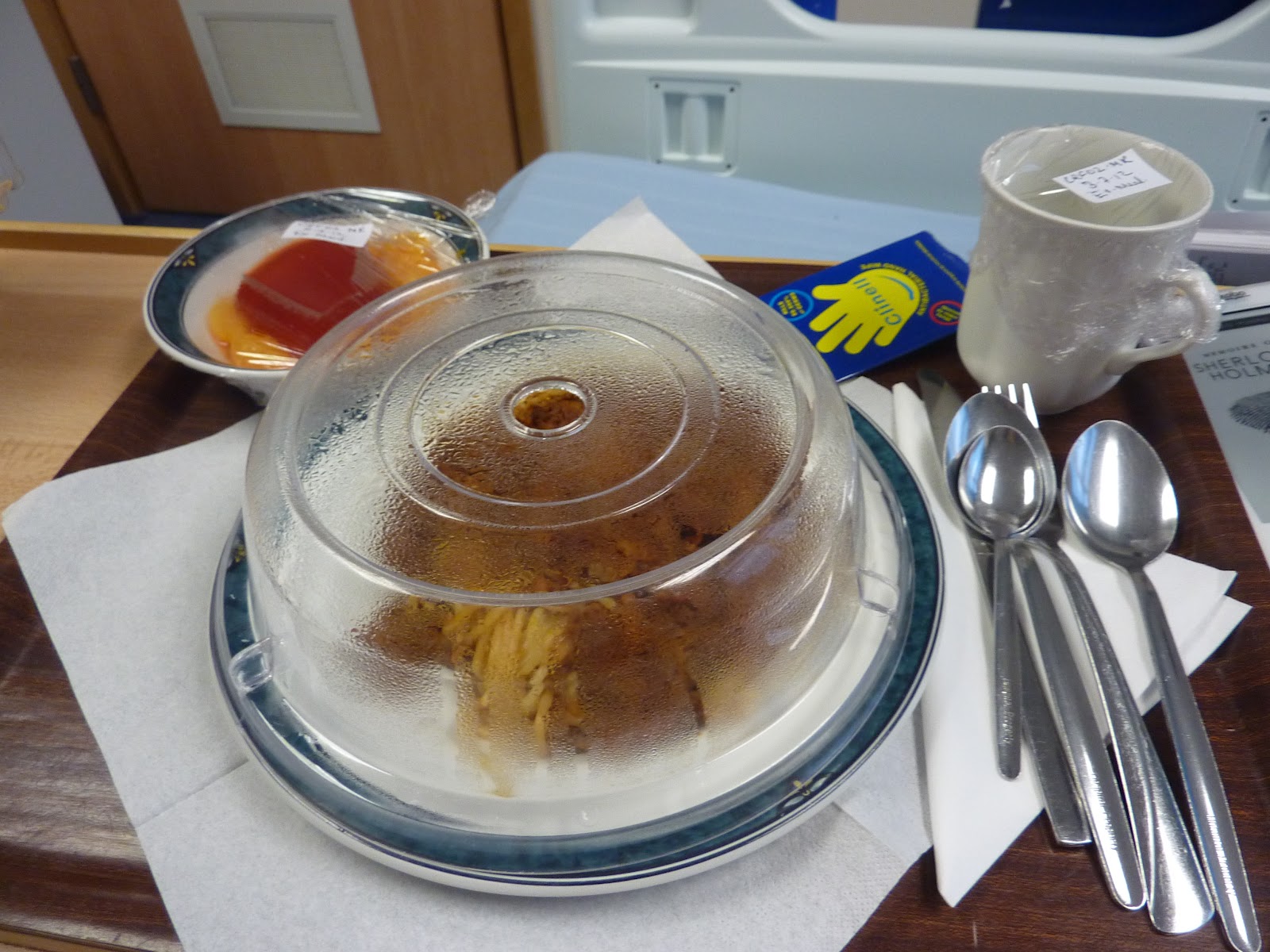
 Every dish had a label to show who it was for and when I should eat it, even to the extent that the milk for my evening (decaff) coffee had been measured out in advance, and I was not permitted any more. The main meal was, happily, spaghetti bolognese, one of my favourites.

But when I saw the dessert, my heart sank.

Close friends and family are aware that when it comes to desserts, I am usually more than enthusiastic in my appreciation of the culinary arts (unless it's cheesecake. Eurgh). However, I have a few basic rules. I don't eat jelly with sponge cake. I don't eat sponge cake with fruit.* And I don't eat fruit with jelly.

Here is a picture of the dessert:

In case you can't tell, it's strawberry jelly with tinned mandarin slices. NOOOOOO!
In fairness, it was partly my fault: the hospital did ask me whether I had any dietary requirements or dislikes, and I said no, because it would be strange and embarassing to have to explain my dessert law triad to a doctor. At least it wasn't cheesecake.

And so, I settled down to sup with good grace and managed to eat the entire thing. I did my utmost to separate the jelly from the mandarin segments wherever possible; where it was not possible, I adopted the approach to eating which has been popularised by the Burmese python, and gulped it down in one bite.

I don't know if the night nurse noticed my face fall when I saw the dessert, or whether she just thought I looked like an untrustworthy character, but she kept sticking her head around the door at unexpected moments while I was eating.

"Take your time," she said, smiling. "But you do have to eat it all."
"Ok, thanks," I replied.
My special tray!
Two minutes later, she popped up again. "You can take your time," she said. "Take as long as you want. But make sure you eat it all."

 And so on. It was very disconcerting. The constant visits created a weird kind of feedback loop where I found myself choking down the mouthfuls as quickly as possible in the hopes that she would finally stop telling me I could eat as slowly as I liked.

Eventually, I was done, and I had the evening to myself. I harassed my parents and boyfriend with text messages about jelly and fruit, read about the exploits of Mr Sherlock Holmes on my Kobo e-reader (which I LOVE), and flicked through TV channels. Eleven o'clock was lights-out and the terrifying night nurse came back again to confiscate my water and order me to pee in a jug overnight,** which was probably the moment I most felt like I was in prison.

Adding to this impression was the fact that my door had a small square window in it which opened onto the corridor and let an annoying amount of light in overnight, and the absurdly thin blanket on the bed. I often get chilly at night and hospitals are not cosy places, so I had brought my warmest hoody to wear in bed over my pyjamas, but I still woke up in the night absolutely freezing and had to ask for another blanket. This is extra annoying considering that hyperthyroidism is supposed to make you too hot, not too cold. In fact, I was given a questionaire about my symptoms, and one of the questions asked me to score my "heat intolerance" on a scale of 0-5, where 0 is no intolerance to heat and 5 is getting easily overheated. I wanted to add a -1 to the scale.

________________________________________________
*For those of you who really care about my pudding pickiness, I should note here that this rule only applies where the fruit makes the sponge cake all damp and hideous. I like fruit baked into cakes just fine. Fruit placed on top of a waterproof layer of icing is also acceptable. Trifle is the devil's pie.

**Not just for her own amusement; they did a 12 hour urine collection to monitor various hormone levels overnight.