Monday, 20 August 2012

IMFW: Harvey Cushing

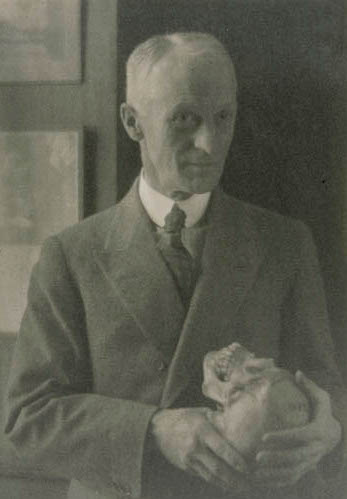
This week's IMFW is really more like an IMPW - an Interesting Medical Person of the Week. Harvey Williams Cushing is often regarded as the "father of modern neurosurgery".

An American descended from a long line of doctors, he was born in Ohio in 1869. After studying medicine, he went on to study surgery at the famous Johns Hopkins Hospital just after it had opened, then spent time in Europe before returning to Johns Hopkins as an associate professor in surgery. As well as writing about medicine, he was a talented medical illustrator and several of his drawings were published in textbooks - and as if that wasn't enough, he received the Pulitzer Prize for Biography for his biography of his mentor, William Osler.

Cushing's first monograph was on the subject of the pituitary, and on this blog, you'll have heard Cushing's name from one of his most famous discoveries, the disease named after him - Cushing's Disease; a tumour of the pituitary gland which secretes ACTH (adrenocorticotrophic hormone) and causes a range of symptoms including weight gain, bruising, sweating, high blood pressure and diabetes. Being a modest chap, he had originally named it "polyglandular syndrome", but his name stuck. However, this was far from his only contribution to medicine:

- He introduced blood pressure measurement to America

- He used x-rays to diagnose brain tumours

- He developed medical instruments which are still in use today, including the Cushing Forcep which is used during cranial surgery, the Cushing clip - a small clip for blood vessels to stop bleeding during surgery, which dramatically decreased mortality rates - and the use of electrocautery which he developed with W.T. Bovie, a physicist

- Along with a colleague, Ernest Codman, Cushing devised the first anaesthetic chart to help surgeons and anaesthetists monitor pulse, temperature and breathing - an innovation which was widely adoped

- Cushing pioneered many new surgical techniques including the use of saline for irrigation during surgery

- He developed a surgical cure for trigeminal neuralgia

- His mortality rate was around 10% - which doesn't sound hugely impressive until you realise that before he came along, mortality rates from neurosurgery were 50 - 90% depending on which source you believe

- He developed the transsphenoidal approach for surgery of the pituitary gland

- He invented the macarena (just checking you're paying attention...)

- He identified and named the phenomena of hypopituitarism and hyperpituitarism

Yes... yes, that is a skull.
 So Mr Harvey Williams Cushing deserves our gratitude and respect. He has thoroughly earned the bewildering array of unpleasant medical things named after him, which include: Cushing's Syndrome, Cushing's Disease, Cushing's symphalangism (a.k.a. proximal symphalangism), Cushing's Reflex resulting in Cushing's Triad (a nervous system response to increase intracranial pressure), Cushing ulcer a.k.a. Rokitansky-Cushing Syndrome, Bailey-Cushing Syndrome (he had to share that one), the Cushing forcep and Cushing clip.

Wednesday, 15 August 2012

Girl with Acromegaly Sues NHS

A story broke some time ago about a young lady with acromegaly who sued the NHS, and won. I've been meaning to write about her for a while but I wanted to take the time to create an interesting and informative post contrasting her case with that of Kane Gorny. Alas, I have not had the time, so you'll just have to deal with a dull and uninformative post instead. Hurrah!

The story is this: Kate Woodward, an aspiring actress, developed acromegaly (i.e. a pituitary tumour secreting growth hormone, which lead to uncontrolled growth of her body) as a child, which went untreated between 2001 and 2005 as medics failed to spot the condition. She attained a final height of 6'5" aged 20, and sued the NHS for £2 million. She was awarded compensation of £1.3m.

Incidentally, the award for "least sensitive headline about this story" goes to Healthcare Today UK, which went with "Freak Growth Woman Sues NHS".*

Nice.

Her case for being awarded this level of compensation was that, as a result of her condition being untreated for so long:

- Her height and "ugliness" meant that she could no longer go into a career as an actress.
- She has psychological difficulties and feels like a "freak" because of her condition.
- She has significant problems with her bones, knees and teeth, and cannot buy normal-sized clothes.
- The condition affected her childhood, schooling and friendships.

And, most significantly:

- She wishes to receive all future treatment in the private sector.

Now, not long after this story was first brought to my attention (by a colleague, thank you!) I noticed that it had also popped up as a topic of discussion on the Pituitary Foundation's forum. For those of you who don't subscribe, one member created a poll entited something like "Should Kate Woodward be ashamed of herself?" The results of the poll were overwhelmingly that she should (although in fairness by "overwhelmingly", I mean "there were four votes in total").

Why the anger? Surely she has a fairly good case, right? Undoubtedly, when a doctor is presented with a girl who measured 5'9" at just eleven years old and keeps growing, you'd hope that it wouldn't take four years to just Google it and think "hmm, maybe we should rule out acromegaly". Although we can't know that faster treatment would have effected a cure, it might have controlled or reduced the symptoms. She will have to live with injections and monitoring and joint problems and feeling self-conscious for her whole life.

BUT.

The problem is that this is not, actually, an unusual case - at least, not within the magical world of pituitary tumours. If every person with acromegaly decided to sue the NHS for delayed diagnosis, it would be one hell of a bonus day for lawyers. If you threw in people with other often-missed pituitary conditions like Cushing's Disease and TSHoma, it would probably result in a sudden UK lawyer shortage as they all retired to small Caribbean islands. If you based the level of compensation awarded on the number of years the condition went undiagnosed, the small Caribbean islands would probably reinvent themselves as world financial hubs.

I exagerate. But the mean length of time from onset of symptoms to diagnosis of acromegaly is, according to this MedScape article, around 12 years. Even if that estimate is too high, the point is that pituitary tumour conditions can be hard to diagnose, and they are often missed because they're rare enough that doctors don't see them often, and often don't expect to see them either. Four years to diagnose a patient with acromegaly is, sadly, not uncommon. I first showed symptoms of my TSH-secreting pituitary tumour aged 17, and I didn't get a diagnosis until I was 22. (In case you're bad at maths, that's five years). Even after my superfast heartrate made it clear that Something Was Wrong, it took a year to work out what that something was.

So if there's a slight lack of sympathy from other acromegalomaniacs,** it could be because they're thinking "Damn, £2m! Wish I'd thought of that."

 But I doubt it.  And I'm not just saying that because they're bigger than me.***

Now I want to note right off the bat that where there is evidence of medical negligence or it takes a long time to get a diagnosis, you should complain. Vociferously. You should complain in the hope that procedures can be improved. Otherwise there's nothing to stop future patients from suffering through the same tortuous process to find out what's wrong with them. But there's a difference between seeing a problem, taking a complaint as far as necessary to fix that problem for future patients, and just suing to get as much as you can out of them. Through the normal complaints process, the hospital in question offered Miss Woodward compensation of £700k, no court appearance required. If she lives to the age of 90, that would be £10,000 medical expenses covered every year. Additionally, according to the Daily Mail, which I personally take with a pinch of salt and under the supervision of a doctor, the hospital trust had already spent £288,000 on Miss Woodward for "treatment, dental care, holidays and special footwear".

Even the £500k difference between what she was offered and what the court awarded is a big chunk of money. £500k that could have gone towards treating other patients. I need somatostatin analogue injections (probably much like those Miss Woodward takes), and if you've been reading this blog lately, you'll know that it is proving slightly tricky to persuade someone to fund them. £500k could pay for 666-and-a-bit doses of those injections. Which doesn't sound like that much, until you realise that each dose lasts for a month, so £500k worth of injections would last me for fifty-five years. And six months. Assuming I needed them continuously. And of course by that point I would be 79-and-a-half, so chances are I could be dead by then anyway.

 And here's the thing. If the NHS messes up and, as a result, you end up incurring further costs in your daily life (eg. you're a professional tap dancer going into hospital for an appendectomy, and you wake up with a leg missing) then yep, you should get compensation and if they won't agree to pay it, sue them with my blessing and encouragement. If the clinical negligence of your child at birth leads to brain damage which will affect that child for their entire life, then sue for the money needed to support them. And if/when the NHS messes up so badly that it becomes a danger to other patients, and you follow through that complaints process and nothing changes, sue them until they sit up and pay attention and mend their ways.

 But I am somewhat uncomfortable with suing the NHS for the loss of a career that did not yet exist, and for the costs of having exactly the same treatment as the NHS provides, but done privately. (I'm also intrigued by the concept, since she presumably did not have private health insurance before diagnosis and consequently insurers would be unlikely to cover her pre-existing condition?).  I've had an MRI scan done by a private provider and done by the NHS and the experience was almost exactly the same - except the private hospital was a lot harder to get to on public transport.

I guess in some way I think that when the NHS messes up, part of the compensation is the NHS. The very fact that you live in a country where you don't have to worry about the cost of healthcare means that when the NHS makes a mistake, it - not you - ends up bearing any increased costs of your care as a result of its mistake. Perhaps in some countries when a patient gets a hospital-acquired infection, their bill from the hospital is increased - but in the UK, if a hospital gives you an infection, it has to foot the bill to try and fix it.

But it also means that when you sue an NHS hospital in the UK, you're not taking lobster off the table of a fat cat investor (well... not yet... comments about Mr Lansley on a postcard, please). You are taking money away from that hospital. Any sensible hospital trust will have a big old stash of contingency fund to cover the cost of lawsuits, but I still confess I'm uncomfortable with the idea of suing the NHS for anything less than an ironclad reason, because that money could be put to better use. It could be used to help treat someone just like you.

I don't think Kate Woodward is a bad person, and I don't think she should be ashamed of herself. I simply don't have sufficient details to form an opinion on this case, and she may well be entirely justified. But she sparks off an interesting debate. That's my opinion. What's yours?

______________________________________
*I noticed Jon Danzig, a journalist with acromegaly, took them to task for this in the comments section of the article, good on him!

** I don't know what the collective noun for "a group of people with acromegaly" is, but it should really be this.

***Common misconception: people with acromegaly only become very tall if the condition develops during childhood/adolescence. If it develops in adulthood, it will lead to bone and soft tissue growth but usually won't increase height much, if at all.
Tuesday, 14 August 2012

Hypoglycaemia time!

Had my first bout of post-lanreotide hypoglycaemia today. It's silly, you'd really think I would be used to handling it by now but it still catches me unawares now and again. Fortunately I had a delicious and nutritious dried fruit bar with me to help out, although it's not quite as good as Starburst. Mmm, Starburst.*
In other news, since having my Somatuline Autogel injection last wednesday I have been feeling rather better; I've been able to take fewer beta blockers because my heartrate has been a little slower, which has been reeeally nice - and also slightly surprising, because my heart is usually extremely slow to react to hormone changes, as far as I can tell. Plus it has been noticeably easier to go to sleep and to get up in the mornings which oh my goodness is seriously appreciated.

Also I was reading a newspaper article about the Olympics and I got a little teary-eyed, so I guess the "overemotional" aspect of these injections has also jumped in to play. People who know me in real life, you have been warned! Don't show me pictures of sad animals or I might drown you in my tears.
____________________________________________
* No, I'm not sponsored by Starburst. I'm just hoping if I mention them enough they'll take pity on me and send me some free Starburst.
Mmm, Starburst.

Monday, 13 August 2012

IMFW: Skinny Minnie or Stressy Bessie?

My favourite medical fact of the past week has been that a study has indicated that men in stressful conditions are more likely to find larger women attractive. Presumably this should prove useful to husband-hunters everywhere - the more slender ladies can go on the prowl at yoga centres and juice bars while their heavier sisters can target office blocks and traffic jams... In less jolly news about things that are definitely true, a man with Parkinson's was arrested at the Olympic men's cycling road race. His illness meant that he did not "visibly appear to be enjoying the event", and this coupled with his proximity to a group of protestors apparently was enough for him to be arrested for breach of the peace.

Sunday, 12 August 2012

The Power of Negative Thinking

I like to think of myself as a reasonably positive person. I try not to let all my medical bother get in the way of having fun, and I also try, on the whole, not to continually go on about my bloody pituitary tumour to other people (unless they are foolish enough to ask, of course). That's one of the nice things about having this blog. As well as a place to vent after my third phone call to the hospital in a day, and a lovely way to get into contact with people going through similar medical fun times, it provides the option for those of my friends who give a shit about the details of what's going on inside my head to keep up-to-date, and enables those of my friends who don't to… not.

Not that I judge those guys, but if you're reading this, you're one of my favourites. SHH DON'T TELL ANYONE.

One of the things that gets my goat* a little is being told to "stay positive". This only happens very occassionally, but when it does it kind of grates. A) I am trying and B) the nature of reverse psychology gives me an uncontrollable urge to shout "screw you, I can wallow if I damn well want to!" Everyone needs to be allowed to feel blue without being made to feel guilty, and for the most part a hug is all that is required to cheer me up. I should point out that I know the people who say "stay positive" mean well and I do not hold it against them, because it can be hard to know what to say to a persistant offender of the unhealthy variety. But it gets me pondering.

Indeed, I was pondering about this the other day and realised that actually, I would argue that when you're sick, negativity has a useful part to play (as long as you're sensible about it and don't just end up depressing yourself). Take my current situation, for example. I knew that even back last winter when my thyroid blood tests were coming back within the normal range and my endocrinologists were excited that I might be cured, I still felt a bit symptomatic. I could have stayed positive and said "I'm sure it's probably just a bit of a hangover from spending a year and a half ravaged by thyroid hormone. The blood tests say I'm fine so I probably am. Hurrah, I can forget all about this horrible tumour business!"

However if I had done that, then the news that I am not cured and that the tumour has grown back and that I need more surgery and possibly radiotherapy would have been even more crushing. Instead I always tried to keep in mind that more surgery was a possibility because I knew I didn't feel 100% right. And consequently when I got the news, it was less of a shock because I had already prepared myself for it.

Equally I think always taking into account the worst case scenario can not only make the negatives less unpleasant if they finally do hit, but also makes the positives more uplifting. If you go around staying positive all the time, then when you get good news it's not so much of a hurrah-moment, because you're really just getting confirmation of something that you were trying to convince yourself was true. If you're prepared for the worst, on the other hand, even slighty-bad news can seem like an improvement.

I actually think it's really sad when you read articles in magazines (usually in doctor's waiting rooms…) that extol the powers of positive thinking to heal. It really does just pile on the guilt. Feeling sad or worried is a perfectly normal response to illness and to me it just seems healthier to accept that and deal with it and move on. Being constantly instructed to feel positive all the time is only going to make the person feel guilty when they can't manage it. (And please, show me the healthy person who manages to be positive 100% of the time. If moments of negativity caused illness, we would all be sick). When you then compound that by saying that positivity will heal, it creates even more guilt. If the person doesn't get better, it's their fault for not being positive enough. But they're not better so they find it harder to be positive. And so on.

So acting like Eeyore all the time has its benefits.

As long as you don't turn into such an unrepentant cloud of gloom that no-one can stand to be around you.
______________________________________________
*N.B. if you find my goat, please return him immediately.

Saturday, 11 August 2012

Getting Aggressive

Last Thursday was my latest trip to hospital. My mum came with me, which was nice - she often tries to make it over for the more "important" hospital visits (and the ones where I would be bored out of my skull if I went alone, thankfully!). We got there in ok time, I registered at the reception and we grabbed a seat in the endocrine waiting room. Mum went and got me a coffee (she is a hero) and just as I was raising it to my lips I was called in for the weighing and blood pressure tests.

Weight: 57kg fully clothed and shoe-ed, so I've lost 2kg since the beginning of May and possibly even lost a little since the beginning of July, when I weighed 57kg with no shoes on. That's probably down to the hyperthyroidism. When I first started losing weight, it was because I was on treatment that made me not hyperthyroid anymore, and my appetite dropped massively. Then after my pituitary surgery I lost a bit more weight initially and then was fairly stable for a while. So the fact that it's going down again is now probably a bad thing and due to my crazy thyroid levels. It's strange - I never expected to be one of those people whose doctors want them to stop losing weight, haha!

Resting blood pressure: good; standing blood pressure: a bit low, but fairly standard for me whilst on beta blockers. Then I was finally allowed to return to my delicious coffee.

I actually saw four endocrinologists in total, which was a personal best for me. Although I don't know whether to count one as she didn't speak. I would refer to her as the Silent Endocrinologist, but as she didn't say anything I really have no reason to mention her again.

So first we sat down with Dr Nightcap (shh, I'm stuck for ideas on what to call him) and the Silent Endocrinologist (damnit!) and he went through the basics of symptoms etc. and asked how much I'd been told about what to expect from further treatment. Then Dr Olive and The Main Endocrinologist joined the party. I am so popular!

The short of it is, the tumour has grown and they are going to do more surgery. I had previously been told it had grown "slightly" and this word was repeated. I took this to mean "It has grown a tiny bit, such that a non-medical person like yourself would likely be unable to perceive it at first glance". Then I was shown the latest MRI of my head. It has grown what I would describe as "a slightly alarming amount". You can no longer see the separate pituitary stalk. It's still a fair bit smaller than it was before my original surgery, but at that point the tumour was cystic (ie. had a lot of liquid gunk in the middle, yum) and now it looks probably solid. The good news is that it is not yet encroaching on my optic nerve and it looks like it has remained fairly central so far. You really don't want it growing off to the sides because it becomes impossible to target with surgery if it starts growing around major blood vessels. However, because it has grown a fair bit, they started to bandy around the word "aggressive". I now have an aggressive benign tumour in my head, and if that's not an oxymoron then I don't know what is.*

The Main Endocrinologist described it as "a beautiful surgical target", which I am adding to my list of Weird Compliments I Have Received From The Medical Profession (one day I will publish a book).

The sad news is that it's looking much more likely I might have to have radiotherapy. Previously radiotherapy was mentioned as an option that they would try to avoid if possible. Now it is an option edging its way onto the table. I am super not keen. Obviously I am infinitely more keen on having radiotherapy than on having my head slowly fill up with tumour, but pituitary radiotherapy is really not fun. It basically usually ends up killing off quite a bit of healthy pituitary as well as the tumour, and in the years after treatment you will almost certainly end up needing a selection of fun hormone replacements, which you're then on for life. Plus, with girls (not sure about the boys?) there's a fairly high risk of infertility. I may do a more in-depth post on pituitary radiotherapy later.

So that was a bit sad. Essentially I am back on the lanreotide injections for three months, then surgery. Surgery is a little bit complicated by the fact that I have a persistant sinus/nose infection ever since my last operation, so I will need to be checked out and possibly treated by the Ear Nose Throat team before they let me have surgery. This may apparently involve sticking a camera up my nose. Obviously if that happens you will be the first to get the disgusting details, dear reader! At the moment, surgery may be in November-time, but obviously that depends on appointments getting booked and ENT giving me the all clear and things.

The good news is they're doing fancy endoscopic surgery on me this time which does have higher success rates. The surgery is still a possibility of cure, but success rates are quite a bit lower for a second surgery. And the fact that the tumour has clearly grown in quite a short time (it was stable at my previous scan in March) is not a good sign. Consequently they're already planning how to treat me if/when it does turn out that they don't manage to get the whole bloody thing out.

___________________________________________
*Pituitary tumours are only considered cancerous if they metastasize, which is extremely rare. The majority of pituitary tumours are very slow growing, however mine has grown back quickly so they are treating it as "aggressive". These tumours are also treated as aggressive if they invade the areas surrounding the pituitary fossa.

Thursday, 9 August 2012

Film of transphennoidal endoscopic surgery to remove a TSHoma

So while I don't wish to make everyone feel as nauseated as these injections sometimes make me, I found a film of transphennoidal endoscopic surgery to remove a TSHoma! How exciting! This is the type of surgery I will be having soon, probably around November time. The person whose head this was filmed inside is one of my fellow TSH-producing pituitary tumour brethren.

Don't be fooled, it doesn't actually just take six minutes. There's a whole lot of drilling down your nose required first.


Looks pretty simple to me. Well, I mean, it's not rocket science, is it?


The above is a) more suitable for an audience of a delicate disposition and b) one of my favourite Mitchell & Webb moments!